
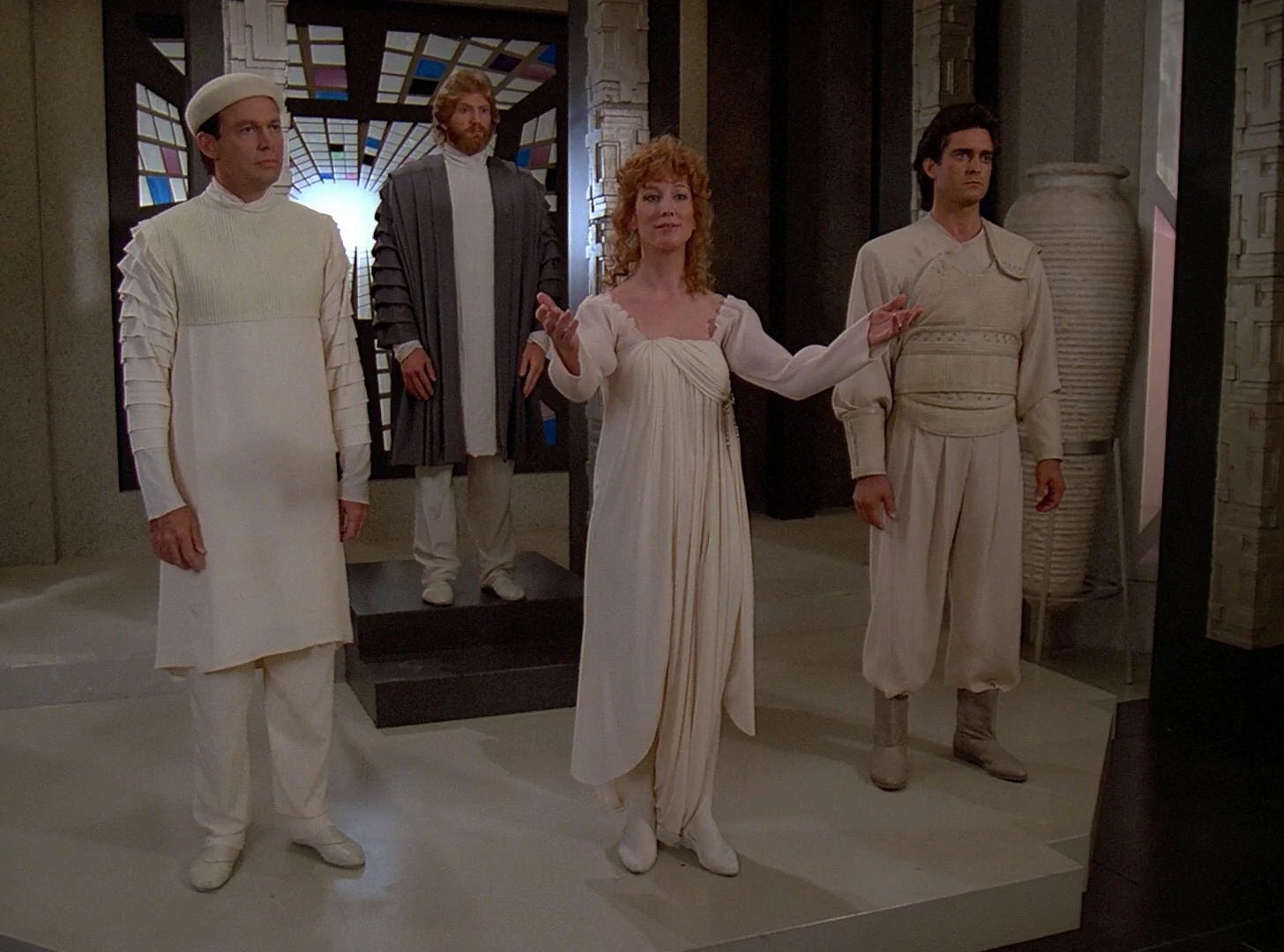
This, unfortunately, is an episode about which every good thing that I might say is mitigated by a corresponding bad thing, but some of the bad things that I might say don’t have mitigating good things. It doesn’t flat-out suck, nor is a total waste. It has a basic, coherent plot that isn’t utterly pointless and that does require effort from the regular characters to resolve, it at least attempts to dramatize a worthwhile idea or two, and it’s not painfully stupid and unbearable to watch. Its mix of ideas with potential and deeply flawed execution land it firmly in the two-star category.
TNG seemed to love plots (this is already the second episode to feature one) involving warring factions who have agreed to peace talks—but exclusively with one specific mediator who is supposed to be a highly skilled peacemaker. I always found this concept rather silly and implausible. It seems to me that belligerents either want to talk peace or they don’t; who will serve as mediator just doesn’t seem like something that would make the difference between their willingness or unwillingness (unless, that is, it were a matter of there only being one person on whom both sides could agree, with all others being perceived by one side or the other as too partial to the opposing side—but that’s never the way it’s presented at all). Basically, this is a necessary plot contrivance in an episode that wants to be about a guest character; if someone else could easily take the mediator’s place, then the thing that happens that interferes with the guest character’s ability to play his role wouldn’t really matter, and the plot therefore wouldn’t work. The lesson here is that stories that revolve around guest characters are often problematic, and should only be done if they can actually be made to work (and even then, only if they’re also actually interesting…but I digress).
Putting that issue aside for the moment, the character idea behind Riva has some theoretical merit, even if not much of it is really realized. The episode doesn’t explore this, but the fundamental concept of a deaf and mute mediator strikes me as potentially rich with symbolic meaning. The idea of his communicating via a “chorus” is mildly interesting, but ultimately doesn’t make a terrific amount of sense—and worse, the writers clearly think it far more clever and engaging than it actually is, and thus devote way too much screen time to introducing it and obsessing over it. Also, for the main characters not to know in advance about Riva’s disability and his method of coping with it is totally contrived, and just ends up undermining the notion that he is this well-known and widely respected mediator. Riva’s extreme oversensitivity (pitching a big fit when Picard makes the mistake of addressing himself to his chorus rather than to Riva himself) also rings false to me; a person in his situation would surely grow accustomed to people reacting in this way, and would develop some patience about it—especially if that person were renowned for his diplomatic skills!
Before dealing further with the meat of the episode, I need to comment on several things that are either odd or problematic just in its teaser. First, there’s the weird scene in Picard’s ready room where he is obsessing about the anomalous orbit of some planet. This was a nice try at developing the captain’s intellectual side, but it’s so out of the blue and so pointless that it doesn’t work. Also, the facts that it deals with a made-up conundrum that doesn’t even make much sense, and that Picard’s “hypothesis” consists of nothing but a holographic simulation whose principles even he doesn’t understand, both help to ruin the attempt. His line about “a knot I had to untie” feels right, but the scenario that it relates to needed major work. Second, the teaser makes a big point of the fact that the Enterprise will merely be transporting the mediator to the warring planet for the peace talks and is not to interfere in any other way. This is both dumb in and of itself (what’s the rationale?) and utterly ignored throughout the rest of the episode, in which they do everything they can to assist Riva with his mission! Third, Riker’s overwrought concern about Picard “leading the away team” doesn’t work for me. I have always liked this character dynamic between the two of them (i.e. Riker’s insistence that the captain does not go on away missions), which was established right at the outset back in the pilot, and this kind of interaction between them is usually fine with me—but in this case, Picard is so obviously right that what he is beaming down for is more in the nature of a ceremonial greeting than an “away mission,” and that it is a function that manifestly belongs to the role of captain, that Riker’s objection just seems dumb (like an instance of the writers trying too hard). Fourth, the bit in the transporter room about Worf’s uneasiness at the prospect of meeting Riva is just plain ill-conceived. As I argued in reference to “Heart of Glory,” Worf is the last person in the galaxy who should have mixed feelings about Klingon-Federation detente, since his entire life is premised upon it! If he’s not sure how he feels about a man who played a key role in making peace between the Klingons and the Federation, what’s he doing in Starfleet? And when he expresses this sentiment, why doesn’t it make anyone leery of trusting him? What would actually have made sense would have been if Worf had harbored respect and admiration for Riva, and had been eagerly anticipating meeting him! And fifth, the teaser ends (and the first act begins) with a real WTF moment, in which the episode seems to want to create a tension point out of the fact that when Picard and company beam down, no one greets them right away. What’s up with that?
Moving on, the main problems with the episode (apart from the ones that I’ve already mentioned) are, briefly, these: First, the relationship that emerges between Riva and Troi doesn’t work at all, mainly because of how totally one-sided it feels (notwithstanding Troi’s diplomatic assurances that she enjoys Riva’s company, too—some of which the episode even seems to want us to believe) and how creepily transparent Riva’s intentions are, given that it’s always the member of his chorus who represents his “passions” who does the talking when he addresses Troi. Second, there’s way, way too much focus on the “wonderful and harmonious” way in which Riva has overcome his disability, and way too little actual plot. Third, the attempt to shoehorn in a subplot about Geordi’s visor feels totally phony (what a coincidence that the issue should come up just when the subject of coping with a disability is already on everyone’s minds because of Riva!), and goes absolutely nowhere. Fourth, Riva is just fundamentally unconvincing as a character; his smug, complacent confidence giving way to utter panic and self-doubt when his chorus members are killed just isn’t pulled off successfully. And fifth, the warring aliens don’t come across as at all plausible. A couple of thugs with guns are these societies’ leaders and/or diplomats?
With all of that said, there are some glimmers of merit in the episode as well. Some of Riva’s thoughts on negotiating peace are worthwhile (though a bit too obvious, in some cases, to really work as a substantiation of his reputation, or to be things that he has to enlighten the regulars about). And despite the politically correct heavy-handedness of the “handicapped people are special” theme, the idea of “turning a disadvantage into an advantage” is a worthwhile one, and Troi pushing Riva to cope with his loss and move forward with the peace talks by challenging him to do precisely that is effective—even if the parties to the talks (who, as Riker comments, seem like unlikely candidates for peace) don’t strike one as at all likely to have the patience for the approach that he decides to adopt. Like I said at the outset, most of the good things are mitigated by caveats; this doesn’t totally negate them, but it does keep the episode from actually being very good.