
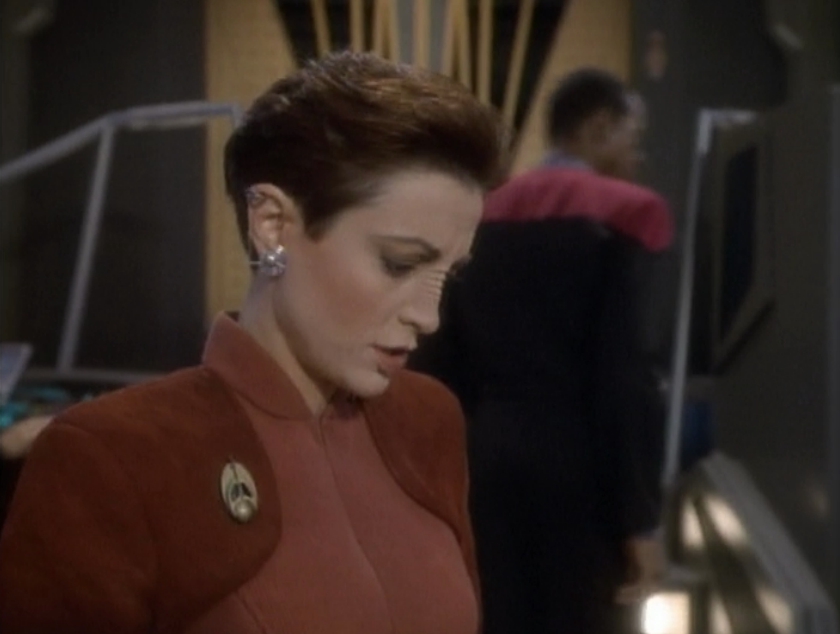
“Past Prologue” is a pretty good follow-up to the pilot episode that makes a lot of solid storytelling moves. It’s not an incredible standout by any means, and four stars might even be a hair on the generous side (though three would strike me as decidedly harsh), but it begins the process of delving deeper into the post-occupation Bajoran political issues that were built into the show’s premise, does some solid character work, and also continues the more general process of fleshing out both the station as a setting and the tone and style of the show. What’s more, it juggles these various objectives just at deftly (if not even more so, at times) as the pilot managed to do with its own numerous tasks. One major aspect of the episode’s main story (in a nutshell: the guest character, and the relationship between him and Kira) doesn’t quite measure up, in my view, and this does hold it back somewhat—but it does just about everything else so well that it still ends up being quite good.
It was definitely a good call for the first post-pilot episode to not only stick with Bajoran independence and fallout from the Cardassian occupation as its subject matter, but even more specifically, to focus on Kira as a character. As I acknowledged in my review of “Emissary,” I hardly expect for every episode to deal with Bajoran issues; still, to have moved away from the show’s stated central focus in the very first post-pilot episode would have been a misstep, in my view. And while Sisko, as the guy in charge (and the character who naturally would get compared to previous Trek shows’ captains), is the show’s “leading” character (to the extent that anyone is, what with DS9 being a very ensemble-oriented show), Kira is arguable its lynchpin, as the resident representative of the occupation-devastated planet that Starfleet is here to help rebuild and prepare for Federation membership. As I also previously noted, while Kira does have a character arc in the pilot, it was very much secondary to Sisko’s, so making her the focus of the next episode was emphatically a smart move. Also, while this is certainly not the first time that a Trek show has done a “divided loyalties” type storyline for a main character (my thoughts go immediately to “Heart of Glory” for Worf in TNG’s first season), it made way more sense to do this kind of story with Kira, who after all is not a Starfleet officer, and whom the pilot had already told us was ambivalent about the Federation’s presence here (and thus, one presumed, also about her own new role on the station). More broadly, too, Kira represents the transitional moment that Bajor as a whole finds itself in; thus, in this episode, Tahna Los represents the mindset of radical self-reliance and all-out resistance by any means against clearly defined external enemies that has held Bajor together for the past 50 years, and Kira is confronted with the difficult struggle to pull herself away from that mindset and embrace Bajor’s current reality, even if doing so might feel like a betrayal of the values that she’s clung to and fought for all her life. So, all of that is good. Execution-wise, some aspects of this work really well, while others are unfortunately kind of weak…and that, of course, is what most of the rest of this review will be about.
I suppose the biggest problem, for me, is that at no point do I find Tahna Los a particularly compelling character. He seems pretty shifty right from the get-go, and is too obviously just a one-off guest character introduced to press Kira’s buttons and question her loyalties. He offers no insightful or challenging critiques of Bajor’s/Kira’s relationship with the Federation, but merely throws barbed comments at Kira designed to make her feel bad about it. I also never quite buy into whatever bond the two of them are supposed to share from having fought together at some point in the past. Now, to the episode’s credit, it doesn’t make the mistake of trying to string us along through too much of its run time believing, or at least wanting to believe, in Tahna’s sincerity, only to serve up some cheesy reveal of his duplicity near the end; instead, it lets us in pretty quickly on the fact that he’s up to something, even though it doesn’t reveal exactly what until the moment when he almost manages to do it (i.e. blow up the wormhole). But it doesn’t really play his deception as a meaningful character issue, either, so the result ends up being that he just feels more like a plot device than like a character, and that’s not great. Down the road, the show will get better at introducing characters whose vision for Bajor’s future differs from that of our heroes, but who nevertheless feel like fleshed-out, real people, and not merely foils for the main characters. We’re not there yet…but even so, Tahna’s impact on Kira here is effective, and does force her to make the kinds of hard choices that we want to see her having to make.
In particular, what I think I enjoy the most about “Past Prologue” is that, more than just being about Kira’s uncertain loyalties, what it’s really about is that all of our characters are trying to find their feet in this new place and in their new roles, and none of them is quite sure yet whom they can or can’t trust. After all, Kira’s not the only one making hard choices that potentially involving betraying trust; right off the bat, Sisko is confronted with having to decide whether or not to grant Tahna asylum, with Kira on one side pushing him to do so and a threatening Cardassian presence on the other side demanding that he give him up.1 Kira lays into Sisko early on, lecturing him about how her point of view is the right one, with Sisko pushing back and demanding straight answers from her about the Kohn-Ma and her loyalties, in a scene that clearly exemplifies the writers’ determination to actually portray conflict between main characters on DS9 in a way that TNG famously avoided. What I like about this scene, though, is that their conflict doesn’t actually spring from any fundamental disagreement between the two of them concerning the relevant issues; it just represents the fact that neither of them is sure, yet, that they can trust the other. Sisko is trying to navigate the nuanced complexities of Bajoran politics, wanting to be an ally against the Cardassians and to help Bajor to rebuild, but not wanting to provide cover for ongoing violence from those too embittered to move forward, and he doesn’t yet know quite where Kira stands in all of this; Kira still isn’t convinced that Sisko truly cares about Bajor’s fate, or that he can appreciate the blurred lines between “terrorist” and “freedom fighter”…or even that a relationship with the Federation is in Bajor’s interests. When she gets in Sisko’s face and says her piece about the necessity of repatriating splinter groups like the Kohn-Ma, she’s not saying anything that Sisko would disagree with; she just makes the mistake (one to which her life experiences, no doubt, have predisposed her) of leaping to the conclusion that anyone who doesn’t immediately see things her way must have bad motives. (Even so, though, the moment when she corrects herself from “you have—” to “we have an opportunity here” is nice little touch, revealing that despite her mistrust, she actually is trying to find common ground on some level.) The subsequent story beats, with Kira going over Sisko’s head by calling up Admiral Rollman, then being pleasantly surprised when Sisko ends up coming through for her, while Sisko meanwhile puts off coming down on her for her little chat with the admiral until she takes the initiative to extend an olive branch, and only then telling her in no uncertain terms that she’d better not pull anything like that on him again in the future…all while also working with Odo to figure out what the other Kohn-Ma people are up to and not letting Kira in on this…are all really good. Also, of course, there’s the Kira/Odo scene, which starts to establish another key relationship on the show while also doing some good character work for each of them individually. All of these bits function to tell the immediate story, but are at the same time also crucial parts of the larger story of these characters figuring out how to work together, and learning that they actually can trust one another. (I especially enjoy watching Kira in that scene that I just mentioned where Sisko calls her on going over his head; she’s reacting to being reprimanded by a commanding officer, but at the same time digesting the fact that Sisko has been supporting what she’s trying to do despite knowing that she complained to the admiral about him. There’s a lot for her to take away from this moment, and you can kind of see the various aspects of what it means to her all tugging at each other in her brain by watching her facial expressions and general body language.)
But the theme of sussing out each others motives, and not being sure whom to trust, runs through other aspects of the episode, too…which brings me to the other big aspect of “Past Prologue” that I need to talk about: Garak! The episode actually starts by introducing DS9’s resident “simple tailor” to the audience, by way of having him introduce himself to Dr. Bashir, in a delightfully weird and unsettling scene that leaves both the audience and poor Bashir with no idea what the hell this guy is all about. Garak is both entertaining and intriguing from the first moment he appears on the screen, and Bashir’s adorably flustered and awkward reactions to him are enormously fun, too. At first, it seems like this scene is just there as a way for the show to introduce a new character/piece of the station’s milieu—and it is there to do that, but the episode eventually ties the Garak/Bahsir thread into its main plot, which makes it even better. (Later, something kind of similar happens when the Duras sisters seem to randomly show up on the station, but then that, too, proves relevant to the plot.) Still, though, it leaves us wondering just what Garak was up to when he introduced himself to Bahsir in the first place! He helps the main characters thwart the Khon-Ma instead of just selling Tahna to the Cardassians, so we’re given to understand that he’s not anything as straightforward as a Cardassian agent or outright villain, but of course his background and motives remain entirely mysterious…and watching Bashir navigate this new “relationship,” from his initial ridiculous exuberance to his later freak-out when he starts to feel like he’s in over his head, is super-fun. Meanwhile, of course (sticking with the theme of not knowing whom to trust here), we have the Duras sisters selling a bomb component to the supposedly reformed ex-terrorist Tahna while also plotting to sell Tahna himself to the Cardassians. Schemes within schemes, and Garak acting as an unpredictable rogue element weaving through them, while Bashir struggles to fathom what any of it might have to do with him. Gotta love it!
A few small points of appreciation: I like how Sisko identifying himself to the Bajoran scout ship near the beginning of the episode as “Starfleet commander of the station” sells the idea that the whole setup of Starfleet on DS9 still feels like a novel situation in-universe. I also like how the sequence with the Cardassians pursuing the scout ship plays out in a way that reinforces the differentness of this show, taking place on a space station, from the kind of Star Trek that we’ve seen in the past. On TNG, Picard might have reacted to a scenario like this one by maneuvering the Enterprise in between the Bajoran ship and the Cardassians, or firing a warning shot across the Cardassians’ bow, or something—but we’re not on a starship here, and Sisko doesn’t have the same kinds of options at his disposal. It’s nice to see the show playing with that, and actually making the setting feel as different as it ought to feel. Similarly, Sisko having Dax delay the Cardassians via made-up docking regulations helps to establish setting and set tone (plus, his using the damage that the departing Cardassians did to the station as an excuse is pretty brilliant).
- I appreciate the difficulty of Sisko’s position here, and I think that showing him taking some time to research and reflect (and delaying the Cardassians with bureaucratic maneuvers to buy himself this time), but then coming down decisively in favor of granting asylum, was appropriate. However, I also think that the episode overplays the idea of Tahna’s “crimes” against the Cardassians a bit. Sure, it clarifies that some of these acts have taken place since the end of the occupation; still, even Sisko’s comment that “both sides commit atrocities in war” undersells the right of an oppressed people to fight back against their oppressors a bit, it seems to me. Of course, the episode also makes it clear that the Kohn-Ma have committed crimes not just against the Cardassians, but against other Bajorans—and that’s fine…but then, shouldn’t the alternative to granting asylum be to turn Tahna over to the Bajoran authorities? Needing to placate the Cardassians in order to preserve the peace is an issue, of course, but acting like the Cardassians might have a legitimate claim on this guy just doesn’t ring true for me. ↩︎
I also came to your “four star” rating independently. Here’s what I wrote before I saw your review:
This is the kind of story that I really want from DS9, and I really enjoy it. I notice the community reaction seems a bit less enthusiastic than my own, but personally, I really can’t believe the quality that this show is producing right out of the gate. My overall feeling about this episode is that the villain is sketched too thinly to completely work; I mean, there is so much meat in the complexities of a culture that has finally successfully gotten rid of their colonizers using violence, so I think there’s a lot of room to develop Tahna Los with this.
While I’d grant that he says this while talking to the Gul, Sisko’s “in war, both sides commit atrocities” take suggests he doesn’t quite get it. Likewise, you could say he’s pretty harsh with Kira given that she is literally the survivor of a worldwide, absolutely brutal, trauma and, if you ask me, was fully justified in her past behavior as self-defense (at least to the extent I can say that, not knowing exactly what she did). However, yes, chain of command, and Kira is definitely stepping pretty far out of line, so I don’t actually disagree at all that it made sense to write him that way. My point, though, is that this wasn’t a war, for fuck’s sake. This was a culture defending itself from an occupation, and doing whatever they had to to get rid of oppressors that were gutting their planet for resources. And if you think about what fifty (or sometimes I think they said sixty; I’m not clear) years of brutal occupation would do to a culture, there really is a lot of meat here for a more specific motivation from Tahna. I mean, he’s far from the worst sort of guest star we’ve seen on Trek before, but he’s still pretty two-dimensional. Can we learn something about what motivates him, and a bit more about his connection to Kira? Maybe we needed some additional “freedom fighter” characters to round out some different perspectives on the end of the occupation? I’d expect that an end to the occupation would come with some complicated feelings, where you’d want to be able to let go of the violence, and maybe even be looking for excuses for doing so, but on the other hand, I can see why people might see the Federation as a substitute for Cardassian oppression, and there would be people who are so hurt, or just so accustomed to the way they had been living, that they can’t let go of violence. But not only do we lack a good sense of what motivates Tahna personally (though I guess his political motive does make some sense, assuming he doesn’t have a sense of the wormhole’s relationship to Bajoran religion yet), he comes across as sort of self-important, coy, and snarky, and his manipulation of Kira is pretty obvious; he basically tells her what his loyalties are, but she goes along for quite a while giving him the benefit of not much doubt. I also think Visitor does still push it a *little* too hard here acting-wise, though not so much as the pilot.
And by the way, aren’t the issues this episode raises, and that DS9 in general raises, timely?
Also, the characters are standing weirdly close to each other in some of the scenes.
Also, just to say I appreciate your points about how the episode shows “characters trying to find their feet,” about the different levels of intrigue, and about the superb Garak/Bashir dynamic. Just bringing in all the reasons this show was great!