
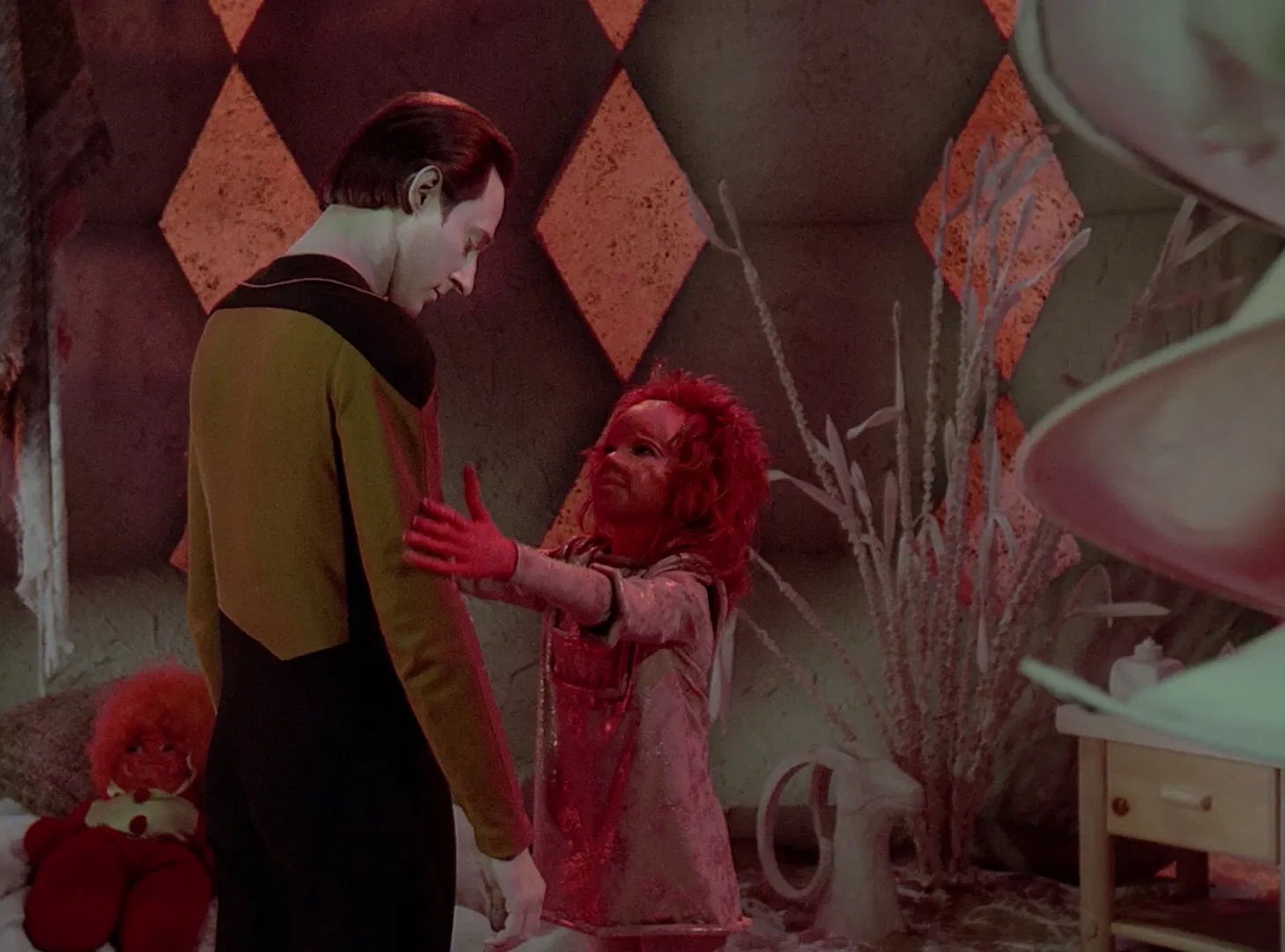
It’s a fair generalization, I think, that the majority of the episodes in roughly the first two thirds of this season are essentially mediocre (with a few big exceptions, of course), and that many of both the best AND worst episodes of the season cluster together in its final third. That starts with this utterly inexcusable piece of garbage, which unforgivably mischaracterizes both Data and Picard, while forcing a seemingly untenable and putatively dramatic situation into existence by means of a dizzying string of implausible and/or nonsensical contrivances and boneheaded character moves. Aside from the Wesley-centered subplot (which is actually fairly decent, despite some execution flaws) and a few very small touches, nothing about this episode was a good idea—and after all the progress that has been made in this season developing Data as a character, I just can’t imagine what the writers were thinking here. This is one of my all-time least favorites outside of the first season. And yet, unfathomably, most other reviews and reactions to this episode that I’ve encountered are relatively favorable (!?).
The gross mischaracterization of Data begins before the episode’s plot even emerges; he’s sitting at a bridge station working on a (totally undefined) “personal project,” and he has miscellaneous pieces of equipment scattered around him on the floor in a disorderly fashion? I don’t think so! First of all, is he on duty or not? If so, he should be at his station and not working on a “personal project”; if not, he should be working on his project in his quarters, not on the bridge. Second, just what is this “project”? He talks about messing with sensors and boosting signals, but all to no apparent purpose—which is just flat-out silly, and obviously nothing more than a lame contrivance to make the story of him making contact with a little girl possible. Third, it’s utterly out of character for him to have junk strewn about the floor; it would be wildly wrong even if he were in his own space, and it’s still more wrong on the bridge. No, no, no.
Moving on, it goes without saying that the right thing to do when he picks up the girl’s transmission would be to report it to the captain immediately. I mean, when a mysterious transmission is picked up from an unknown planet, is this a personal matter, or is it ship’s business? Any even vaguely competent officer would know the answer—and would also be immediately sensitive to the possible Prime Directive implications of the situation. This episode’s plot, however, hinges entirely on Data’s utterly unprofessional and totally unbelievable action of responding to the transmission—so respond to it he does. But the lamely contrived nature of the basic dilemma of the episode is broader still. Just what sort of society is the one to which Data’s “pen pal” belongs? Why is some little girl sending out a transmission to no one in particular that is picked up by Data from multiple light years away, but not by anyone else on her planet? Imagine some kid from twentieth-century earth randomly broadcasting something on some kind of ham radio or something, and receiving a reply from deep space! Now imagine that happening, and no one else on Earth noticing! Now imagine that what the kid is broadcasting is a call for help in the face of an impending planetwide natural disaster, and that this kid’s transmission is the only such cry for help that the situation appears to have prompted!? Of course, when Data eventually beams down to the planet, appearances suggest that the girl and her family are essentially hermits, since their dwelling seems to be the lone structure sitting in the middle of a vast stretch of rugged terrain that shows no signs of humanoid presence whatsoever. Yes, a geological disaster is occurring on the planet—but rather than a formerly settled area thrown into devastation, we see no signs of civilization whatsoever. This all conveniently diverts the viewer’s attention from the wild nonsensicality of the isolated contact between the girl and Data, but it makes no sense whatsoever. (Also, the writers for some reason can’t seem to resist giving the girl’s house doors that work by vanishing—a technology (if indeed technology it be, and not simple magic) that seems entirely out of sync with everything else that we see of the society.)
So, all right—the episode completely cheats in getting the Enterprise into the dilemma over whether or not to do anything about this doomed society’s plight. But what of the dilemma itself? Picard calls a conference (in his quarters, for some bizarre reason) to discuss the issue, but the discussion is awful in a number of ways. Picard makes a case that being “flexible” with the Prime Directive is tricky business, but his argument doesn’t make much sense. He gets everyone else to realize that it’s difficult to determine where to draw the line between situations in which they should intervene in less developed societies and situations in which they shouldn’t; a natural disaster is one thing, but what about war—or governmental oppression? I grant his general point, but the specific “slippery slope” argument totally fails for me; the situation at hand isn’t one of those latter types of situations, so how are the issues that those situations would raise relevant? No one calls Picard on this or asks this crucial question, however. Meanwhile, there are much more pertinent points that Picard totally fails to raise. The Enterprise ends up “magically” (from the point of view of the planet’s inhabitants) making the natural disasters that are tearing the planet apart just go away. What are its people to make of this event? Doesn’t it have enormous cultural implications? I’m not taking the position that this consideration justifies letting everyone on the planet die, but if the question of whether or not to intervene is being debated, shouldn’t this subject at least come up in that debate? After all, if there’s a cogent, concrete “con” to intervention, this would be it, right? But instead of addressing it, much of the debate idiotically centers on philosophical abstractions concerning the possibility of “fate”—which the characters take seriously with all the naive earnestness of beginning philosophy students at their first exposure to a set of issues that they should be addressing (if at all) from the seasoned perspective of adults who are already aware of their various permutations and ramifications. (See, for example, Picard’s reply to the time traveler character in the fifth season’s “A Matter of Time” for a much more believable portrayal of our heroes’ grappling with similar philosophical issues). Of course, since this is “his” episode, it is Data, of all people, who tries to pull the discussion out of the realm of abstraction and ground it in the factual reality that actual people are going to die. Data? Isn’t he the least likely candidate to play this role? Next, some of the characters make a lame attempt to interpret the little girl’s transmission as a “request for aid,” and to treat this as a justification for intervening. To his credit, Picard shoots this disingenuous crap down in no uncertain terms. But eventually, and mere minutes after giving a speech about how one of the purposes of the Prime Directive is to keep them from letting their emotions overwhelm their judgement, Picard—who has decided against intervening (!)—hears the voice of the little girl calling out to Data and sounding piteous and lonely and afraid, and allows his emotional reaction to this event to sway him, resulting in a reversal of his decision! And perhaps even lamer (if that’s even possible at this point), the only reason this is able to happen is because, for some mysterious reason, when Picard orders Data to cease communication with the girl, Data responds by walking over to a control panel and fiddling with it (as if something that’s currently running needs to be “turned off” in order for him to cease communicating with her)—and more inexplicably still, the outcome of his fiddling is that the transmission is played for the assembled senior officers to hear! This is such abysmally contrived writing that it leaves one absolutely stunned.
Moreover, having once been swayed by emotion, Picard proceeds to disregard all the possible ramifications of his decision to intervene from this point on (as does the episode as a whole). What, then, was the point of raising all those philosophical issues during the big debate scene? What do the writers want the audience to take away from it? Is the whole debate just a pointless exercise intended to somehow ease the audience past its potential objections, and start Picard along the string of dubious decisions that he (and Data) will make throughout the rest of the episode? Data continues to pile up irresponsible requests, bogus arguments, and rash, impulsive decisions right up to the end, in a manner that is not only totally non-android, but also unbefitting a Starfleet officer with even a shred of integrity—and Picard continually acquiesces, never with reason. Even if the Enterprise has committed to saving this planet’s people on ethical and humanitarian grounds, nothing but pure emotionalism can warrant beaming down to save one particular girl at the cost of revealing the existence of whole other worlds to her! Data simply would not behave in this way. Granted, in the end Picard does have Pulaski erase the girl’s memory—itself a disturbingly invasive act that raises huge ethical concerns that the episode totally ignores—but one gets the sense that this act is supposed to make the entire intervention “okay” in retrospect, even though it doesn’t address any of the real ramifications of what has been done beyond Data’s personal intervention with the girl. The story is ultimately framed as a step along Data’s path to understanding what it is to be human (even though he is already behaving more emotionally than anyone else in the episode), and the larger issues briefly (and ineptly) raised in the “debate” scene are left unaddressed—which is terrible writing to begin with, but also cheapens the larger arc of Data’s exploration of humanity (which is dealt with far more effectively and satisfyingly in other episodes).
As I commented earlier, the episode’s subplot about Wesley being in charge of the geological survey team is, in all fairness, actually okay. It arguably suffers from plausibility issues, true, but only in the sense that the whole idea of Wesley as an “acting ensign” lacks plausibility; given that the show was going to include “Acting Ensign Wesley Crusher” as a character, a story like this one was called for and made sense to do. There are quibbles to raise, though. The conference room scene at the beginning where the characters debate the merits of putting Wesley in command of the operation lacks structure, for example; various people raise various points, but few of them seem to take any particular position on the question, and Riker eventually just declares his initial idea a good one without it being clear what factors have decided him, or even whether anything that anyone has said has influenced him at all. Also, it seems wrong for Pulaski to be involved in this discussion; she has had no visible relationship with Wesley up to this point, and she isn’t really part of the group that took on the responsibility of playing surrogate parents to him when his mother left the ship (indeed, she’s the one member of the senior staff who doesn’t even know his mother), and yet she seems more opinionated and vociferous than almost anyone else in the meeting. This rings false. Conversely, it seems to me like Data, who isn’t present, should have been (though given how out of character he is in this episode, that probably wouldn’t have gone well). Also, the question of whether or not Wesley is ready to tackle the responsibility is the only thing that gets any attention; the issue of how the officers whom he selects for his team will feel about having to take orders from some teenager who lacks any professional credentials whatsoever, and whether or not this is at all fair to them, isn’t even broached! On the bright side, though, Wesley himself does struggle with this very question—showing that he/the writers have come a long way from the first-season days of him being a smug know-it-all who rolls his eyes at the silly foibles of the clueless adults holding him back from doing whatever the hell he wants. The episode also earns some points for not having the people on his team actually be jerks to him, and for keeping the focus on his own insecurity about being in charge. Finally, the scene between Wesley and Riker in Ten-Forward, in which they discuss leadership, is an actual bright spot in this travesty of an episode.
Even the bits about Picard enjoying horseback riding, while well-intentioned, are not carried off very successfully. Picard’s dialog about his appreciation for horses (tempered by his resistance to anthropomorphizing them) is good, and the scenes generally work on an immediate characterization level (in stark contrast to the scenes involving his decisions in the main plot of the episode), but they seem out of place (being totally unrelated to the rest of the episode). Also, the scene in which Picard and Troi go into the holodeck just feels contrived—like the episode is trying too hard to “do character development.” What’s Troi doing there with him, exactly? And the “Picard’s recreation is interrupted by a call from the bridge” motif just seems gratuitous (especially since the call turns out not to be about anything that he doesn’t already know!). If the writers want to flesh out the character by showing him recreating and just being a person, then for god’s sake, can’t they let him actually recreate? Stopping short (especially to no actual purpose) ends up having the opposite effect—it gives the impression that our characters are people who are too married to their duties to have time for hobbies and personal lives. Bad move. Plus, this scene serves as the lead-in to a first-seasonishly lame teaser climax: Oooh, an area with lots of geologically unstable planets! Umm…so what?
In any case, the summing-up is that this episode sucks. Both its relative popularity, and the fact that its script was written by Melinda Snodgrass (the same writer who gave us “The Measure of a Man”!), are unaccountable. (The script was based on a story from Hannah Louise Shearer, with whose body of TNG work “Pen Pals” is much more consistent, for the most part). This is one of the worst episodes not just of the second season, but of the entire post-first-season series, hands down.