
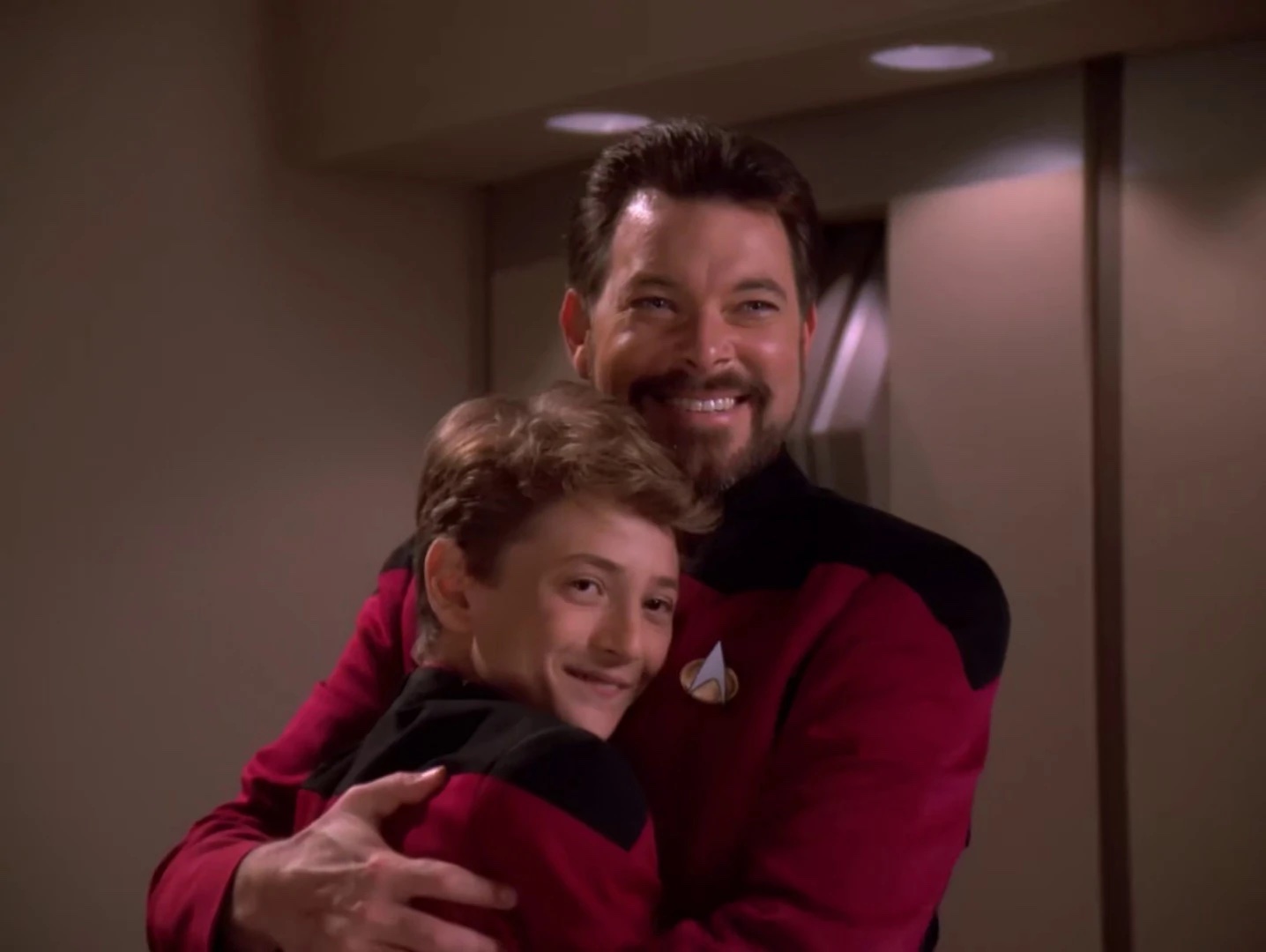
“Rascals” is an episode with a beyond-absurd premise and an insultingly implausible plot, but one that somehow manages to be entertaining enough that I actually don’t hate it. When you think about it, that’s quite an achievement! I expect that some fans probably view it less indulgently than I do, but for me, this one mostly goes into the “turn off my brain and enjoy it” (and then pretty much edit it out of my head canon afterwards) file.
I needn’t waste too many words belaboring this episode’s obvious flaws. They begin, of course, with the sheer ridiculousness of the idea that the transporter could turn four adult characters into children (conveniently shrinking their uniforms down to fit them in the process!). The technobabble rationale that the episode offers up not only seems inconsistent with how the transporter is actually supposed to work (I didn’t think it reconstructed people based on their DNA?), but also seems vastly more likely to simply kill the characters than to de-age them. It’s just a bogus justification that the writers spewed out to get where they wanted to go, and only the fact that seeing our captain and the three others as children somehow succeeds in being mildly interesting and good for some genuine laughs induces me to be even remotely tolerant of it. When it comes to the Enterprise being easily taken over by a pack of bumbling Ferengi, however, I’m considerably less tolerant. To begin with, TNG’s writers seem never to have quite grasped the fact that the show’s early failures to depict the Ferengi as a remotely believable or threatening enemy pretty much ruined any possibility of ever using them in such a capacity. Even worse, episodes like this one don’t even seem to be trying very hard to overwrite those early failures; following their quick takeover that makes our regulars look totally incompetent, the Ferengi quickly prove to be every bit as sub-sapient as we viewers have come to expect them to be. The episode plays them for laughs, which is preferable to the show expecting us to take the Ferengi seriously as a threat, but this makes for some weird tonal dissonance; the story plays out like a comedy even though the Ferengi DaiMon is threatening to enslave the crew and execute its children. (“Even you wouldn’t be so cruel,” Riker deadpans, as though he’s somehow in on the joke.) It also, of course, allows for some childish hijinks from the four de-aged characters (with an assist from actual child Alexander) to suffice for the re-taking of the ship. Questions about how these Ferengi could have managed everything necessary to carry out their plot in the first place, of course, are best not asked.
Okay, so what do I like about “Rascals”? Well, to begin with, this is one instance when TNG actually managed to get some decent performances out of some child actors. The kid who plays the 12-year-old captain, in particular, absolutely knocks it out of the park; his mannerisms and facial expressions completely sell me on the idea that he is Jean-Luc Picard, even as his appearance and his high-pitched little boy voice make me struggle to take him seriously (which is the episode’s intent). Ro, also, comes across very believably as an adult in a child’s body. The actress playing Guinan isn’t quite as effective, and the one playing Keiko doesn’t really have enough to do to make much of an impression one way or another (and is also hampered by bad writing), but none of the young actors’ performances detract from the episode, and two of the four are really compelling. This is extremely impressive! It makes one wonder if the cringe-worthy nature of so many of TNG’s child characters in the past has perhaps been more about the writers not knowing how to write dialog for children than about the child actors really being so bad; here we have child actors portraying adult characters, and it mostly works. Furthermore, watching Picard, in particular, react to the ridiculous predicament in which this episode puts him is actually interesting. Our captain is famously uncomfortable around children, is someone who clings to his dignity, and is accustomed to (and very naturally assumes) authority, so finding himself suddenly in the body of a child is obviously going to be very disconcerting for him. That the episode mostly doesn’t play this situation for (cheap) laughs is to its credit, as it could easily have gone the other way. At first, we see the captain trying to bull forward as though nothing is wrong, and it feels very true to character; then we get the nice scene in which Dr. Crusher finds exactly the right words to get him to realize that he needs to step down for the duration (“You are still Jean-Luc Picard; what do you think you should do?”). Even better is the later scene in his quarters with Counselor Troi, in which we see him confronting the possibility of having to remain in this predicament and trying to re-imagine his life. His intelligence, self-awareness, and willingness to face unwelcome realities and move forward (something that has always served him well in his role as a starship captain) shine through here, but there is simultaneously a sense of the same bullheadedness as earlier, with him jumping right into weighing huge life-direction decisions with scarcely a moment’s pause. And yet, he also has enough of a sense of humor about the situation to gamely make a joke about “speaking to his tailor.” The scene is well-written, the kid at its center totally channels Patrick Stewart and brings Picard’s situation to life, and I come away feeling like I know (and empathize with) Jean-Luc Picard a little better than I did before. Nicely done.
And then, there’s the fact that the comedic elements of the episode, despite both depending for their existence upon insulting plot nonsense and being sort of a weird fit tonally for the situation in which the regular characters find themselves, are actually pretty funny. Picard affecting a childish tantrum in order to get himself in the same room with Riker could have been awful, but it works for me because of the dismayed resignation that he displays just prior to doing it. Instead of coming across as the writers poking fun at the character, it reads as the character deliberately sacrificing his dignity as a means to an end, and he seems all the more captainly for being willing to go there. The subsequent cheesy grins as he gives his “dad” a big hug, the communicating under the noses of the idiot Ferengi, and (of course) the line “He’s my number one dad!” are all pretty much gold. Riker befuddling the other Ferengi with a bunch of technobabble while ostensibly teaching him how to use the ship’s computer is pretty entertaining, too, even though I don’t actually find it at all plausible that anyone in the Ferengi’s position could be fooled in this way.
As for the material given to the other three de-aged characters beside the captain, I find it something of a mixed bag. Ensign Ro’s overall reaction to the situation is very relatable and in-character—as, I suppose, is Guinan’s. Guinan eventually breaking through Ro’s prickly defenses and persuading her to act like a child is right on the line between believable and not for me (it would be clearly on the “not” side if it were anyone other than Guinan—the very first person on the ship to win Ro’s trust, back when the latter first came aboard), but I’ll roll with it. But Keiko, alas, is as about poorly written here as usual. For her to take note of Miles’s discomfort with the very weird situation and jump immediately to wounded and angry mode (demanding to know whether their marriage is over, and acting as though the situation is somehow her husband’s fault) plays as the opposite side of the coin to Picard’s much more self-aware (yet still fallible and human) efforts to grapple with the situation, and just leaves me feeling grateful that the episode only really devotes the one scene to her end of things.
So: God-awful premise and plot, some good character material (interspersed with some other, less compelling stuff), and some silly fun that largely works on its own merits, even if it does come at the expense of the aforementioned garbage premise and plot. I’d like more/better from any given episode…but I’ll take it.
“You are still Jean-Luc Picard; what do you think you should do?”
In a culture that has supposedly overcome prejudice, for the captain to step down simply because he looks like a child (or perhaps) very young man seems pretty silly, doesn’t it? People can accept all. kinds of weird aliens as equals, but not someone who looks like a child but actually has decades of experience? I know, I know, the show doesn’t work as well if people look at it that way.
For that matter, everyone acts like getting the last few decades of their lives back is some kind of horrible curse. I get that it would be uncomfortable to try to fit into old roles in the body of a child (if you were married, perhaps particularly so), but surely you’d at least consider some of the advantages of staying young! Obviously it’s all about reverting to the status quo to suit the reality of 90s TV.
I dunno. I mean, just because a society has overcome the forms of prejudice that have plagued it in the past doesn’t mean its members are immune to having irrational reactions to wholly new situations, like adults who suddenly have the bodies of children. But more importantly, the issue wasn’t “you should step down because others have a hard time taking you seriously.” If that had been the argument, I imagine Picard rejecting it outright, and rightly so. But it wasn’t. At least as I’m remembering it at the moment, it was more a matter of “You’re been affected by a mysterious physical alteration and we don’t know all the effects of it or what might happen next–and also, you are probably somewhat compromised emotionally by the situation and you don’t seem to really be processing that. So, maybe you should take a little time out?” And that seems entirely reasonably to me, AND like exactly what Picard would have said to any other member of the crew in a similar situation.
Also, to your final point: Both Picard (to some extent) and for sure Guinan DO consider some up sides to their situation. But that said, I personally would most certainly react with great dismay to finding myself suddenly in the body of a 12-year-old (that is, assuming I didn’t have reason to believe that the condition would soon be reversed). Would there be SOME advantages? Sure. But my basic emotional reaction would still be an unhappy one…
Ah, I didn’t remember that that was the context of the conversation. But for the rest, while I can understand that are some pretty frustrating *immediate* (years long) consequences, I find it completely baffling how someone couldn’t see becoming young again while retaining all of one’s mental faculties and life accomplishments mostly as an incredible gift. It might be better to be a young adult than to have to wait years to overcome the issues associated with looking like a child… but this is a classic human desire–to know what you know now when you were younger? It’s a literal fountain of youth. Maybe I’m wrong, but I remember Guinan’s focus as being mostly about how now she could act silly (as if you can’t do that as an adult if you want!), but… okay, maybe some people would get caught up in some of the immediate negatives and take a short-term view, or maybe people in the future just don’t like being healthy and having years to live ahead of them, but for *none* of them to even *notice* the advantages of few extra decades of life in a healthy state and consider staying that way? To me, that’s a major WTF.
To be fair, Guinan was mainly focused on trying to get Ro to loosen up and look on the bright side (and act goofy); we don’t get much about how Guinan herself feels about the situation. Also, the point of view that the opportunity to have “a second childhood, without the pain of growing up” is something that people dream about does come up in Troi’s conversation with Picard, and he does get a little excited about the opportunities that it might open up.
But more generally, my take on this is that it’s a “classic human desire” in a pipe-dream kind of way, not in an “I wish this would somehow actually happen” way. Like–it’s one thing to think, damn, if I had had the benefit of all my current life experience while I still retained my youthful body/looks/energy, I would have done so many things better! And of course, just the having *more time ahead of you* part is desirable. But it’s not like suddenly being in a younger body would be the same as “having my youth back.” I’d presumably still have to work for a living, after all, and none of my current obligations and responsibilities would disappear. Also, I really think you’re minimizing the “short-term” annoyances of suddenly being a 12-year-old. If I were suddenly, say, 25 again physically, my reaction would be MUCH more positive!
The conversation between Ro and Guinan is kind of fun as I remember it… just not really all that relevant to the advantages of being young. 🙂 But in the Trek universe, people supposedly only do fulfilling work, unmotivated by the need to do drudgery to keep themselves alive, so unless Picard is upset by what Kirk would no doubt describe somewhat dramatically as the burdens of command (that he has freely chosen), you’d think he’d be able to see the opportunity involved.
I certainly would go through puberty again it in a second if I got to start my life over without erasing all my accomplishments, earnings, and knowledge! In fact, it might be fun to go through puberty knowing what was happening this time. The biggest disadvantage I can see is finding sexual partners when you’re way more mature mentally than everyone around you… and everyone your actual age would be terrified to date you because they could go to jail, haha
But your response makes more sense to me if you would be more positive about being twenty-five again. 😉
Also, setting aside that the transporter accident could have had other effects (indeed, it’s hardly comprehensible how it wouldn’t have), I absolutely think a society of people that had broadly overcome prejudice wouldn’t particularly struggle with accepting a child in command if they knew the circumstances. I personally would find that pretty easy compared to accepting an alien that didn’t look even remotely human (or maybe even, say, a klingon), in command.