
“Realm of Fear” works reasonably well as a character story, but its plot is decidedly unsatisfactory. There are some good Barclay moments here, and watching this always-fun and always-relatable minor character struggle with his fear and anxiety and self-doubt is pretty engaging. What I’ve always disliked about this episode, though, is that its premise feels sort of “too far up its own ass”—existing entirely within a self-contained “realm” of murky, made-up nonsense that’s just too disconnected from anything real.
Obviously, I have no beef with stories that rely on speculative science or fictional technology. These are key elements of most science fiction, and Trek couldn’t exist without them. Nor, I think, is Trek’s oft-derided penchant for “technobabble” exactly the problem here, even. At its worst, sure, technobabble is just strings of nonsense words used by lazy writers to justify the characters extricating themselves from some problem or other, when said writers can’t come up with anything actually interesting or narratively satisfying. But at its best, so-called technobabble provides the audience with a kind of intuitive logic for making sense of a story’s imaginary tech conceits, while at the same time keeping them just fuzzy enough to obscure the gaps between fictional possibility and the limits of known scientific reality (starships can travel faster than light because they generate a field that warps spacetime). In this episode, of course, our focus is on the transporter. Now, there are plenty of thorny issues raised by the whole idea of Trek’s transporter technology if you actually think about it at all, but the basic concept makes perfectly viable, intuitive sci-fi sense: a person or object is scanned and its “pattern” is stored, then its matter is converted into energy, transmitted to a destination, and converted back to matter based on the stored pattern. Conceptually, that’s all we really need; having characters talk about the “matter stream” and “pattern buffers” and “signal lock” and whatnot normally just serves to shroud the details of this process in enough mystery to make the fictional technology sound complicated, and to hand-wave away reality-based objections. And, to be clear, most of the time that’s totally fine.
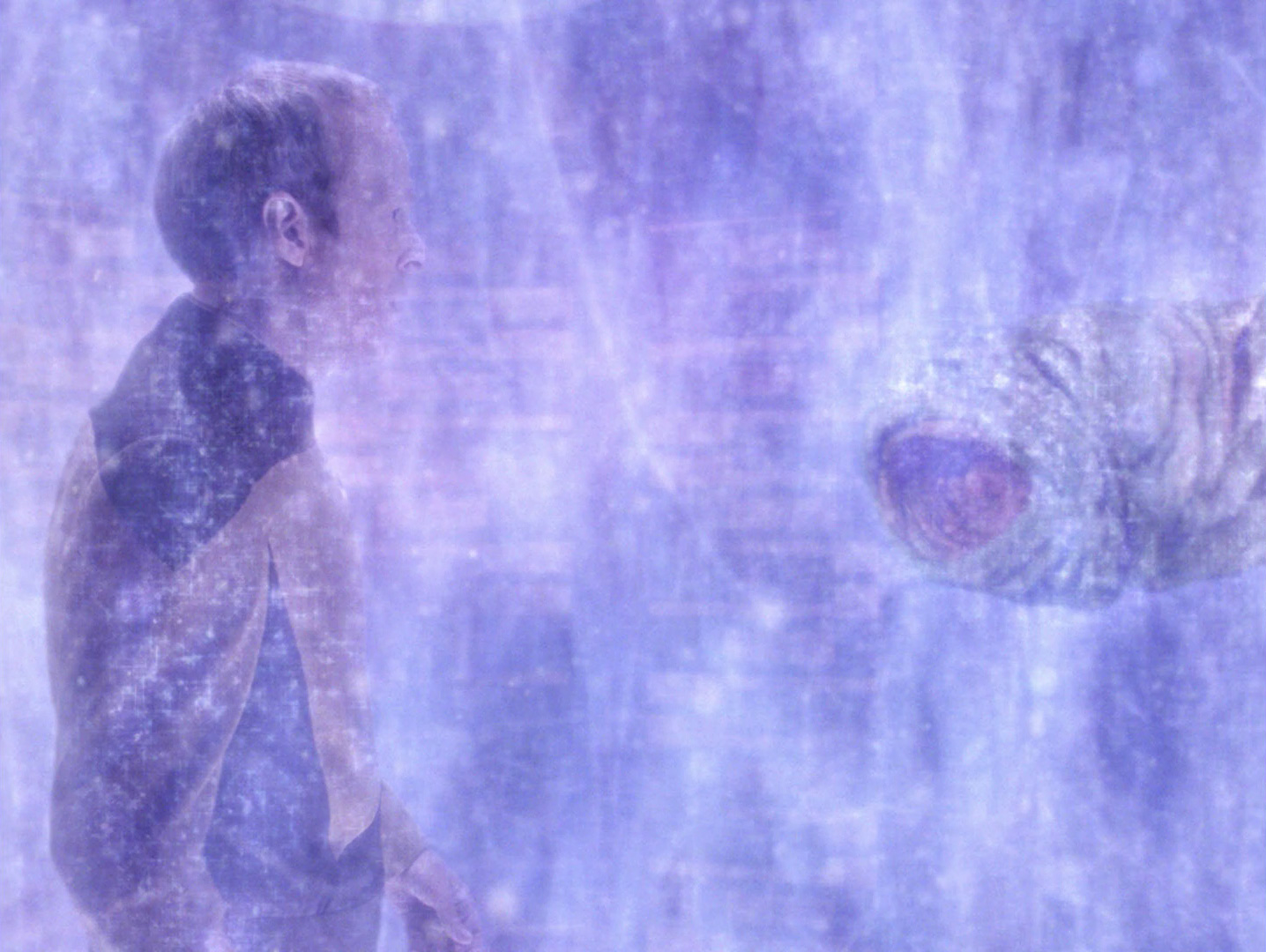
But “Realm of Fear” tries to make this bogus stuff—the imaginary mechanics of pattern buffers and matter streams—the actual story. Theoretically, there is a mystery in this episode concerning what happened to the Yosemite and its crew, some of whom are missing. But it’s not an interesting mystery at all, because the answer is just made-up nonsense about them being lost in the “matter stream” due to having attempted to use the “transporter buffer” to filter weird space microbes out of their bodies, but having allowed their patterns to degrade too far, or some such gobbledigook. This is all so self-referentially wrapped up in the pretend details of made-up technology that don’t even make intuitive (let alone actual) sense, that the story can’t actually do the things that a good mystery does: plant clues, employ misdirection, pique the audience’s curiosity, get them thinking, and ultimately reveal a surprising but logical answer that viewers will feel like they “could” have been able to figure out, even if they actually didn’t. And the episode seems to more or less know that it can’t do these things, too, because it actually barely dwells at all on the question of where the missing crew members could be; indeed, one could be forgiven for failing to even fully register this as a mystery that the characters are trying to solve. In part, this is okay, because what we get instead is Barclay facing his fear of the transporter, and thinking that he might be going crazy, and that’s actually way more interesting than the “where did the crew of this random ship go” question. But it leaves me wishing that the character story could have been grounded in a plot that made a bit more sense, and it also takes a lot of the power away from the climax in which Barclay realizes that the “things” in the beam are actually people, rescues one of them, and then spews out a technobabble line about how some unique conditions related to the phenomenon that the Yosemite was studying must have “preserved” their patterns, or whatever—you know, to “explain” this whole heap of nonsense. (Left unexplained, though, is the nonsense of how someone can have conscious and visual experiences, and even move around, all while being molecularly disassembled and reassembled.)
Still, we do get a mostly successful Barclay character story out of the deal. In particular, we get to see a Barclay who has become a respected member of the crew and seems mostly to be coping, and yet who also clearly still struggles with anxiety, and I love that. I like, too, that while his anxiety is primarily about the transporter, there’s a level on which it’s also (still) about self-confidence and social/professional acceptance. He’s been hiding his feelings about transporting because he’s afraid of what other people would think, and afraid that it makes him unfit to be an Starfleet engineer. And of course, when he has an actual weird experience during transport, he initially doubts his own perceptions. But then, in the key turn of the episode, he makes a choice to stop spiraling out of control with anxiety and instead simultaneously confront his self-doubt and his transporter phobia by going “back in” to confirm whether or not he really saw something in the beam. The moment right after this, where he confidently orders a clearly skeptical O’Brien to awaken the senior staff, has always been the highlight of the episode for me. As a viewer, you kind of can’t help but to cringe for him, and to share O’Brien’s doubts—but then the awakened regulars pay him the respect of taking him seriously, and he turns out to have been onto something after all, and you equally can’t help but to be proud of him! This is what works for me about “Realm of Fear.”
Some other parts of the Barclay story don’t work for me, though—and they’re mostly the parts where he interacts with Counselor Troi. I find the counseling scene early in the episode to be particularly bizarre and disappointing. For one thing, it seems like an ill-considered callback to Barclay’s abbreviated counseling session with Troi back in “Hollow Pursuits,” wherein he was intensely nervous (and beat a hasty retreat) because he didn’t know how to appropriately handle his attraction to her. This should no longer be a problem for him in the same way, though, especially since we saw in “The Nth Degree” that they had developed an effective rapport. Also, Troi’s “plexing” bit comes off as the made-up pseudoscience that it is. And then, later in the episode, Troi suspends Barclay from his duties merely for being all worked up and agitated, which again seems bizarre. Really, Counselor? Sure, you should probably take some kind of action here…but relieving him of duty? It seems like a wild overreaction in context. In short, Counselor Troi comes off even more poorly in this episode than she normally does (and the depiction of Barclay’s relationship with her shows signs of continuity-breaking regression).
So, the plot is contrived, convoluted nonsense (on top of everything else, isn’t it narratively convenient that Barclay—the neurotic character who is already hampered by a paralyzing fear of the transporter—happens to be the (only) one who sees the “things” in the beam?), and there are some other issues as well…but there’s still just enough Barclay goodness here to make this a minimal keeper, for me.
Right. Here, the matter stream is depicted seemingly as some kind of continuously operating “realm” that people are just sparkling around in. Some wacky things that they’ve done with the transporters in the past (or the future from the point of view of this episode), like healing people from medical issues or duplicating them, make sense if you accept the reality of the transporter (it’s just weird that they can’t do these things consistently); others, like splitting people into a good half and an evil halfm or merging two people into one, are really more fantasy than science fiction. But in all of those cases, the concept makes intuitive sense and are consistent with what the transporter is established to be. Here they just invent a whole new concept for how the transporter works (or what it is supposed to be). Like you, though, I do enjoy the character pieces. I wonder if they could have been salvaged somehow if they’d put more thought into the story background.