
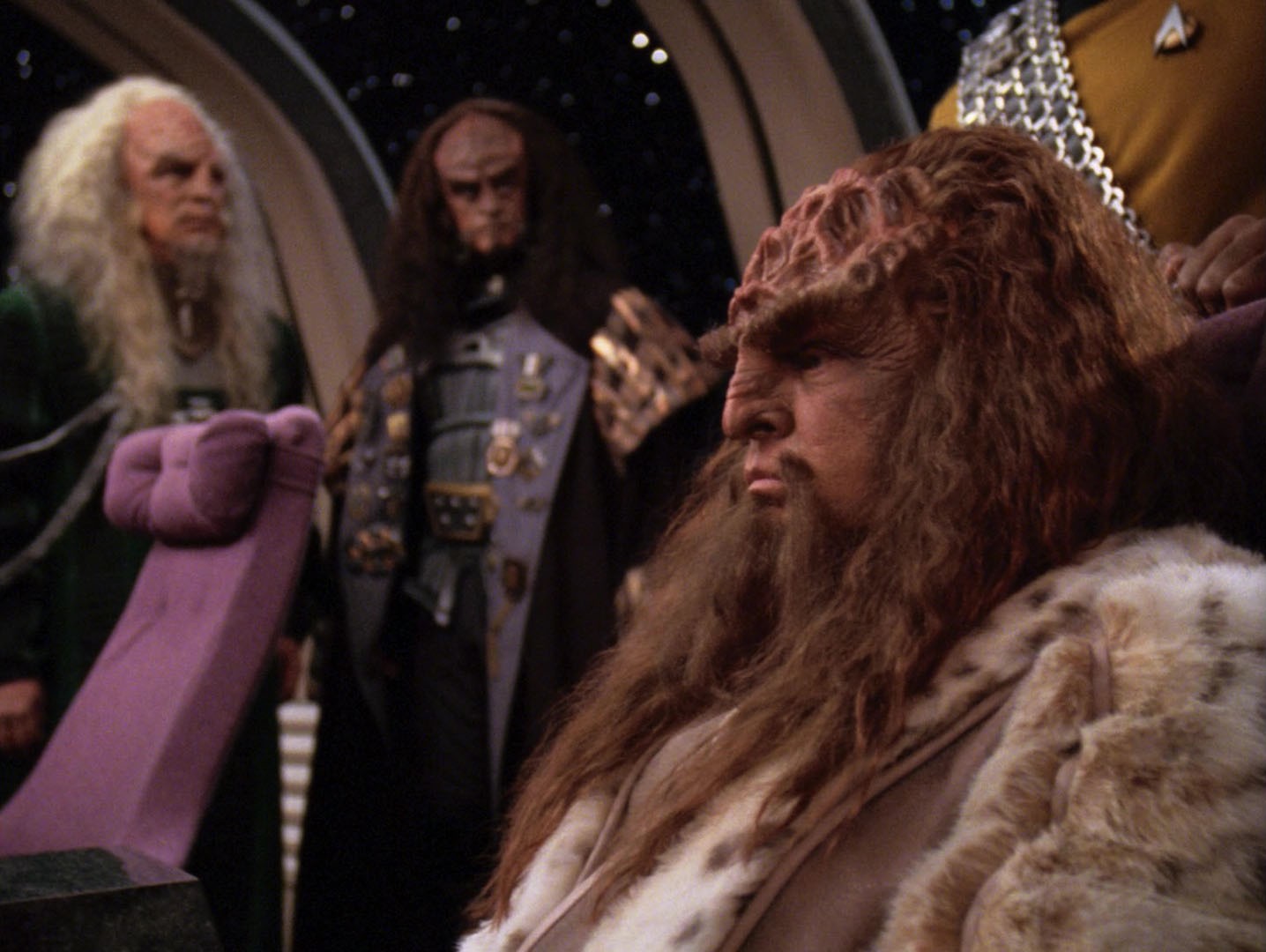
You can’t help but to admire the ambition of this episode, which plunges Worf into a crisis of faith, then immediately confronts him with an apparent miracle, and has him stand in for the entire Klingon Empire as he wrestles with the implications (political, intellectual, moral, and personal) and comes up with a resolution, all within the space of an hour. Almost needless to say, “Rightful Heir” bites off rather more than it can chew. Also, there are both some world-building details and some character interactions that don’t entirely work for me. Still, this is definitely an episode that engages with big ideas in an interesting way, and I appreciate what it is trying to do. I don’t think it really succeeds at what it aspires to do, but it still manages to be entertaining and thought-provoking along the way.
At the broadest level, “Rightful Heir” is a kind of sci-fi parable that uses the Klingons to play out a what-if scenario paralleling the second coming. Right off the bat, though, this runs into the problem that (at least for me) it doesn’t entirely work to Jesus-ify Kahless like this. For one thing, it reduces Klingon mythology to a disappointingly familiar rehash of Christianity, rather than making something more original and distinctive of it. But also/more specifically, I never understood Kahless to be an explicitly divine/supernatural entity prior to this. It’s possible that I’m forgetting other things that did present him in such a light, but I rather thought that he was just supposed to be, like, a guy. A larger-than-life, semi-legendary figure, whose reputation has perhaps eclipsed whatever historical personage may have given rise to all the stories, sure…but still basically just an ordinary mortal believed to have played a pivotal role in defining Klingon culture, not someone with any business promising to come back from the dead one day. Turning him into the latter feels like a retcon to me, and also, retcon or no, I just don’t particularly like it. (On a bit of a tangent, though, this episode inspires curiosity in me regarding Klingon history. Kahless is repeatedly credited with having united “our people,” but to whom, exactly, does this refer? Surely, in the time of Kahless, we’re talking about a very pre-modern society of tribal warriors, not a global civilization uniting against external, non-Klingon enemies, right? So in actuality, Kahless must have united some Klingons in opposition to others, whom the former eventually conquered? And the Klingons we know are the descendants of this eventually dominant culture, who have retroactively defined their particular cultural values as the essentially “Klingon” ones? I’d love to delve more into this kind of Klingon back story. Are there still remnants of other (subjugated) cultural traditions surviving on the Klingon home world “today”? This could tie in with speculations that I’ve entertained elsewhere about the existence of Klingons who may not be part of the seemingly-universal warrior class.) Anyway… I don’t have a problem with the idea of a Klingon mysticism wherein religiously inclined Klingons seek “visions” from the great warrior Kahless, attribute a level of wisdom and greatness to him that border on the Klingon version of superhuman, and treat his teachings as capital-T truth that must be accepted on faith, but I would have preferred for the show to stop short of defining him as someone whom the faithful believe capable of literally transcending death.
With all of that said, the episode does do some interesting things with its sci-fi spin on the “how would people react if the second coming actually happened” premise. Just as you would imagine, there are some who are eager to believe, and others who, though professing faith in an eventual/theoretical return, refuse even to consider that this particular claimant could be the real deal. That Gowron numbers among the latter comes as no surprise, both given what we know of his personality and, of course, because he stands to lose the most from the sudden appearance of a living Kahless, and I quite enjoy everything that we see of Gowron here. Also interesting are the Klingon clerics who masterminded the cloning ploy, in that they are presented as true believers who fail to see anything underhanded or cynical in their scheme of giving the second coming a covert technological assist. The medieval historian in me, too, sees interesting historical parallels between this plot and the ways in which real-life rulers have aligned themselves with and/or secured control of assets (persons, stories, relics, institutions) regarded as sacred as a means of cementing their political power. And then we have poor Worf, standing at the center of the whole mess, his instinctive realistic skepticism warring with his more-Klingon-than-the-Klingons cultural true-believerism and leaving him unsure what the hell to make of the whole situation. This is undeniably a good setup for both political/cultural and character drama, and even though, as a committed rationalist/secularlist, I find it awfully hard to relate to the version of Worf whom we see in the middle section of this episode (having set his doubts aside and become a believing follower), I enjoy his overall arc as he not only wrestles with what to believe, but struggles to come to terms with his own crisis of faith and search for meaning.
With all of that said, though… Okay, time for another digression here, this time to ruminate a bit (as we near its end) about TNG’s sixth season as a whole. Historically, I have held somewhat contradictory general impressions of season six. The first thing that comes to mind has usually been the presence of a number of really great episodes (“Tapestry”, “Chain of Command,” “Ship in a Bottle,” and “Second Chances,” to name a few), which, along with things like Troi wearing a normal uniform for most of the season, incline me to think of the season as a mature and sophisticated period for the show. But at the same time, I have also long felt like an undefinable something had changed by the time season six rolled around, and have tended to mentally group seasons six and seven as the “later” seasons, in contrast to seasons 3-5, which I tend to think of as the “core” seasons of the show. Perusing online comments, I’ve found that I don’t seem to be alone in this perception, either, even if different people seem to attribute it to different things in a way that doesn’t lend itself to clarity as to what I’m even talking about. What it maybe comes down to, though, is just a sense of the series beginning to show its age. This isn’t anything as simple or straightforward as saying that it was become stale and formulaic, or that the writers were running out of ideas, although that isn’t entirely wide of the mark, either. I mean, plenty of sixth season episodes are wildly inventive and original! But this season perhaps nevertheless constitutes the point in the show at which the number of stories left to be told about these characters that felt fresh and new without running the risk of retconning established premises or threatening to disrupt the show’s fundamentally episodic, status-quo-bound format, started dwindling. So, there are a number of phenomenal episodes, several other really good ones, and the usual assortment of mid-grade and lackluster ones, but there are also a few too many that feel like retreads of episodes from previous seasons (“True Q,” “The Quality of Life,” “Face of the Enemy”), or that look like they might break new ground but then retreat from doing so (“Lessons”), or that, in reaching for fresh story ideas, stray into the absurd (“Rascals”). Many of these are actually pretty decent episodes, but their flaws are beginning to be the kinds of flaws that appear later in the life of a show, and they point in the direction of the show’s only having so much potential left in it. And, in that vein, I am inclined to question whether the Worf character arc in “Rightful Heir” is really new ground for Worf. True, we had not seen him specifically wrestling with the extent of his faith in Klingon spirituality before—and also, I do appreciate the fact that the starting point of his arc in this episode is tied back to his experiences in “Birthright, Part II.” His role as a champion of traditional Klingon ways in that episode didn’t feel quite right, but the idea introduced here—that the experience left him actually questioning his own fidelity to those beliefs—actually redeems it somewhat. Still, you can only dip into the well of “Worf struggles to define the extent of his adherence to traditional Klingon culture” so many times, and for me, this episode marks the point at which that motif begins to feel tired. (In fairness, maybe I would feel less that way if DS9 hadn’t gone on to further milk this theme well past the point of exhaustion…but it did, and I can’t entirely forget that it did when watching this episode.) Also, the episode tries to provide some kind of resolution for Worf’s crisis of faith in its final scene, but that resolution consists essentially of platitudes, and I’m left with little clarity as to what Worf actually takes away from the whole experience.
A related problem is that “Rightful Heir” comes at a time in the show when it feels as though the Klingon political saga that played out over various episodes in earlier seasons has kind of been resolved, and yet, the episode requires a backdrop of ongoing strife within the empire to really make sense. The Kahless clone talks a lot about how modern Klingons have lost their way, and there seems to be a shared sense among many of the Klingon characters that that a unifying figure like Kahless is needed to (with apologies) make them great again…but it’s not clear what Klingon social, cultural, or political ills, exactly, are so in need of remedying. Yes, there was a civil war not too long ago—but are we really to believe that this sort of thing hasn’t pretty much been endemic to Klingon political culture since always? And, for the past two seasons of the show, have we had any indication of ongoing disunity within the empire? And sure, earlier episodes established the premise that Klingon honor tends to be dispensed with when it becomes inconvenient, but have we seen any recent examples of this? It just seems like the necessary backdrop against which Kahless’s apparent return, with the promise of a “new era” that it portends, ought to be playing out, isn’t quite there. And on top of that, it seems equally unclear just how, in particular, Kahelss’s leadership was going to change whatever might have needed changing. And while one could maybe argue that this merely points to the whole cloning scheme having been a cynical power grab on the part of the clerics, with them not genuinely having anything to offer for the good of the empire…the episode would be much stronger if there were real cultural stakes. As is, it comes off feeling a bit like the episode itself (as opposed to merely the clerics’ scheme within it) is a bit empty. Or, to couch this criticism in somewhat broader terms (that parallel what I said above about the handling of Worf), it sort of feels like this episode marks the point in the show at which its engagement with Klingon culture begins to feel a bit hollow and reductive. What, exactly, are these “teachings” of Kahless whose importance is said to perhaps transcend that of the man himself in the episode’s closing scene? Does the Kahless clone, as a potential leader, actually stand for anything in particular? If so, the episode fails to specify what; if not, then I’m not sure why we’re supposed to care very much. (Relatedly, it would be nice if the restoration of the title of actual emperor, and the installation of a Kahless clone in this position, seemed likely to mean anything for the future of the Klingon Empire, rather than merely serving to resolve the plot of this one episode.)
Still, the episode does have some things to say about the nature of faith, and its relationship to integrity, and its connection to meaning, that are worth attention. In particular, I very much appreciate that Worf’s solution to the conundrum created by the existence of the Kahless clone involves giving him a role as symbolic leader of the empire, yes, but not under false pretenses; his insistence on publicizing the full truth of who and what this Kahless is is true to his character, and also keeps the episode from conveying a deeply problematic message (i.e. that it’s okay to mislead the public with inspiring lies in order to achieve a unity of purpose…and shore up a governing regime). It won’t happen, but it would be interesting to get to see how different Klingons going forward react to their test tube emperor, given the transparency with which he will be presented to them. This transparency stands in contrast to the deceptiveness of the clerics who hatched the whole plot in the first place, but even then, I appreciate the fact that those clerics are portrayed as, in some sense, believing in their own sincerity. Faith can be, and often is, a convenient way to rationalize self serving behavior, but it can be genuine and still function in this way. I appreciate that the episode shows us this, while juxtaposing it with Worf’s struggle to nurture faith while also maintaining his integrity. And then… Interwoven through all of this is a thread involving Data taking an interest in Worf’s crisis of faith. This is interesting, but needed (in my opinion) a bit more to make it really work. I mean…okay, to get this out of the way: Yes, the rationalist in me cringes just a bit to hear Data, of all people, arguing for (and claiming to have once, himself, taken) a “leap of faith”—but I don’t actually have a problem with the specifics of what he describes. This does, however, reflect the writers conflating a “leap of faith,” in the sense of choosing to believe a thing that might just be flat-out false merely because you want to believe it, with what to me is a very (and importantly) different kind of mental leap. What Data describes is a choice of values, or outlook, as opposed to making a baseless assumption about external reality. Data is “a collection of circuits and sub-processors”; that is a fact. But whether he is “merely” that, or instead qualifies as a “person,” is not a question of fact, and in choosing to define himself as a person, Data did not commit himself to a possibly-false claim about objective reality; he just resolved an existential crisis in a way that made it possible for him to function, and to continue learning and drawing conclusions about himself and about reality. And, okay, maybe that’s also what Worf does at the end of this episode, after Kahless-clone prompts him to focus on whatever it is that is meaningful to him about Kahless’s teachings (a choice about values) rather than worrying about whether or not the teacher will one day return from the dead (a highly dubious claim about external reality). I would still like to have heard Worf voice something about how he, as a person who values faith, comes to terms with this letting-go…but still, there’s good here. What’s missing on Data’s end, though, is anything to account for how he goes from “as an android, I am unable to accept that which cannot be proven through rational means” in an earlier scene, to volunteering in a later scene that he once took a “leap of faith.” As I’ve just been arguing, there’s actually no contradiction here; still, he seems to have a completely different perspective on Worf’s crisis of faith in the later scene than in the earlier one, with no scenes in between to explain how he came to connect Worf’s dilemma with his own prior experience. I enjoy the aspect of Data being curious about Worf’s experience (and asking him a bunch of annoying questions that he can’t answer), but the writers didn’t put in the work to earn the later scene, in my view.
Anyway… This episode is interesting, and although I would like it to be better than it is, I find it reasonably enjoyable. As such, it’s pretty easy to assign it a three-star rating.
I think any ongoing series of stories set in an fictional universe needs to become more complex as it ages or it will stagnate. If the mythology doesn’t get any bigger, once you explore all the relatively straightforward stories, it’s just gonna get hard to think of new ideas. Likewise, once you’ve defined the characters and their histories, if they themselves aren’t allowed to change much, the potential for interesting stories narrows. There were ways TNG was unable to grow (due in part to the constraints of its television context), and other ways that it just didn’t because of the limitations in the writer’s thinking and to some extent constraints placed by Roddenberry that really needed to be ignored for the franchise to grow—like the idea of avoiding conflict between the crew members. In the latter years of TNG, it therefore started to become necessary to ask “what is this culture actually like? What characteristics does an ideal, healthy society actually *have*?” Other questions, like “how is this period in history different from other periods?” also became increasingly necessary as other Trek series were conceptualized. As Trek became increasingly more of a phenomenon, its success as an art form, if not its commercial success, depended a lot on that. DS9 was willing to do some of this, at least in terms of allowing more complexity in the universe—exploring some moral gray areas and having things happen that change the universe, like the war. It’s a shame successor series’ didn’t pick up where it left off… and even that DS9 rather dropped the ball at the end.
Klingon culture is a great example of this. Surely it can’t be entirely (or even mainly) made of a warrior class, especially if it’s a functional spacefaring society. But the writers always seemed to trapped in klingish klichés and reluctant to expand their concept of this species. And eventually, this simple portrayal of the species gets mined out. This whole thing with Kahless could’ve actually been great fodder for exploration. How does this event change the universe? A lot of it comes back to one of that most fundamental rule of storytelling that in a way seems obvious but is so often neglected, which is that you have to be *willing to let things change*. Trek really never was willing to do that much—not only in terms of its episodic format, but also in terms of its concept for its basic formula. So we get Voyager and Enterprise, which invent radical and intriguing new premises which they then largely ignore. Aside from networks’ preference (at least at this time) for a show you can air out of order, there seems to be a powerful mental resistance in general to seeing things vary from a formula. You see it in the fan base, too, like in the initial resistance to TNG in the first place back when it first aired—or in the Star Wars fandom with a significant number of people who just want simple, nonchallenging retreads of the same old formulas that doesn’t vary much or shake up their concept of who the characters are or what happens in the world. I had to learn to resist that reluctance to change stories in my own mind, too, even though strangely enough I always preferred to experience stories that were willing to change.