
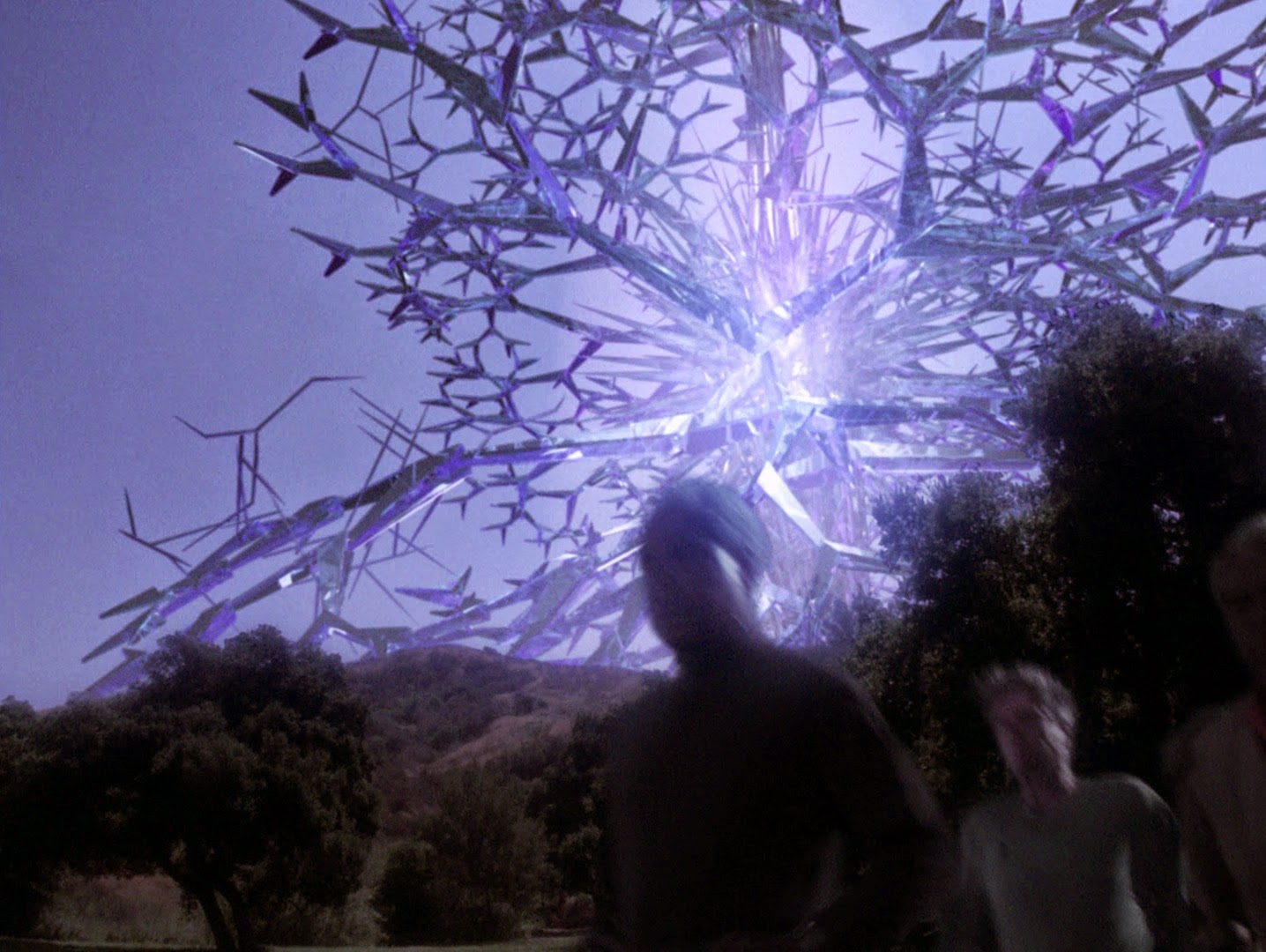
This episode is chock-full of problems and really isn’t very good, but I usually remember it somewhat more fondly than one would expect from that statement. I think one reason for this might be that the opening section, with Riker, Data, and Crusher on the new colony planet, tends to stand out somewhat more clearly in my memory than the rest of the episode. The said opening section goes from pleasant, to nicely atmospheric, to tense and somewhat desperate, holding my interest all the while, and I enjoy watching the characters respond to the crisis. It almost feels like a different episode from what follows, and I sort of wish I could see the rest of that episode. Instead, things go downhill fast as soon as everyone is back aboard the Enterprise and Dr. Marr shows up.
The said doctor is not the episode’s only problem, but she’s a big one. She’s a boringly two-dimensional character who is supposed to be a respected scientist but who has basically devoted her life to a revenge quest against an alien entity, and has seemingly given little complex thought to the nature of this creature that she’s spent all these years “studying” or the obvious ethical considerations raised by its existence. Indeed, she displays little capacity for nuanced understanding of much of anything, and seems rather out of step with the values of the society in which she exists. That she has remained under the radar as an apparently functional member of that society despite being extremely mentally unstable strains plausibility for me…and, on a related note, Counselor Troi is even more useless than usual here. (After flat-out admitting in an early scene that her “abilities” are superfluous, she also totally fails to pick up on the fact that Marr has gone batshit crazy while the climactic encounter with the crystalline entity unfolds.) That Dr. Marr switches from being irrationally biased against Data at first, to latching onto him because of his having some of her son’s memories, is most of what leads me to call her two-dimensional rather than one-dimensional, but it doesn’t make her seem any less crazy, and it honestly isn’t all that interesting, either. Some value can just about always be wrung from the interplay between the even-keel Data and emotional characters who project their feelings onto him, but this has been done to much better effect in other episodes. Here, too, what is intended as a reality check from him in the final scene, when he tells her that he does not think her son would approve of what she has done, feels a bit gratuitous and comes dangerously close to sounding petty and shaming, and I don’t care for that. Fundamentally, too, what we have here is another instance of an episode that revolves around a one-off guest character (and a fairly unlikable one at that) rather than really being about any of the actual main characters. (Also, does Dr. Marr remind anyone else of Admiral Satie from “The Drumhead” at all? Another older, female, supposedly highly respected person who does not come across that way at all, and in fact turns out to actually be unhinged and on a personal vendetta? And both appear in episodes written by Jeri Taylor, too. Hmm.)
The basic premise and plot of “Silicon Avatar” are a mess, too. First, the whole conflict over whether to destroy the crystalline entity or try to communicate with it seems manufactured and phony. Of course peaceful resolutions should be sought first, and equally, of course destroying it (should other avenues fail) is preferable to allowing it to continue ravaging whole colonies and killing people by the thousands. Neither of these points should be remotely controversial, nor does the episode make any real case for there being anything to lose by attempting communication first. There is a token effort, with Riker arguing to Picard that if they take the time to try to communicate they might “miss their chance” to destroy it—but this notion seems sort of arbitrarily pulled out of his ass, with no clear story logic backing it up or giving us reason to see it as accurate. Furthermore, the setup in which Dr. Marr seems to just assume that the purpose of the mission is to destroy the entity, so that the conflict with Picard only comes to light once they set off in pursuit of it, seems clumsy and amateurish. Surely there would be communication about goals and intentions as part of the process of arranging for her to aid them in seeking to address the problem of the crystalline entity? Not to mention orders from Starfleet command regarding what to do about it, which Dr. Marr would presumably be aware of? Also, to take a step back, it seems to me that from a storytelling point of view, there is an inherent difficulty with bringing the crystalline entity back and having the Enterprise attempt to deal with it: ultimately, you pretty much either have to redeem the entity or have our heroes decide to destroy it, and neither of these options seems particularly dramatically viable. Either it’s an irredeemable killing machine (which would be sort of off-theme for the show), or some kind of reconciliation is not merely possible, but can be achieved in fairly short order (which feels like a big stretch). The episode weasels itself out of this impasse by conveniently having Dr. Marr go rogue and destroy the entity on her own initiative, which basically amounts to a deeply unsatisfying cop-out. And finally, on another plausibility/plot convenience note (and a consideration that could even be seen as contextualizing Marr’s initial distrust of Data): Doesn’t it seem like an awfully big coincidence that the crystalline entity just happens to show up on a colony world that Enterprise personnel (including Data) are visiting, and that they (along with the colonists) manage to survive the attack when no one else has ever survived one?
I appreciate that this episode is trying to pull from the show’s own history and provide continuity with a previous episode, but alas, the whole thing just seems ill-conceived and rather poorly written.