
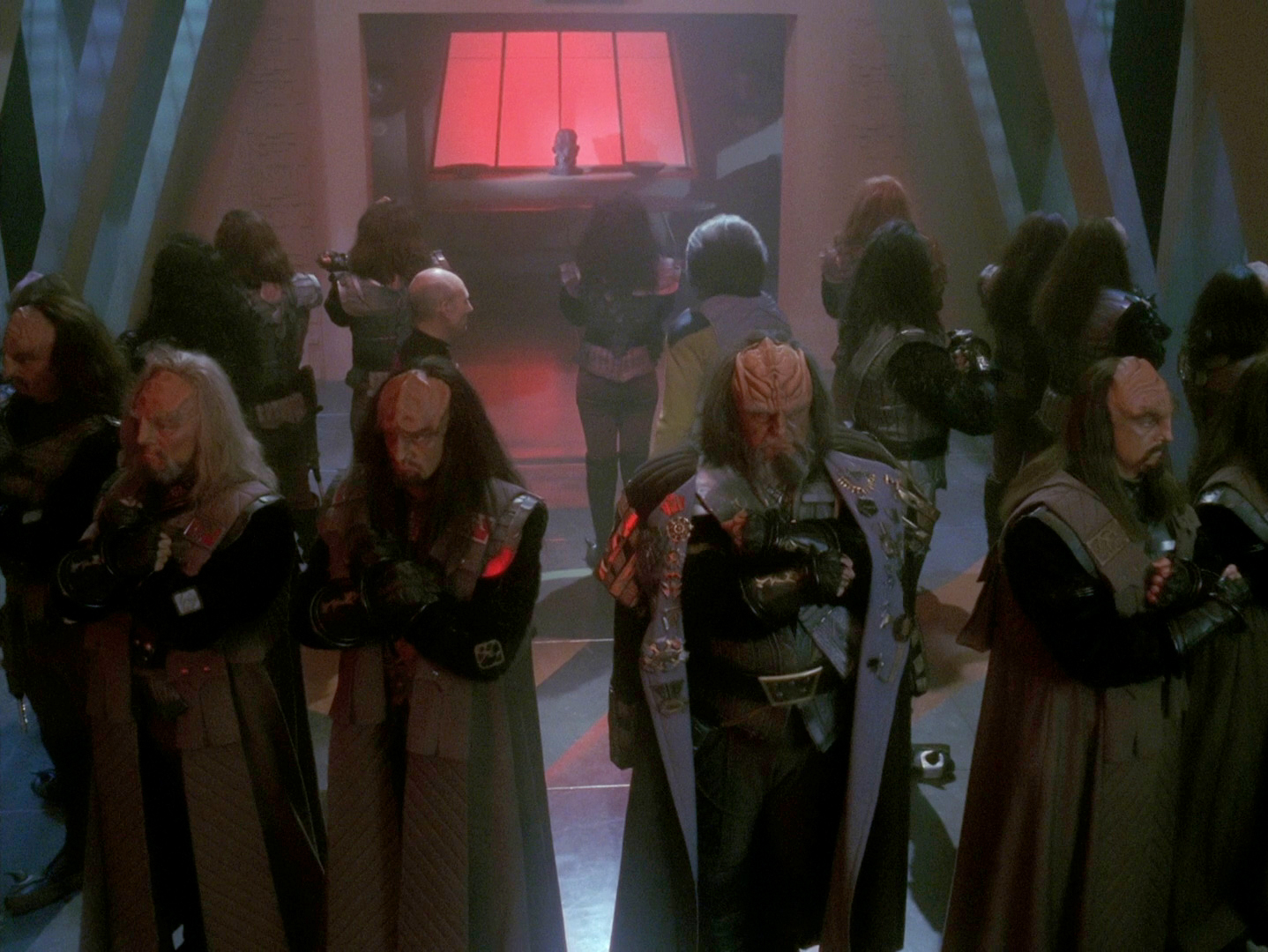
Ah, the first entry in what will develop, via future episodes, into the Klingon civil war storyline! While it’s a tad odd structurally, this is a strong character piece for Worf that stirs up meaty thematic material and throws in some interesting world-building for the Klingon Empire. It’s also just thoroughly enjoyable!
The episode begins with a bit of a fake-out that results in the main story not getting under way until the second act. However, the stuff that precedes the reveal that Kurn is Worf’s brother is both logical and enjoyable, and if you take a step back from assessing things on a plot level, it’s readily apparent that the heart of the episode is about assessing Worf’s character and the extent to which he is able to successfully straddle two very different cultures. This focus provides a consistent through line, from the early part of the episode with Kurn evaluating Worf’s Klingon-ness right up to the dramatic final scene. Besides, it was cool to see the “officer exchange program” concept come up again (yay continuity!), and the various scenes of the regulars struggling to cope with a Klingon first officer (and Kurn proving, during the dinner scene, to actually have a sense of humor!) are fun.
This episode digs into Klingon internal politics for really the first time, and to wonderful effect. Maybe it’s not only the Romulans, after all, who can offer up a good “game of chess”! “Sins of the Father” debuts the premise that, for all their talk about honor, the Klingons are as corruptible as anyone—and that beneath the “honor is all” facade, the affairs of the empire are actually governed by realpolitik as often as not. This rings wholly true. Worf, the outsider and Klingon idealist, is shocked that the council would cover up the truth about who the real traitor was twenty years ago in order to protect that (dead) traitor’s now-powerful family, but—of course they would. And so, Worf suffers the first of what will become a long series of disillusionments about the home culture that he has grown up idealizing from afar. Furthermore, that the episode manages to unveil the council’s dishonorable political machinations while still presenting, in council leader K’mpec, a likable, three-dimensional character who comes across as being an honorable Klingon at his core, is very much to its credit. If I were to raise one quibble, I suppose it would be that it doesn’t make a ton of sense that Kurn gets ambushed by two assassins who successfully get the better of him…but then leave him alive after beating up on him a bit (?). I would hate for him to have died here, as he was a well-realized character who would go on to contribute to future good episodes, but it doesn’t really make sense that two Klingon assassins would stop short of actually killing their victim. (But on a more positive note, albeit one that’s not really related to the rest of this paragraph, I’ll throw in here for lack of a better place to mention it that the episode’s visual realization of the First City of the Klingon Empire is pretty great.)
In episodes that focus on Worf, Picard frequently (and only naturally) plays a mentoring role. But in this one, although the captain certainly has his security chief’s back, the primary dynamic between them is somewhat different. Picard getting to demonstrate that he can hold his own among Klingons is fun, and the moment when Duras asserts that Starfleet hasn’t prepared him for fighting and he shoots back “You may test that assumption at your convenience” has always stuck in my memory. But what’s particularly compelling in this episode is watching as Worf steps up and earns his captain’s respect and admiration. Our exemplar of humanity is deeply impressed by the self-sacrificing gesture that Worf chooses to make here—in the interest, yes, of preserving a corrupt power structure, but also of averting the possibility of a bloody war over who betrayed whom two decades ago. A future installment of the Klingon saga that begins here will see Picard praising Worf for his ability to blend the best parts of Klingon and human/Federation cultures and values. Worf earns that praise here. Picard urging Kurn “Do not forget what he does here today. Do not let your children forget,” is a wonderful moment—and a cool turning on its head of the titular “sins of the father” notion, too. (Also on that scene: Picard’s declaration that a day must come when the injustice being done to the family name is reversed reads as a promise to the audience that the show intends to follow up on this storyline, which was an encouraging sign when this initially aired.)
To expand on what I’ve already said here about Worf successfully straddling a serious cultural divide: In my review of season two’s “The Emissary,” I brought up an idea that I encountered on another site (credit to commenter William B) to the effect that the role of the Klingons in TNG, narratively and thematically, was to dramatize the challenge inherent in reconciling a traditional culture with a modern, pluralistic one. In this episode, Worf addresses this challenge directly when he makes the mental adjustment (you can almost see it happening on his face) to separate his personal sense of honor—his knowledge of the truth, and of the person he really is—from what he is about to concede with regard to his public reputation among his people. The traditional way—to put honor above all—does have value, and he does not surrender his belief in it. But Worf is not living in a small-scale, premodern culture, where society is held together entirely on the strength of personal loyalties, and one’s fortunes depend critically upon one’s reputation. He’s living in a complex, pluralistic, large-scale, modern world, in which the cost of salving his personal pride by defending his father’s innocence could be the destabilization of an empire and a bloody civil war. So, he compartmentalizes his personal truth from his public standing, and willingly sacrifices the latter for a greater good—a quintessentially modern act that transcends notions of there being “one right way” to live one’s values and recognizes the true complexity of the situation. And, ironically, the result is that he is able to walk out of the council chamber at the end of the episode with his head held high (and his admiring captain at his side), the only truly honorable Klingon in a room otherwise full of politicians who are making a hypocritical public display of dishonoring him to protect a lie.
Pretty cool stuff.
Yeah, I’ve really been enjoying the Klingon sage this time through TNG. I always had a sort of knee-jerk aversion to Trek’s interest in Klingons on the grounds that with the exception of Worf, they are largely portrayed as psychologically rather boring. I was wrong to dismiss them to the extent I did, though, because the politics here and in the sequels are about as well actualized as you could get in a 90s network TV show.
As to their psychology: There is a certain complexity to the fact that Klingons aren’t really so honor obsessed as much as this is the veneer for their culture’s politics, but Trek does stop short of creating much individuality among Klingons, or exploring other facets of their culture. Even after multiple series and many episodes exploring Klingon culture, we’ve yet to see much of their culture beyond bravado and honor-guilded violence. One could introduce the idea that Klingon subcultures exist, though that is a rare notion in sci fi, but I always though seeing other facets of their society beyond the military and ruling classes might have been a good place to start. What other kinds of activity besides war are Klingons up to? This kind of politicking is a game for the upper classes, which is a tiny fraction of the population, ad it’s next to impossible to imagine a technologically advanced species being as violent and cruel as their culture is survive without other complexities holding it up.
Agreed. I, also, would have loved for other aspects of Klingon culture to be explored at some point. What if, outside the elite class, the rest of Klingon society tends to roll its eyes a bit at the persistence of the honor-obsessed warrior ethos in an age of starships and replicators and whatnot? What is Klingon class conflict like? Are there Klingon pacifists?