
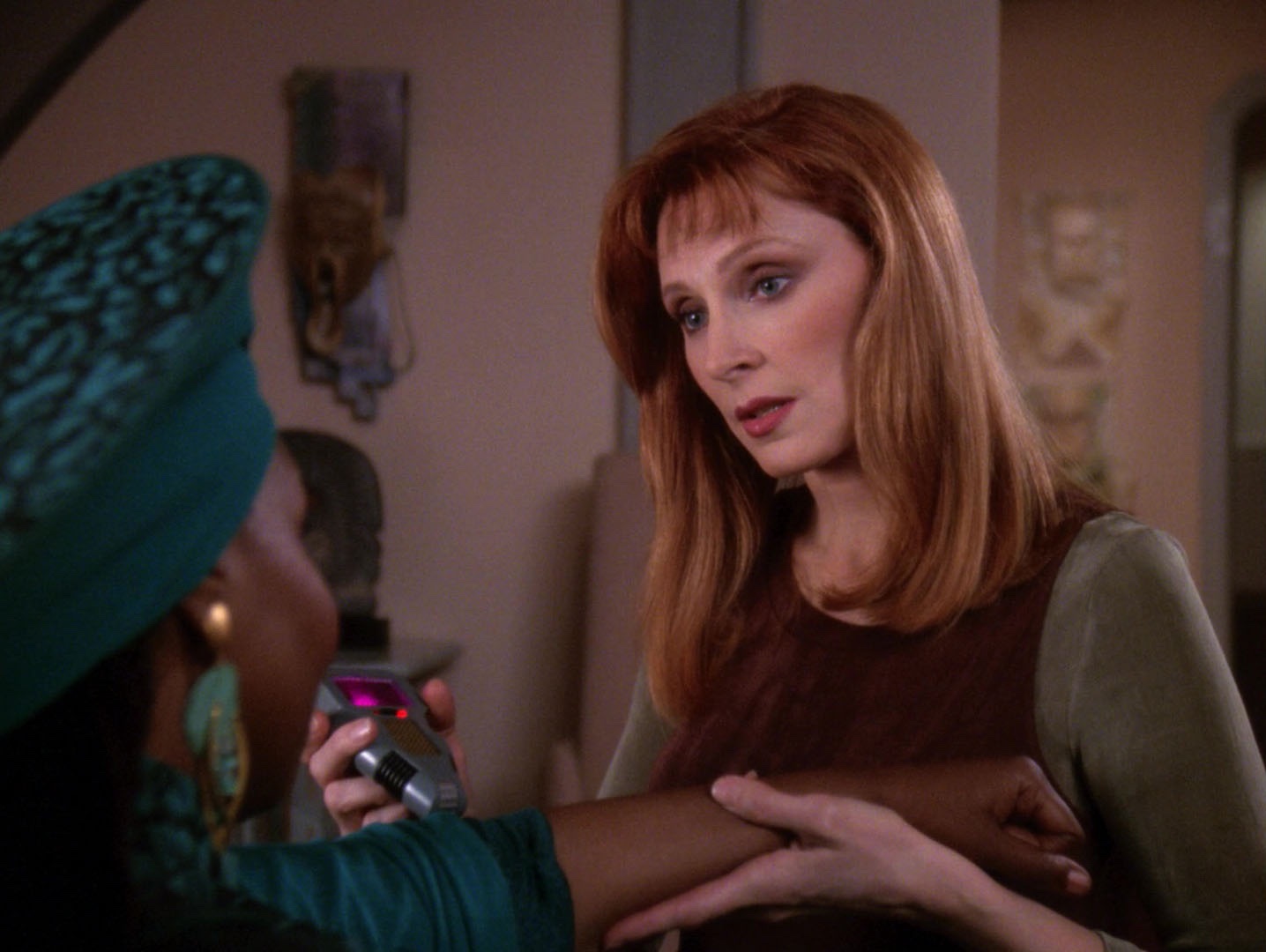
This is a bad episode, and pretty much nothing about it works (or even particularly makes sense). There are, alas, worse episodes of TNG, and I even considered giving this one two stars on the grounds that, while bad, it’s at least not a god-awful, cringe-inducing embarrassment of an episode, like most of the others to which I’ve assigned one-star ratings. Still…honestly, there are no redeeming qualities here.
The basic setup and premise for this story are so riddled with nonsense and contrivances that it’s hard to know where to start, but how about here: Why Dr. Crusher? I mean, don’t get me wrong; I’m all for the idea of the show actually bothering to highlight this most neglected and overlooked of its main characters once in a while. But why would she, of all people, suddenly take an interest in the controversial work of some Ferengi scientist specializing in subspace technology? And how is she qualified or able to judge, from reading his published work, that it’s “sound,” when all the experts in the field have dismissed it? On a basic storytelling level, this setup would make more sense for a Geordi story—or, if they really wanted a Crusher story, wouldn’t it have been much more sensible to make it about a medical doctor whose work attracted her interest despite being dismissed by others? I just don’t buy into her sudden interest and involvement in this, and that’s kind of fatal for the story. If we’re going to do a Crusher story for once, how about doing something that relates to who she is, and thus actually makes sense as a Crusher story? Then, on top of that problem, we layer the usual one of presenting scientific and technological breakthroughs as mainly arising from the isolated work of lone geniuses, and also act as though, you know, peer review is some kind of novel concept that can only happen with the intervention of an impassioned outsider who brings scientists together to witness a demonstration of the genius’s work. I’m sorry, but if there were merit to the Ferengi scientist’s work, others in the field would have recognized it long before Crusher! The episode gestures toward addressing this issue by insinuating that all the other scientists are either prejudiced against their Ferengi colleague or jealous that they didn’t come up with his idea first (or both), but that’s just stupid. Yes, prejudice is a thing, but this is supposed to be a future in which it no longer runs rampant, isn’t it? Or are we to understand that Dr. Crusher alone, among the scientifically inclined denizens of the Trek world, is broad-minded enough to accept a Ferengi scientist? (As an aside: It is refreshing to see the show actually portray a non-stereotypical Ferengi. So there’s that, at least.) Anyway, yet another nonsensical plot point concerns the idea of needing an “objective” pilot for the test shuttle (or even a pilot at all, for that matter). I mean, was Reyga’s partiality going to somehow influence whether or not the shield successfully protected him from dying horribly?
Plot incoherence aside, another thing that just does not work about “Suspicions” is the flashback/voiceover structure, wherein we experience the story via Crusher relating it to Guinan. For one thing, why does Guinan seem to know practically nothing about what’s been going on, and therefore need to have recent events related to her in detail? Actually, she must be faking her ignorance, right? I mean, she conveniently shows up at Crusher’s door right after the doctor has been relieved of duty…and then, in the end, confesses that her professed reason for doing so was bullshit. This is played as though it’s supposed to be cute and heartwarming, but—to me, at least—it comes across instead as contrived and cheesy. But also, what storytelling purpose is served by having the story related via voiceover narration? Normally, a device like this (which, incidentally, had never been used in Trek before this) would be employed to allow a character to reflect and comment on her actions and choices as she relates them, thus adding an extra layer of characterization and emotional engagement between her and the audience. But Beverly tells her story in such a detached, straightforward, and dry manner that the opposite ends up happening: any sense of her as a real person, with feelings about what has happened, is seriously blunted. This contributes strongly to my most fundamental problem with “Suspicions”—on which, see below. But also… It’s not that I object on principal to the show trying out new storytelling styles, but I’d like for such experiments to feel motivated by something. (“Lower Decks,” in season seven, can perhaps serve as an actually successful example of this.) Here, the use of flashbacks and voiceover just seems totally random, and makes the episode kind of stick out like a sore thumb, and feel like it doesn’t quite “belong” as part of the show. And then, finally, the episode also pulls the bullshit move of using Guinan to prompt Crusher into further action by drawing upon her deep well of otherworldly wisdom to press a blazingly obvious point upon the good doctor. What they were going for here is a thing that has been done successfully with Guinan in various past episodes (“Ensign Ro” comes to mind), but it’s just such a token effort on the part of the writers this time, and it comes off as really cheesy and fake.
Fundamentally, though, the thing that I feel about “Suspicions” is that it’s just…bloodless. This is an episode that imperils the future of one of the show’s main characters aboard the Enterprise (indeed, starts with the announcement that she’s gotten the boot), and the whole affair just feels so dull and routine. Nobody really gets worked up; Crusher barely emotes in any way, and neither does anyone else, really. Hell, we don’t even get to actually see Picard relieve Crusher of duty! She goes to his quarters to confess her transgression, and we do see him chew her out a bit, but then we cut straight to her telling us that the captain was disappointed in her, without having gotten to see it. (We’ve seen “Captain Picard is disappointed in someone” before, and it’s made for more than one emotionally powerful scene! The most obvious example would be with the doctor’s own son, in “The First Duty.” Also, Picard and Crusher are supposed to have this special, close relationship. Why does the episode just skip over what should have been the most emotionally intense moment of its story?) There’s one token scene of Riker expressing concern, of a sort, but he harps more on warning her off of pursuing things further than on being upset on her behalf—and as for the rest of the regulars, they’re barely even in the episode. (The scene in which Nurse Ogawa—the one person who does seem to care, at least about Crusher if not about the murder—helps her out, is the most we get.) Why does no one else seem to care, either about the murder or about Crusher being in trouble? And, given that they don’t, how can the writers expect the audience to care?
I also feel like the conflict at the heart of the episode (the issue over which Crusher behaves insubordinately and gets herself “fired”) is poorly justified, and employed in a sort of cynical way. An entire episode could have been centered on an issue like forensic medicine running into the obstacle of cultural beliefs, and while I’m not necessarily suggesting that I would have particularly liked such an episode, it at least might have felt like the writers taking the issue seriously. Here, it just feels thrown in to contrive a bogus pretext for getting the protagonist in trouble. I mean…really? The Ferengi have death rituals that require the deceased’s body to not have been “violated”? That was hard to swallow when this originally aired, and is even more bizarre in retrospect (DS9 having later done a whole episode in which Quark, believing that he’s dying, arranges to sell his remains to pay off his debts). Besides… Look, as an atheist and secular humanist, my sympathies align with Dr. Crusher in her frustration over not being able to perform an autopsy that will harm no one, and may provide evidence of a murder, just because of some kind of irrational cultural belief. Still, I am uncomfortable with how cavalierly this matter is treated in this episode, where it is used as a mere plot contrivance rather than being examined as an idea, and where the doctor decides to ignore the issue with very little soul-searching—and, in the end, gets away with it, merely because she ultimately proves her theory. I’m confused; was it that she shouldn’t do the autopsy, but if she did it anyway and it proved what she wanted it to prove, then it becomes okay? (Also, no small point: During the climactic scene, Crusher ends up vaporizing the murderer with a phaser. Why the episode chooses to go there, I’m not sure—but doesn’t it kind of mean that she still has no evidence to present to anyone else regarding who sabotaged the experiment and killed Reyga?)
In a weird way, the “flat affect” tone of “Suspicions” makes a one-star rating almost seem harsh. Like I said, this is not cringeworthy on the level of, say, “A Man of the People” (to cite the most recent example). Most one-star installments tend toward overwrought, rather than ho-hum. Still, this is a very bad episode.
One wonders why exactly this episode is so lacking in emotion, but honestly, that’s what I remember most about it. And it’s liked the cast is mostly missing, as if they were trying to deal with the actors being unavailable or something.