
Once again, just when it seemed like the season was, relatively speaking, on a roll (three consecutive two-star episodes!), it crashed and burned with this piece of garbage. The lameness of this episode’s “that’s why drugs are bad, Wesley!” speech by Yar is legendary (and the scene in question is very awkwardly shoehorned into the episode in the first place), but the badness of the episode goes way, way beyond that scene. This is another episode featuring POTW alien societies (two of them this time) that utterly lack verisimilitude, and on top of that, its guest characters are so unrelentingly one-note that they start to grate on one’s nerves in their first scene after beaming on board the Enterprise. Like two-year-olds, they simply will not shut up about their utterly simplistic, polarized, “the medicine is ours—no, it’s ours!” conflict, even though they never have anything new to say about it. Moreover, the episode ultimately boils down to yet another putative prime directive dilemma that makes no sense either logically or dramatically. The writers responsible for this turd had, quite simply, no idea how to write.
So, this episode asks us to believe that an entire planet has no industry apart from making a single drug and selling it to another planet, and that every inhabitant of the second planet is utterly addicted to this drug. However, no one on the latter planet has apparently ever so much as suspected that perhaps their entire planet might be getting fucked over by the former planet. Also, the two planets’ “long-standing trade arrangement” is, apparently, entirely reliant upon a “fleet” of (count them) three barely-functional ships run by imbeciles who don’t know how they work and can’t fix them when they break down—a situation, by the way, that the episode makes no attempt at all to explain (it’s just another recycling of the old “society that doesn’t understand its technology” idea from the original series, here with less explanation/point than ever, being leaned on like a wobbly crutch). And as for the big dispute about the medicine—where are the planets’ governments and diplomats? Some guy from the addict planet does contact the ship at one point (though it’s not clear who he is or what level of authority, if any, he may represent), but not in order to negotiate with the drug-withholding Brekkians, or even to plead his planet’s case to Captain Picard; nope, instead, all he does is urge the guys from his own planet to be really persuasive! Additionally, did the loss of whatever payment was on the freighter really render the addict planet totally incapable of paying for the medicine? I thought these two societies’ entire economies revolved around this trade! And finally, why do the two characters from the drug-producing planet so adamantly refuse to budge an inch for most of the episode, but then suddenly reverse their entire position near the end? Picard opines that they don’t want their customers to realize that there’s no actual plague—but surely this motive should have prompted them to be more accommodating from the outset? (I suppose that to show these characters coping even remotely intelligently with the dilemma of wanting to be paid, but also needing the trade to continue just as badly as the other planet’s inhabitants do, would have required the writers to develop, at a minimum, two dimensions for the characters.) My god, is this bad.
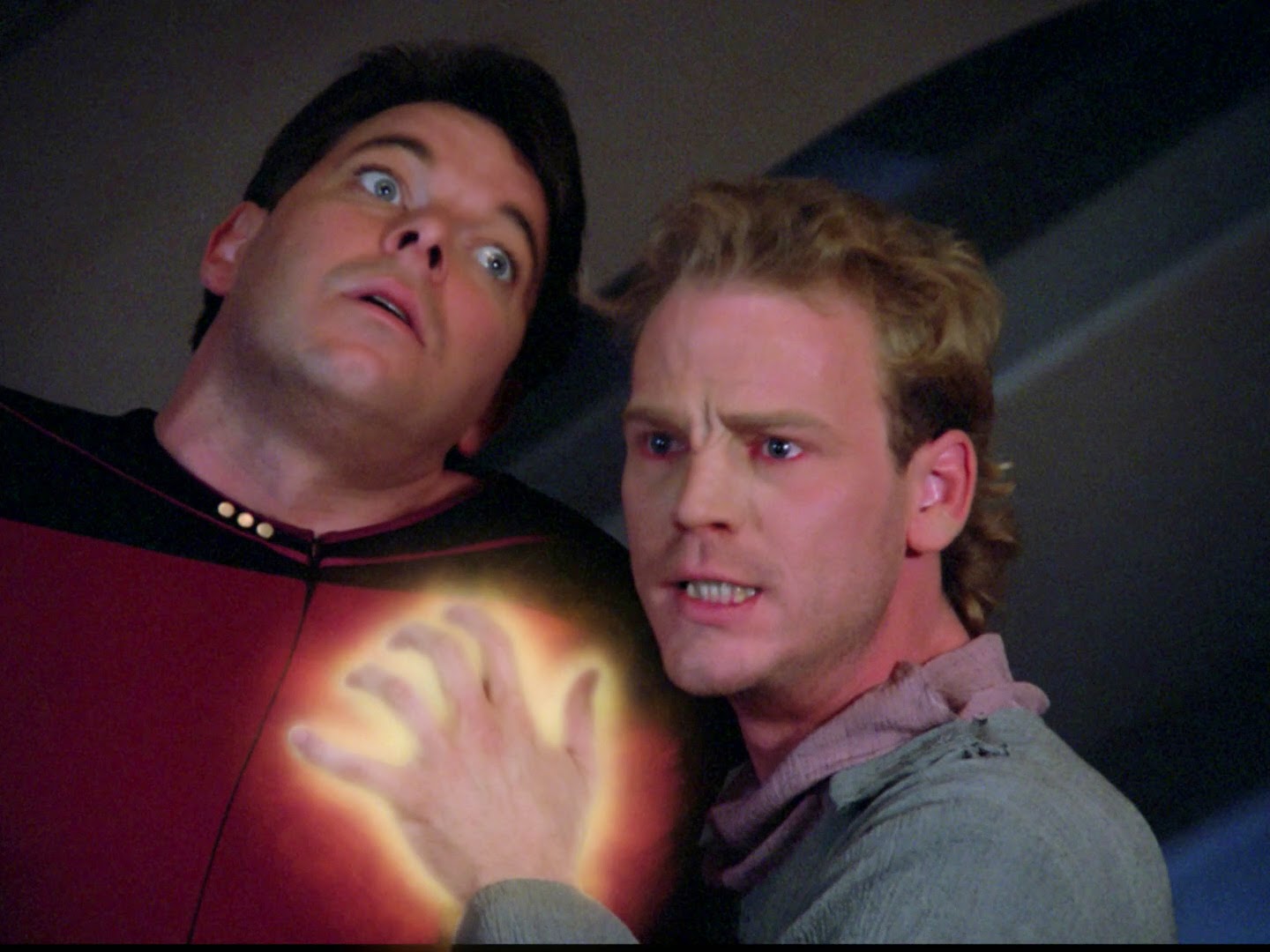
The episode also suffers from a serious shortage of ideas, with the result that the first section of it actually comes off as relatively inoffensive (if also not terribly riveting)—until it becomes clear that this is merely because the story is taking way too long to get going. I mean, what (besides filling up running time) is really accomplished by stringing out the revelations about the true nature of these two planets’ relationship over half the episode? It’s not as though characters get developed, or thematic layers built, or even as though any events of particular interest happen, before the eventual “plot twist” (the plague is history, the medicine is a narcotic, the Ornarans are addicted, and the Brekkians know it) is revealed! Furthermore, when the truth does finally come out, it does so via a barrage of intuitive leaps suddenly arrived at by Picard and Crusher, and hurled at the Brekkians like accusations—not as a result of events that actually dramatize anything, or allow the audience to draw its own conclusions. And on top of all of this, before the real story even starts to get going, the episode futzes around for a while with the crew studying an unusual star, and then with the bumbling ineptitude of everyone on board the freighter, and then with the main characters approaching the freighter crisis by trying to troubleshoot its engine problems and provide them with repair parts even though the craft has been established to be minutes away from disaster, before finally deciding to just beam the people to safety instead! Meanwhile, free-floating tidbits like the locals’ electro-zap powers are thrown into the mix for no very clear reason. Although Yar expresses concern about how to defend against this power, this plot thread goes nowhere, and no precautions are taken against its eventual use on the crew—and yet, when the latter happens, nothing really comes of it, either.
The theoretical point of this episode would seem to have been to put Picard in another Prime-Directive-related tight spot and see how he deals with it. But the particular dilemma that the writers dreamt up is totally unsuitable for this purpose. In the first place, it required cobbling together a staggering assemblage of half-assed contrivances just to land the Enterprise in the middle of the Brekkians’ and Ornarans’ dispute at all—the reality being that there was no compelling story logic behind the matter being in our heroes’ hands. Secondly, I just don’t buy the idea that the Prime Directive actually does tie their hands in this scenario. I mean, for once, the alien societies in this episode are actually not “underdeveloped” ones with whom the Enterprise shouldn’t even be interacting at all; they’re interstellar-aware and have at least some Federation-level technology (even if they for some reason don’t know anything about how it works). Picard blusters about how imposing our values on other societies is wrong, but is that even what’s at stake here? Societies try to persuade and influence each other all the time; if they didn’t, there couldn’t be a Federation in the first place. Since when has non-intervention meant totally abstaining from any involvement in others’ affairs at all? Does the Prime Directive really mean that if one people is deceiving, manipulating, and exploiting another, the Federation is forbidden to inform the latter people of what is going on? And while it’s a valid point that it would be unwise to impose outside values on these societies by force, or even for the Enterprise folks to take it upon themselves to decide who gets the medicine/drugs, it’s hard to see why Picard couldn’t try to mediate the dispute via talks between the two planets’ leaders, or something. This type of thing happens in plenty of other episodes, after all! This episode, however, instead goes the route of pretending that to do anything direct at all about the situation would violate the Prime Directive—yet to refuse to repair the Ornarans’ ships (which they otherwise were willing to do) is just fine, even though it will predictably lead to outcomes not much different from what would happen if they just told the Ornarans what’s what! Picard’s only justification for this, moreover, amounts to a retreat into stale abstractions about the invariably disastrous outcomes of intervention, which he fails to back up by so much as offering one example—much less by suggesting any possibilities for what might go wrong in this particular case. (His comment that “we may never know” whether the consequences of what he does choose to do are good or bad is also a super-lame cop-out on both his and the episode’s part!) Bottom line: an episode centered on a Prime Directive dilemma ought to be concerned with the task of concretizing the abstract principles represented by said directive in dramatic and interesting ways, via engagement with genuinely thorny situations—and this episode fails to come anywhere even close to doing this.