
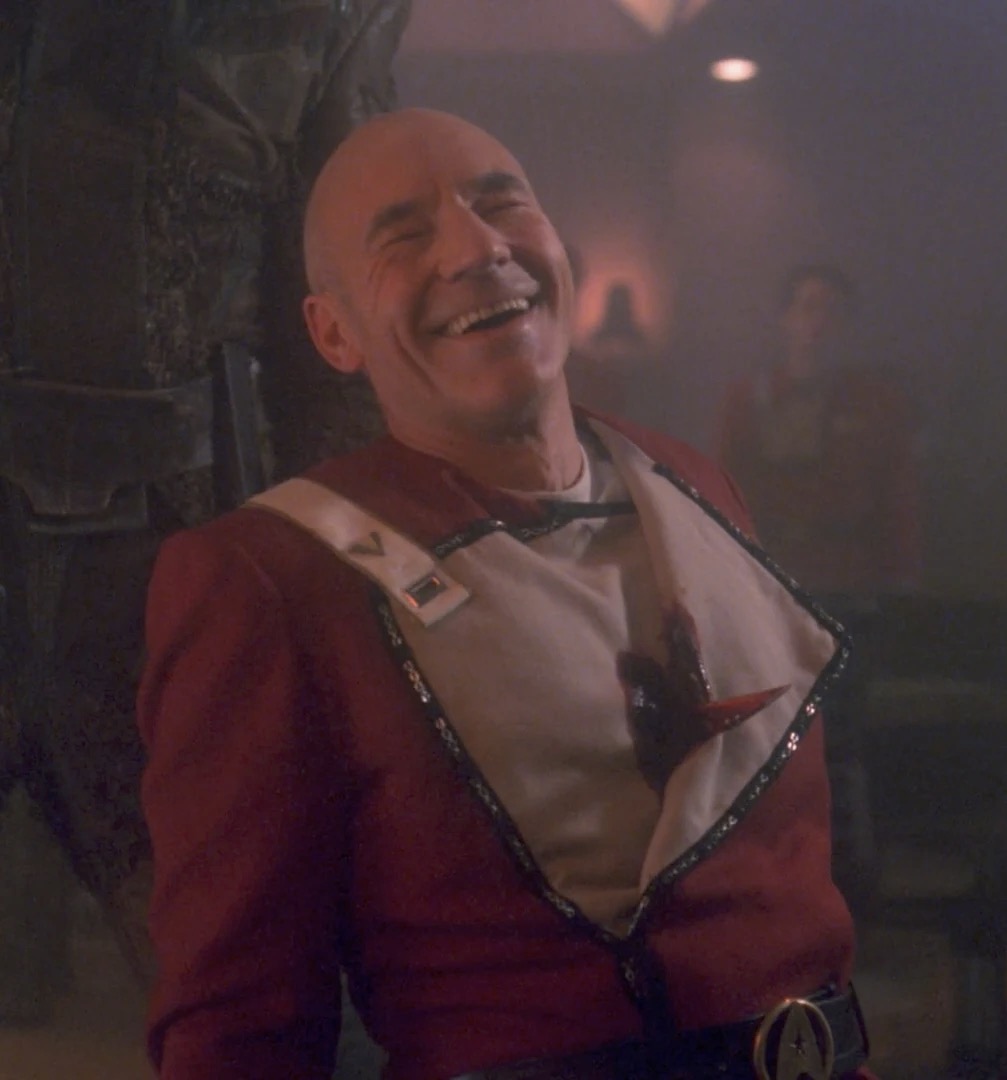
“Tapestry” may be my personal pick for all-time favorite TNG episode. A philosophical exploration of how our pasts (including the parts of them that we’re least proud of) shape us into who we are, delivered via a Q-guided reliving of a key moment in the life of a young Jean-Luc Picard that was first mentioned way back in season two? This was a solid gold premise, and Ron Moore knocked it out of the park in the execution as well, creating an episode that is both highly entertaining and extremely thought-provoking. For me personally, at least, it’s for sure one of the most meaningful Trek episodes from any series.
It’s also a real return to form for the Q character, whom we’d most recently seen in the terrible “True Q,” and before that in the mediocre “Qpid,” neither of which got him right. And even before that, the next most recent Q episode was “Deja Q”…which was fantastic, but in a one-off kind of way that differed from what I consider to be the normally “correct” way to use the character. “Tapestry,” by contrast, is reminiscent of “Q Who,” giving us a sarcastic and all-knowing Q who jerks our captain around and puts him through the wringer for reasons that seem petty on the surface, but can also be interpreted as intended to help him. Actually, this time around, it’s tough to plausibly argue that he doesn’t have Picard’s best interests at heart, as even the captain himself acknowledges in the episode’s final scene. I suppose one might therefore argue that this particular Q story is a little too on the nose, with Q’s true motives a little too plain…but this late in the show’s life, and with an episode this good, I’m very willing to give them a bit of a pass here. Besides, even if his motives are benevolent, he still gives poor Jean-Luc a pretty hard time throughout, with his constant sarcasm and goading, and the way he clearly relishes poking at the captain’s weak points. He may have cast himself in the role of a guardian angel of sorts (with definite shades of playing Clarence to Picard’s George Bailey), but he makes for a decidedly (and appropriately) irreverent and mischievous one.
At the heart of what makes “Tapestry” great, though, are the thought-provoking things that it has to say about Jean-Luc Picard’s life story and how it has shaped him into the person he is—and, by extension, what it says about us all. The message of the show is simple in a way, but there are, all the same, nuances and complexities worth exploring. Our captain has been, understandably, carrying a certain amount of shame with him for decades in connection with the immaturity and arrogance that got his younger self stabbed through the heart by a Nausicaan (“untidy parts of me,” as he puts it), but Q pushes him to embrace the whole of himself (warts and all) by making him realize that his mistakes played a key role in making him the person he is today. So, in the end, he opts to relive the key moment once again, and pick the fight with the Nausicaan after all. But in having him make this decision, the episode is not, in my view, suggesting that the young Jean-Luc was somehow right to do this very stupid thing. It would be possible to read the episode as smiling indulgently at Picard’s youthful dip-shitery in a “boys will be boys” kind of way, as though his eventual “rise to greatness” made it forgivable that his younger self was sometimes a bit of a jerk. But I think such a reading would be too simple, mistaking the episode’s observations about life and human nature for moral judgments (or rather, I guess, for moral absolution). The idea isn’t that, because he learned from it, it’s therefore “okay” for Picard to have done what he did; it’s just the factual observation that ‘A’ did play a role in bringing about ‘B.’ Life is complicated (one might even liken it to a tapestry), and humans (even 24th-century ones) are flawed beings; every event impacts the future in unpredictable ways…and sometimes, like it or not, doing really dumb things does end up making us better people. Also, I think that Q’s (and the episode’s) argument about the debt that the Picard of “today” owes to the cocky, “hell-bent for leather young officer” that he once was, has multiple layers to it. It’s partly that, as Q explicitly tells him, his brush with death as a young officer brought his life into focus, pushing him to seize whatever opportunities came his way. But we know that the young Jean-Luc was already driven and ambitious; it’s implicit in his having rejected the life path laid out for him by his father and gone off to join Starfleet Academy (which this episode reminds us of in an early scene), for one thing, and we’ve elsewhere heard about things like his having (unprecedentedly) won the academy marathon as a freshman cadet. So I think that, when Q needles Picard about wishing to have been “less like me” in his youth—and when Picard recoils from the version of himself that would have resulted from this alternate path, as a man “bereft of passion and imagination”—the argument is also that the character traits that have made Picard stand out as an officer, and eventually a great captain, are “wised up” versions of the very traits (the passion, the drive, the confidence) that made his younger, dumber self pick the fight with the Nausicaan. Again, though, it’s not about justifying bad choices; it’s just suggesting that maybe humans don’t often get to be wise and reasonable and generally awesome and admirable people without having traits that, in their pre-wisdom youth, can make them total boneheads. We’re dumb, we learn, we improve; the lesson for Picard is about self-acceptance (and perhaps, as a consequence, increased empathy for others). (Also, I think it’s important to say that having a career in which you never advance beyond the level of a junior officer in astrophysics doesn’t automatically make you a failure, or prove that you lack passion or imagination—nor do I think the episode need be read as saying that it does. It merely suggests that this career outcome was unsatisfactory for Jean-Luc Picard, who both wanted and was capable of “more.”)
Profundity aside, “Tapestry” is also just really entertaining. It’s fun to be allowed this glimpse into our hero’s past, to meet the friends of his youth, and to see a very different version of him from the one that we know (not least via the expectations regarding his behavior that we see those friends expressing). Then, too, there’s the vicarious pleasure of imagining having an opportunity like the one that Picard has here, to be transported back to a prior epoch of one’s own life and get to relive it, possibly making different choices and exploring roads not taken. The romantic sparks between Picard and his friend Marta are actually engaging (!), and she is, in general, a memorable and fun character. Plus, Q is absolutely brimming with funny lines and bits, from “penny for your thoughts” (right after a woman named Penny throws a drink in Picard’s face), to talking about how Picard’s recounting of events is a moving story that “gets you right here” (indicating the area of his heart), to popping in on Picard and Marta with a flower delivery and purposely butchering Picard’s name (“Is there a ‘John Luck Pickerd’ here?”). And yet…I can’t help but to reflect, as I write this, that I’m not exactly gushing the way I have when reviewing many of my other favorite episodes—which, in turn, leads me to the observation that “Tapestry” is perhaps an episode that makes me think more than it makes me feel. As such, it might be considered an odd pick for my all-time favorite TNG episode. (Is that why I felt compelled to hedge a bit in the opening sentence of this review, saying merely that it “may be” my favorite?) I love it, and I love Picard in it; I find it creative and satisfying both as a fleshing-out of the Nausicaan incident and as a larger piece of Picard back story; the ideas that it explores engage me powerfully; and, of course, it’s by no means the case that it doesn’t “make me feel.” Still, on an emotional level, I have to acknowledge that it doesn’t pack the same kind of punch as something like “Data’s Day,” or “The Inner Light,” or even “Deja Q.” I’m not really building to any kind of conclusion, here; just musing, really. Food for thought, I guess.
In an entirely different vein: If I were to nitpick anything in particular about “Tapestry”… This is pretty minor, but the secularist in me would prefer for Picard to evince skepticism at Q’s “You’re dead, this is the afterlife, and I’m God” claims for more reasons than merely because “the universe is not so badly designed.” It’s completely in character for Q to make this joke/claim, and Picard’s response is funny, but I’m not 100% happy with the implication that Picard might believe that there is a god, and that the universe was “designed” (just not by Q)—nor that he is unsurprised to “discover” that there appears to be an afterlife. I know, it’s a lot to expect of a TV show that it endorse my personal atheistic worldview…but secular humanism is, theoretically, baked into Trek to some extent. I don’t actually ask that the show take a definite stand on such questions, or even definitively establish that its characters share my worldview—but ideally, I would like it to be fully interpretable as portraying a future in which humans have essentially moved past religion, even if it also left room for alternative interpretations. And maybe it is interpretable that way even as is. In any event, this is at most a very minor quibble about a beyond-fantastic episode.
I don’t know if I can say, as I have said with respect to a handful of other episodes (“Data’s Day” comes to mind in particular), that I personally learned something from watching “Tapestry.” Its lessons, I think, resonated strongly with values and ideas that I had come to independently of it, rather than being introduced to me by the episode. But it dramatized concepts that were particularly important to me at the time in my life when the episode originally aired, and that I had not really encountered from other outside sources at the time—so, for my favorite show to come out with an episode reflecting on these insights was pretty amazing for me. And even if its ideas weren’t “new” to me at the time, it still reinforced them and provided me with new ways of looking at them. I have never had an experience remotely equivalent to being stabbed through the heart because of my own cockiness, but I am a person who tends not to “regret” any of the big choices that I made when I was younger, even in those cases where I can see, in hindsight, that they may not have been the best choices. My life has followed the course that it has followed because of all of my choices, the good ones and the bad ones alike—and I am the person I am because of the particular course that my life has taken. How, then, can I meaningfully wish to have chosen differently? I only know the tapestry that I have actually woven, and like Picard, I don’t wish to unravel it.
I haven’t seen this episode in some time, but I remember being more emotionally moved by it than any other Trek episode. Data’s Day, and Deja Q, though fantastic episodes, still don’t seem to get very near Tapestry in that regard for me. The Inner Light was also conceptually brilliant (no pun intended), though I also can never shake the sense that it really needed more development and character to have the emotional impact it was capable of. That sounds a bit harsh, but don’t really mean that as a criticism; it probably did nearly as much as it could have in the 50 minutes it had, but I also feel like I needed more time to get more invested in the characters, and also to see more uniqueness in the alien culture that was being preserved. But I digress, as this is not a review of TIL, and I probably have to concede that my connection to Tapestry may have more to do with my connection to the ideas it espouses being important to me in the developmental stage I was in when I saw it.
My real point regards your bias about Picard’s reaction to Q-as-God, though. As you may or may not be aware, it is unfortunately the case that in the Trek universe, Christianity is canonically true per the TOS episode “Bread and Circuses.” Take that, heathen.
Not that it matters, but just for the sake of argument–that last bit isn’t necessarily true, technically, is it? I think “Bread and Circuses” merely establishes that a very close Christianity-parallel (amazingly! 🙂 ) arose independently on another plant. That doesn’t mean that Christianity is “true”…
Naw, not really, but if I remember it correctly, the episode does seem to imply that 23rd century Federation citizens are Christians from the way they react to the existence of Christianity in this culture, as opposed to primitive sun worshippers. I gotta wonder how that one got past Roddenberry, or whether his secular humanism is exaggerated or something?
Also… It’s possible that I just wasn’t in the right frame of mind, or whatever, and “Tapestry” didn’t hit me as hard on this rewatch as it has at other times. Hard to say. But regardless, I still think it kicks ass, and it’s still my pick for all-time favorite TNG episode.