
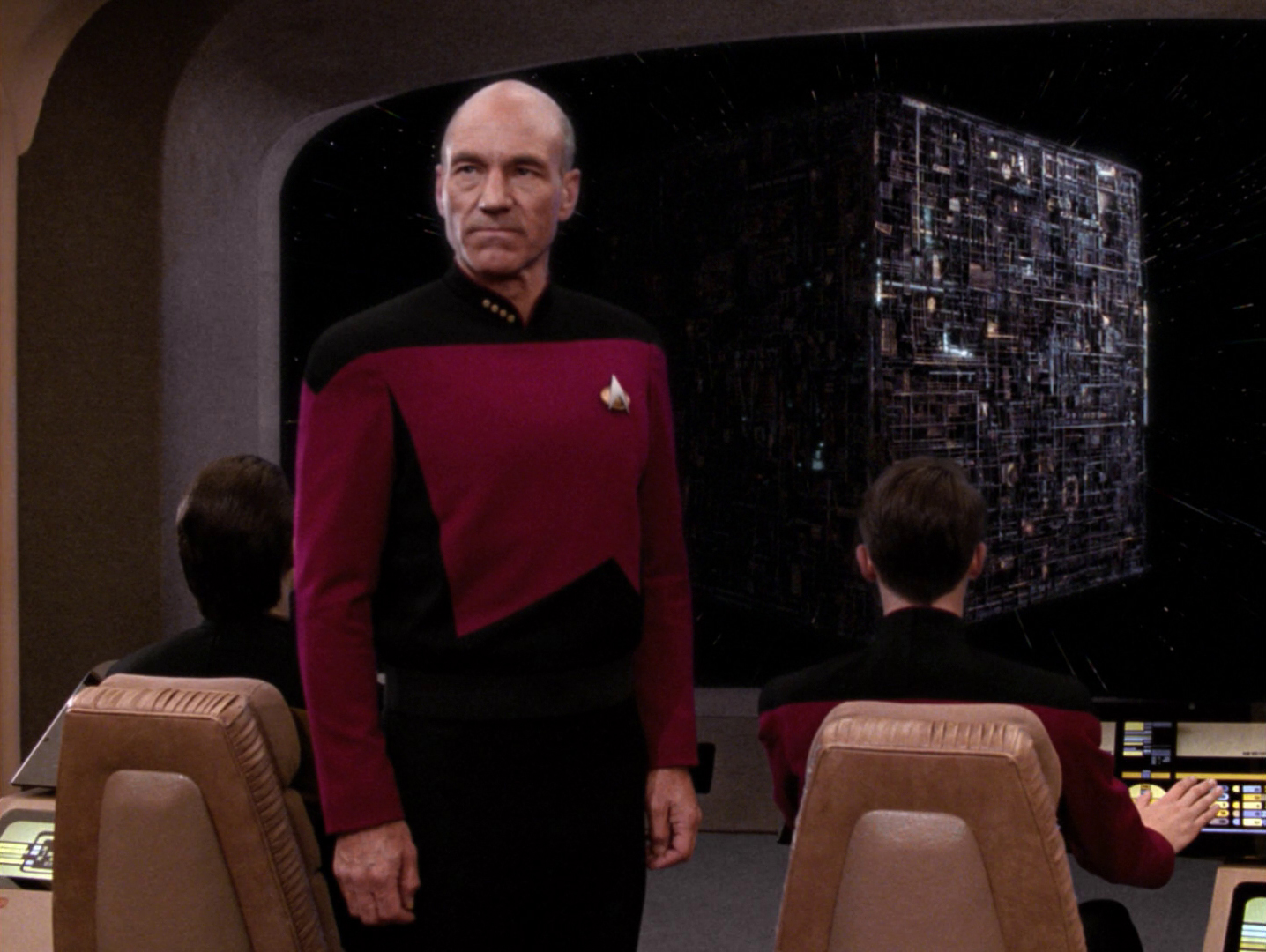
“The Best of Both Worlds” is assuredly TNG’s best-known installment and the biggest “event” episode of its entire run. It’s also a phenomenal piece of work. I’m not saying anything that others haven’t said before me, but for anyone who was still unconvinced, as its third season drew to a close, that TNG had come into its own and matured into a show that was capable of greatness, the season finale put those doubts to rest. It also marked the first time that the show ended a season at the top of its game. The two previous seasons had each sputtered to unremarkable finishes, offering nothing that really answered to the description “season finale”; season three, by contrast, went out on the show’s first-ever, and all-time most epic, cliffhanger episode, featuring both an existential threat to the Federation and a potential shakeup aboard the Enterprise, and leaving the life of Captain Jean-Luc Picard in immediate peril. And it did all of this by finally following through on the show’s implicit promise to its audience from the end of “Q Who”: the Borg have arrived!
One of the most impressive things about this episode, too, is that it’s not just the start of the epic showdown with the Borg; it’s also a surprisingly strong character piece! In fact, through the first two acts, I would even go so far as to say that it’s primarily a character piece (very much affirming my impressions of writer Michael Piller as a character-first storyteller through and through). The interplay between Shelby and Riker, against the backdrop of Riker having quietly turned down yet another promotion to captain, is compelling stuff that both emerges logically from who Riker is as a character in general and builds upon previous events from “The Icarus Factor” in particular. Shelby, too, is perfectly written: ambitious, impatient, competent, and—because we primarily inhabit Riker’s perspective—a little irritating (in a good way). Narratively, she exists to unsettle the complacency of the audience as much as that of Commander Riker. Riker’s scene with Troi after the captain has delivered him a nudge toward the door is also good, with Troi justifying her existence by providing Wil with a balanced perspective and encouraging him to simply approach his dilemma as a question about what he actually wants. Good stuff.
(Incidentally, I’ve never been clear as to the intended meaning of this episode’s title. Is it in reference to Riker, who feels torn between ambition and the comfortable familiarity of his Enterprise position—or between being a brash risk-taker and “playing it safe”—and who will have to balance these dichotomies when he assumes command of the Enterprise in Picard’s place? That’s all I’ve got, really; if it’s not that, then I’m clueless.)
Of course, inexorably, the episode drives itself forward to the moment when the Enterprise encounters and “engages” the Borg cube. At no point does it drop the character threads that it set up in the earlier acts, though; it just adds skyrocketing tension and a looming sense of dread into the mix, and forces Riker to focus his attention on the escalating crisis while continuing to ponder his future and clash with Shelby. The episode also puts in the effort required to make the astronomical stakes actually feel real: the slow buildup, the frequent communications with Admiral Hanson that serve to broaden the story’s scope beyond just the Enterprise, the awesome musical score backing so many of the scenes. When the Borg appear, they’re every bit as alien and single-minded and virtually impervious as when we last saw them, and our heroes’ best ideas for how to hold their own against them barely even make a difference. Rarely do things ever appear as bleak on TNG as they do for roughly the second half of this episode!
The middle section, in which (borrowing a bit, perhaps, from Star Trek II) the Enterprise hides in a nebula, is in some ways the key to the entire episode. Escalating tension temporarily takes a back seat to eerie quiet and a sense of looming despair, accentuated by the quality of the lighting owing to both the ship’s ever-present flashing “red alert” indicators and the nebula’s colors, in a series of atmospheric and visually compelling scenes. The highlight here is Picard’s conversation with Guinan during his observance of a “traditional” captain’s tour of the ship before a (hopeless?) battle. The discussion of Nelson before Trafalgar provides some genuinely ominous foreshadowing; the audience knows, of course, that somehow the Enterprise‘s battle with the Borg will be won…but the hint that its captain’s fate could mirror that of Admiral Nelson will pay dividends by the time we arrive at the cliffhanger ending. Picard’s further musings about the fall of Rome and the helplessness of those brushed aside in the sweep of history both feel utterly in character and go a long way toward making the seriousness of the Borg threat feel real. The fact that the episode pauses to remind us that Guinan’s people were previously wiped out by the Borg, and gives her a moment to offer perspective on what humanity’s future might look like as they now face the same threat, also adds weight to the scene.
The idea of the Borg assimilating Picard individually and using him as their “spokesperson” to facilitate the assimilation of the rest of humanity/the Federation was an interesting one. A cynic could argue that it feels a little inconsistent with what we saw of the Borg in “Q Who” and with their overriding indifference to the concerns of individual outsiders. (“Strength is irrelevant… Your culture will adapt to service ours… Freedom is irrelevant. Self-determination is irrelevant.”) Arguably, too, as a strategy, it will massively backfire for the Borg; had they dispensed with it, it’s hard to see what would have prevented them from succeeding in assimilating humanity. Against these points, I can only say that I find the concept just plausible enough that I’m happy to suspend disbelief, particularly in light of the compelling drama that it makes possible. Besides, if the Borg had shown up and behaved exactly like they did in their first appearance—with no new twist thrown in to upend expectations—that wouldn’t have been as interesting, would it? (On the other hand, this kind of thinking is probably what later gave us the “Borg queen,” so…)
In any case, the moment the Borg abscond with the captain, all the pieces that the episode has set up fall abruptly into place. The weight of responsibility visibly and audibly bears down on Riker (Frakes is really good here) as he orders the senior officers to report to the bridge, then immediately learns that the Borg are now hurtling directly toward Earth. In the next scene, there’s a great moment when he falls into his usual role, hell-bent on leading an away team to the Borg ship and decisvely rattling off a rapid-fire series of orders, only to be brought up short by Troi—again serving an actually useful purpose here by halting Riker in his tracks and reminding him of his proper role in the rapidly evolving reality of the crisis situation. And then, of course, following the reveal of “Locutus of Borg,” he finds himself forced by the logic of the situation to order Worf to fire the big weapon that has been improvised in the hope of penetrating the Borg’s all but impregnable defenses, while staring his Borgified (former?) captain in the face via the viewscreen—and he does so over Shelby’s objections, proving that when push comes to shove, he can “make the big decisions” after all. What a moment!
TNG’s third season as a whole represented an enormous improvement on what had come before, and as part of that maturation, Captain Picard had finally, fully emerged as a unique and compelling central character (portrayed masterfully, of course, by Patrick Stewart). But even so, the show’s early years had been rocky enough—and it still felt enough like a struggling sequel whose fan base was still making up its mind about it—that the specifics of its future seemed very much open to question at this key moment in its run. Or at any rate, such was my personal take on it as a naive sixteen-year-old overawed by a season finale like nothing I had ever seen before. (Hell, I was barely even aware that television shows had distinct “seasons” prior to this; for my favorite show to go into a seasonal hiatus on a nail-biting cliffhanger was something utterly new to me!) According to Larry Nemecek’s TNG Companion, though, I wasn’t alone in genuinely wondering, during the summer of 1990, whether the show might actually kill off Captain Picard. It’s easy to overlook the fact, now, that in 1990 no one yet knew that TNG would run for seven seasons, spawn multiple additional spinoffs, earn a place in the broader cultural zeitgeist beyond its core, nerdy fan base, and even play a role in the evolution of what was possible for a television show. So, anyway, fans like me wondered: Was Captain Picard being written out of the show? Certainly the episode had set this possibility up perfectly, by introducing both Riker’s career dilemma and an ambitious young officer hell-bent on assuming his current position; were the clashes between the two of them in this episode there to provide a launching point for an ongoing character dynamic, with them finding themselves unexpectedly having to forge a long-term working relationship as captain and first officer in season four? And if so, did I like this idea, or would I regret the loss of Captain Picard? Thirty years later, I still remember the suspense and the uncertainty that fueled my eager anticipation of the resolution to the cliffhanger. Well done, writers!
Among people who are not obsessive fans or intimately acquainted with TNG, “The Best of Both Worlds” is the one, iconic episode that anyone who knows anything at all about the show is familiar with, and it has often been cited as the best episode of the series as well. Few true fans, I think, would endorse this view (there are several contenders in seasons still to come that most fans would place above it—myself included), but it is undoubtedly an epic, game-changing, absolutely top-tier installment!
Well said. My only question is—can you really grade this, given it’s only the first half of a story? The format of a TV review suggests you do so, and if you do, you surely can only give the episode five stars. However, one of the hardest parts of storytelling is the resolution… and the sequel doesn’t entirely stick the landing (at least, I don’t think it quite lives up to part one)…
Fair question/point. I address this specific case somewhat in my review of part 2. In general, I think my approach to how to rate the first half of a two-part story is going to be MOSTLY a matter of just judging based on what’s there, and holding the second half accountable for any failures to conclude the story in a satisfying way. This might not be 100% fair, but I think I’ll be content with it except in fairly extreme cases, where a “part one” builds too many problems in for “part two” to have any real shot at being good. And this would include Lost-style scenarios in which the lack of meat in the resolution reveals the earlier storytelling to have been a scam–a house of cards, with no underlying ideas. In a way, BOBW COULD have ended up sort of like that, in that (as I note in my review of part two) Piller had no idea how he was going to resolve the story when part one aired. Still, it wasn’t nearly on the same level; it’s not like he was just bullshitting and didn’t know what the hidden motives of the major players were, for instance.
Yeah, whatever issues existed with how they wrote this script in two parts, they are not in any way comparable to the fiasco that was Lost!
“(Incidentally, I’ve never been clear as to the intended meaning of this episode’s title.”
Ah, I see that returning to read the BoBW reviews in reverse might not have been the ideal approach, ha.
“if the Borg had shown up and behaved exactly like they did in their first appearance—with no new twist thrown in to upend expectations—that wouldn’t have been as interesting, would it? (On the other hand, this kind of thinking is probably what later gave us the “Borg queen,” so…)”
Right. You can really only get so many of this *type* of stories out of a hive mind villain of this sort. The Borg (at least before they introduced the queen—not that it’s clear how having a single mind being part of/in charge of a collective mind is even supposed to work, aside from how much more generic and philosophically dull it makes the Borg as a villain) is essentially a single organism, even if it consists of many individual bodies, and also one that is absolutely single-minded in its pursuit of a single (and perhaps not terribly complicated) goal. I do think there are some ways to advance Borg stories in ways that don’t fuck up the existing continuity. What if we explored the idea that underneath the goal of civilization and “perfection,” there was some underlying state of affairs, fucked up and twist as it eventually became, they were trying to achieve that actually had some heart to it? And I still absolutely love the idea of the Borg as tech farmers that don’t have any interest in anything that they don’t perceive as a threat or that doesn’t have tech for them to appropriate, so they therefore sit on/near cultures and sometimes exert pressure on them in different ways to develop different types of technology before surprising the fuck out of them by assimilating them. This paints the Borg as essentially creatively bankrupt in terms of engineering, which I think is a cool idea, but with a 100% military strategy for development. Some cultures might be interacting with them without even knowing they exist. Others might be constantly encountering them. Some might have been actually given tech by the Borg to develop without knowing why. Voyager, had the writers demonstrated some interest in exploring its own premise in a way that built on TNG rather than retreading it, could really have done something interesting with this—the crew in interaction with civilizations actively being farmed by the Borg. One culture might know what the Borg is up to and be terrified to do any development at all, seeing Voyager’s presence as a threat because it showed up with technology that the Borg might want. Another might be dedicated to coming up with tech in a way that would throw the Borg off their scent and want assistance, presenting a moral dilemma for the crew about whether to put themselves at risk to help. Or (and I’m not sure what the story is here, but it’s still interesting to imagine) consider a relatively primitive spacefaring civilization (not much ahead of 21st Century Earth) that has adapted to the Borg just being around all over the place in their system, say, to mine for ore, and they mutually ignores each other because the Borg have never bothered to interact with them (perhaps in spite of this culture’s early attempts to engage peacefully with them), so they have no idea what the Borg even *are* other than a bunch of (seemingly) peaceful cyborg miners. Whew, they’d be in for a surprise. There are quite a few ideas in this conceptualization of the Borg that intrigue me, and I’m sure we could develop these into some really cool stories if we had the chance. And of course, future (from the perspective of BoBW) Trek Borg stories, like “I, Borg” (successfully) and “Descent” (less successfully) do in fact try to do something different with the Borg, demonstrating that you can in fact tell a completely different kind of story about them. But the whole story premise of BoBW—namely that an superior, intractable military threat with no interest in negotiation (one that indeed, fails even to grasp the most primitive notion of empathy) is coming to kick the shit out of the Federation… well, that can only be done so many times. Having the Borg come back yet again and fail to assimilate Earth a second time… well, you really needed a cool new idea there to make this both interesting and plausible. The idea they had for First Contract… well, it definitely wasn’t a plausible answer to “why are the Borg coming back and why are they going to lose again,” and I personally never even found it particularly interesting, though I suppose YMMV with that. First Contact feels to me like someone wanted to do a time travel movie about a Trek era we hadn’t seem before, and also they wanted to do a Borg movie… so they just jammed them together to make that happen without thinking too much about the logic of it… doing justice to neither concepy. And instead of picking a theme that fits with the concept the Borg values versus Federation values, they just did “revenge” again. Nothing wrong with revenge as a theme, but WoK did it as well as Trek is ever likely to, and the Borg isn’t a good fit for this. Anyway, I’m sure I’ll probably end up saying this again, and plenty more, on your review of the First Contact movie.
Obviously, I 100% agree that there were lots of possibilities for OTHER kinds of Borg stories (and I love your specific thoughts about some of the cool things that could have been done!) after this one, without needing to change fundamental premises. The fact that stories specifically about the Borg showing up to assault the Federation run up against a hard limit pretty quickly is one that I also make in my review of “I, Borg,” when talking about how that episode represented the right kind of “next move” for the writers to make with the Borg. (And as you know, I fully agree with everything you said here about First Contact.)
Re: “a relatively primitive spacefaring civilization (not much ahead of 21st Century Earth) . . . they have no idea what the Borg even *are* other than a bunch of (seemingly) peaceful cyborg miners”… That one sends a chill down my spine!
Ah, I probably assimilated (pun definitely intended) that bit of info from your “I, Borg” review back when you posted it and it probably influenced my response here!