
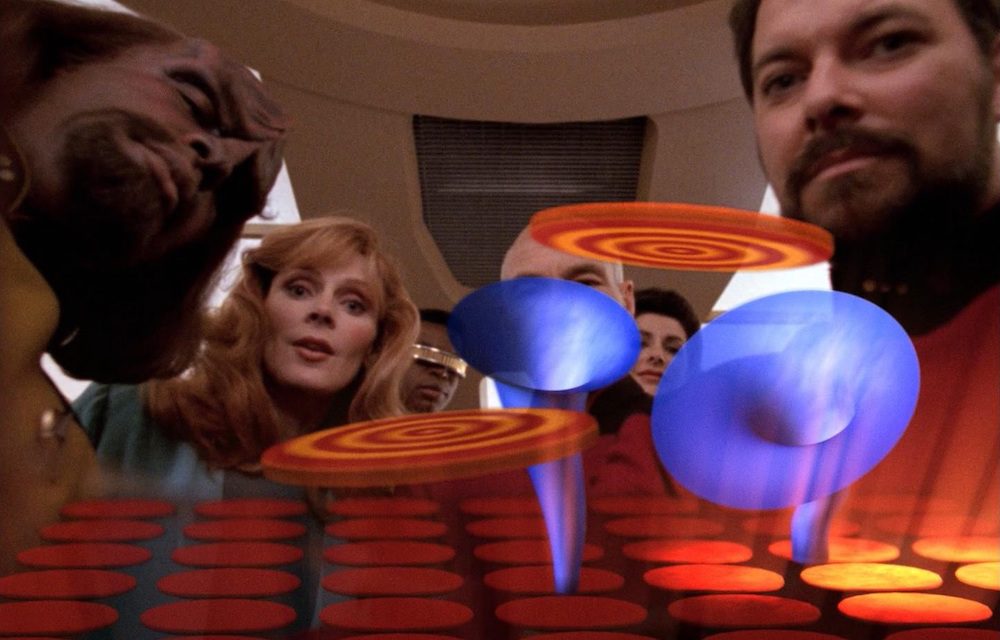
“The Game” seems to be a highly divisive episode that some fans enjoy but many others heartily loathe. I can understand both reactions. Apart from the teaser, and notwithstanding some gradually snowballing suspension of disbelief issues that only really become problematic later on, the entire first half of the episode (and then some) is thoroughly charming and enjoyable! But it’s all built on wildly dubious foundations, and by the final third or so of the running time, it has added up to something that most viewers (myself included) simply can’t take at all seriously. That said, I also feel like many of those who hate “The Game” fault it at least as much for bringing Wesley Crusher back as for any of what I would regard as its genuine weaknesses. As I’ve said before, I do not remotely count myself among the Wesley-haters within TNG fandom, even though I do have a beef with how the character was sometimes used in the show’s early seasons. Of course, some people see “The Game” as a return to those exact bad old days of Wesley saving the day…and they’re not entirely wrong, in my view. But they’re not entirely right, either. It’s complicated!
There is a wonderful “slice of life” quality to the first half or so of the episode that very much endears it to me. The Enterprise is gearing up for a survey mission in a relatively unexplored area of space, which has the ship’s sciencey types all geeking out, everyone’s inner explorer jazzed, and Riker and Geordi stressing over managing the logistics. There’s a perky, competent young ensign in engineering who is impressing her superiors and whom the episode seems to be positioning as a new recurring character. (We’ve actually seen her once before, playing a small role in “Darmok”; alas, we will never see her again.) Also, Wesley is back for a visit! And he seems a bit older, a bit “hipper” and more self-possessed, yet still as delightfully (and relatably) nerdy as ever! Other than a certain subset of the audience, everyone is happy to see him, and it feels like a family reunion, while at the same time the Enterprise as a whole feels like a real, living community. Riker, in between the moments in which he is all business, takes time to connect personally with some of his coworkers, mentioning this cool game that he discovered on Risa…but that remains somewhat in the background for a while. Wes reconnects with the captain in one delightful scene, and then before we know it he’s flirting with the aforementioned perky young ensign, whose evident attraction to his nerdiness played as heady wish fulfillment to viewers like me as a teenager. So far, what’s not to love?
Eventually, of course, we are presented with plenty of things not to love: The wildly implausible game that seems able to brainwash people impossibly quickly and easily. The notion that, in short order, absolutely everyone on board has been introduced to the game and has fallen under its spell…except, of course, for Wesley Crusher and Robin Lefler (well, and Data). The fact that, during his one-episode return visit to the ship and the show, Wesley ends up once again saving the day, and the fact that, in order for this to work, other characters have to behave in implausibly and insultingly stupid ways. But the thing is, the episode is just casual and underhanded enough in how it depicts all of this, and deft and confident enough in its portrayal of goings-on aboard the ship in general, that a viewer who has gotten swept up in the slice-of-life trappings and the budding Wesley/Robin romance can almost forgive a lot of these things, in the moment. Most of the characters’ initiations into the titular game happen off-screen, including (conveniently!) those of people like Picard and Worf, whom most fans (including me!) have a great deal of trouble imagining being talked into trying it. If you stop and think at all about this, you start having major qualms about the story—but if you don’t, it’s easy to be pulled along by identifying with Wes and Robin as they go from the delicious pleasure of feeling like they inhabit their own private little world together as two young people who are falling for each other, to the increasingly disturbing realization that they really are becoming isolated, amidst a ship full of creepily blissed-out game addicts who keep trying to push their weird game on the two of them.
There are a couple of things that I think the episode is going for here that, in my view, do “work” from a dramatic and thematic point of view, but unfortunately totally fall apart when evaluated for plausibility and character consistency. It’s not hard, as you watch, to buy into Wes and Robin being impervious to the “fad” of the game thanks to the accident of timing that has it blowing up all around them just as they are becoming absorbed (and thus distracted) with each other, and this works as a decent metaphor for how falling in love can feel. The problem is, it’s hard to believe that out of the thousand-plus people on the ship, they are the only ones who have anything sufficiently “distracting” going on in their lives at this moment to keep them from succumbing. Well, I mean, that, and also the thing that I already alluded to about it being nearly impossible to imagine certain characters succumbing at all, and the episode sidestepping this hurdle by asking us to believe that it has happened when we weren’t looking. The moment when Wesley leaves Picard’s ready room after bringing his concerns about the game to the captain, and Picard then proceeds to don his game headset as a sinister/dramatic musical cue swells cheesily, has always felt particularly like a cheat to me. Then, too, the episode is also kind of going for a theme along the lines of “once you’ve left home, you can never really go back.” Wesley is welcomed back warmly (after an initial fake-out prank that functions as foreshadowing for what’s to come), but before long, it becomes evident that things are not right; he’s no longer in sync with his Enterprise “family,” to the point of eventually finding himself hunted down by them! (Teleplay writer Brannon Braga has described his take on the story as “Wesley’s come home and his family’s out to get him.”) Again, there’s value in this on a thematic level…but the problem is that the episode has to cheat with the other characters in order to pull it off. The same holds, too, for my reaction to the “Wesley saves the ship again” issue: For the most part, he doesn’t do anything particularly hard to believe for who he is, and we don’t see other characters being overtly dumb so that he can outsmart them, but the whole thing rests on us believing that all the other characters have fallen under the sway of the game, and that’s just too big an ask. (Also, as a small nitpick: When Wesley and Robin discover the sabotage to Data, Wesley asserts that only Geordi and his mother know enough about the android to have been able to do this to him. But if that’s true…how it it that he has managed to figure out exactly what they did, and is then able to repair it?)
Still, the Wesley/Robin story is engaging and sweet (haters notwithstanding). How awesome is it that their date, which appeared to be going all right but not necessarily amazingly in Ten-Foward, really takes off when they decide to repair to a medical lab to subject the weird and vaguely sinister game that everyone seems to be obsessed with to scientific analysis like a couple of huge nerds? Not to mention the great line “Your neutrinos are drifting…” during their earlier, and equally adorable, “meet cute” scene? Both characters are just confident and self-aware enough to keep their scenes together from getting overly sappy or melodramatic, yet also plenty dorky enough to be wholly relatable. As commenter William B on Jammer’s review site discusses here, there is a heartwarming wholesomeness to their flirtation that starkly contrasts not only with the scene between Riker and the alien woman in the teaser (the latter of whom, by the way, is quite grating), but with the generally indulgent and self-involved behavior on display among the older characters in general throughout this episode. And yet, the Wesley we get here is not the naive adolescent whom we saw sweetly holding hands with Salia back in season two’s “The Dauphin,” either. Despite the episode’s significant flaws, its characterization of Wesley and the Wes/Robin relationship really works for me, and the various ways in which the two of them are contrasted with the increasingly messed-up goings-on around them represents sophisticated writing that plays with interesting thematic stuff, even though it doesn’t quite work in context since we as the audience are invested in the setting and characters that the episode is trying to use as a foil for the two of them.
That last point, in a nutshell, is the essential problem here: I find this episode extremely watchable, and I enjoy most of it quite a bit while I am watching it, but I just can’t suspend my disbelief enough, or overlook its swept-under-the-rug cheats with respect to characters like Picard and Worf enough, to fully accept it into my personal head-canon. At best, then, this ends up as one of those “not really to be taken seriously, but fun if you don’t think about it too much” episodes. Even its semblance of almost-working kind of disintegrates in the end, when the senior officers are on the point of handing the ship over to the anonymous aliens behind the game (and then going on to help them infiltrate the rest of Starfleet!) until Data strides onto the bridge and flashes a blinky light in their faces to restore them to their senses…and then everyone just sort of shrugs and moves on. Really? Okay, sure, whatever…except actually, kind of no. You know?
I don’t think it strains plausibility to imagine that Worf and Picard were indoctrinated into the game by force, though we’d kind of need to see that or have it implied. That might’ve worked for a throwaway scene afterward, where someone mentions they had to forcibly restrain Picard because he just resists having a good time so hard (from, say, Riker’s perspective), but at least they didn’t have to stun him like they’d had to stun Worf.
The idea that one’s entire personality can change in a specific and guided way with neuro-tech, though consistent with Trek precedent, strains credibility a bit, though I could maybe buy it if the adversary had enough resources for that kind of research—otherwise, wouldn’t this kind of thing happen all the time? Maybe the Romulans could have done it, though. Of course, the game also somehow taps into your pleasure center without a neural link of any kind, which is definitely strange.
The stuff with the Wesley/Robin relationship makes the episode appealing enough to me.