
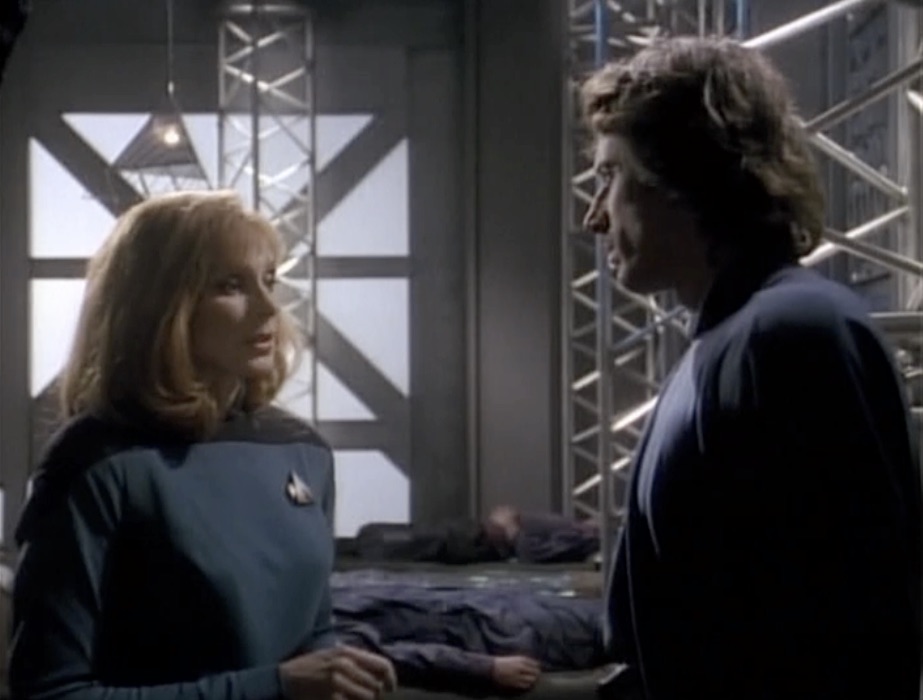
This episode, while not without merits, is both muddled and deeply problematic. It strikes me, too, as sort of the inverse of the previous episode, “The Hunted,” in some respects. Each episode features a “planet of the week” and revolves largely around a guest character who plays an adversarial role but is portrayed at least somewhat sympathetically. But whereas “The Hunted” depicts its society-of-the-week’s problem in a very black-and-white way and errs on the preachy side, “The High Ground” errs in the other direction. To its credit, it offers a reasonably nuanced and two-sided portrayal of a society in conflict, and raises meaty issues that have real-world relevance and also interrogate the show’s own premise somewhat. Unfortunately, the episode seems to have no idea what it actually wants to say about the issues that it raises, and it ultimately drops them in favor of an easy solution to the immediate crisis facing the Enterprise. There’s a fine line between the sophistication involved in acknowledging ambiguity and shades of grey, and the cowardice of being unwilling to commit to any particular point of view—and “The High Ground” lands on the wrong side of that line. Worse, its resolution has our “heroes” opting for a very objectionable course of action that is fraught with ramifications that the episode entirely fails to acknowledge.
Are the Ansata separatists an oppressed group at war with a tyrannical government (which is how they see themselves), or are they merely violent, dangerous criminals (which is how the Rutian government sees them)? Obviously, the episode doesn’t want to settle this question definitively; part of its point is that the answer is a matter of perspective. But failing to provide any background at all explaining either why the Ansata want independence, or why the government won’t grant it, doesn’t really work. The episode does a reasonable job of portraying both the police chief character and the terrorist leader as sympathetic and believably three-dimensional, and I appreciate that it avoids the pitfall of having Riker be really judgmental toward the former. But what it doesn’t do is have either character ever make a case for the rightness of their cause. As a result, it feels a bit like the episode wants us to see the conflict as complex and two-sided, yet stops short of developing the issues behind it enough to really make a case for this. (This problem becomes even worse when the Enterprise ends up siding unilaterally with the government against the Ansata in the end—on which, more later.)
There are two or three “big issues” with which this episode attempts to grapple. One concerns terrorism: Is it ever acceptable? Should it (as Data asks of Picard) be shunned despite its history of effectiveness, or can it be resorted to when all else fails? Additionally, the episode seems, at times, to want to poke a bit at the smug complacency of the Federation’s sometimes-preachy values, and (especially) the ethics of its relations with “non-aligned worlds.” Notably, these questions all speak to the hypocrisy exhibited by members of a privileged society (or an “ideal culture,” as Dr. Crusher puts it) when they glibly pass judgement on members of less privileged societies (a theme with plenty of real-world relevance). Unfortunately, the episode profoundly lacks the courage of its convictions in regard to these ideas. The terrorist leader, Finn, makes a pretty compelling argument to Dr. Crusher criticizing the Federation’s role in the conflict, and his criticisms go unanswered. Yet Picard, who would normally be sensitive to these kinds of issues and who tends to function as the moral voice of the show, seems entirely unsympathetic to Finn’s position. The captain also stops short of offering any kind of substantive answer to Data’s questions about the ethics of terrorism. I’m somewhat of two minds about the latter scene, honestly; it’s not that I wanted him to spout off some pat answer, but the way that he does respond comes across as a dodge. Also, both here and elsewhere, it’s often unclear whether what’s being discussed is violence of any kind, or terrorism specifically. Finn, in his provocative assertion that how history judges figures like himself depends merely on whether they win or lose, makes a strong point, but one that does (intentionally) blur any distinctions between waging a war and murdering innocent civilians. This same blurring seems less intentional, though, when Data talks about “the history of armed rebellion,” then equates this with terrorism. And for Picard to reply by disavowing (contra Mao Zedong) the view that “political power flows from the barrel of a gun” just strikes me as bizarre. Has he forgotten that he is the captain of a heavily armed starship, and that, in this role, he not infrequently finds himself resorting to violence, or at least the threat of it? I understand and applaud the fact that he dislikes violence, but his statement here just seems disconnected from reality. And when he proceeds to end his exchange with Data by essentially saying “Yep, the ethics of terrorism sure are thorny and confounding,” the impression given is of the writers simply shrugging and moving on. (Intriguingly, according to quotes that I came across on Memory Alpha, key members of the TNG writing staff criticized themselves over this episode later, precisely for having tackled the issue of terrorism without having anything to say about it.)
And of course, ultimately, it doesn’t end up mattering whether the Ansata terrorists’ cause is just or their tactics justified, because the Enterprise, due to its superior technology, is able to thwart their efforts and extricate itself from the conflict, thus preventing the ethical questions from leading anywhere dramatically. On top of that, after the episode has spent most of its time being even-handed to a fault regarding the conflict between the Rutian government and the Ansata, in the end the Enterprise gives up the location of the separatists’ base to the police and participates with them in a joint raid on it! They do this without any deliberation or apparent misgivings, yet also with no stated justification or even clear motives, beyond the obvious one of rescuing Picard and Crusher (which didn’t require cooperating with the Rutian government). That the episode fails to flesh out the conflict enough to even allow for much debate over which side is in the right is (as I’ve noted) somewhat disappointing—but for it to then, in the end, take a side anyway, goes well beyond “disappointing” and becomes extremely problematic. It entirely vindicates the negative view of the Federation voiced by Finn earlier, and it represents a sweeping under the rug of the issues that the episode has raised. Based on the rest of the episode, I don’t think the writers actually meant to send such a one-sided message here; it comes across, to me, more as obliviousness than as a deliberate show of support for the crushing of a separatist movement. If not for this perception, I would be even harder on the episode than I’m being. Still, at the very least, this ending cheats the complexity of the issues that it has set up by conveniently sidestepping them via a tech solution—and does so in a weirdly tone-deaf manner, to boot.
That just leaves me with a handful of minor points to mention. For one, the opening scene of this episode really doesn’t work for me. It tries to create conflict between Dr. Crusher and everyone else over her determination to render aid to the wounded after the bombing, but I just don’t buy the attitudes of the other characters. They’re Starfleet officers! Isn’t this sort of thing (rendering aid where needed, including in dangerous situations) kind of “what they do”? Second, I guess I would call myself lukewarm, on the whole, toward the separatists’ “dimensional transport” tech gimmick. It serves its plot purpose, but it feels a tad convenient and arbitrary (why does shifting between dimensions mess with your DNA, exactly?). Also, wasn’t the Ansata’s ploy to blow up the Enterprise a little…lacking? Geordi didn’t seem to find it too terribly difficult to remove the explosive and get rid of it in time! Third, I have to say that I found the story element of Finn’s weird attraction to Dr. Crusher—his abductee—on the creepy side. And finally, the scene at the end in which the doctor “talks down” the kid holding a gun on them via the dazzlingly persuasive three-word argument “No more killing!” is pretty cheesy. For starters, it would have helped if the kid had been an actual character with whom Crusher had been shown developing more of a relationship, rather than a glorified extra whom she did compliment once earlier on, yes, but who didn’t even have any speaking lines in the episode. But also, I find the moment unpleasantly reminiscent of some of the worst first season instances in which intractable conflicts get resolved amicably in the end via a brief speech from one of the regulars. I suppose that this scene represents the writers’ attempt to paste in an idea at the last minute, to make up for the ending’s copping out on the episode’s earlier ideas. Unsurprisingly, this does not work!
An extremely cogent analysis; had there been a clearer focus, this could have been a much better episode. But one thing that struck me reading your review is that another limitation of the episode was simply having the time to explore them. How much more interesting would it have been for the episode to have explored all these details in two hours? Which leads me to wonder how many TNG episodes could have been made into movies by fleshing out cultures in detail and really diving into them.
“Finn, in his provocative assertion that how history judges figures like himself depends merely on whether they win or lose, makes a strong point, but one that does (intentionally) blur any distinctions between waging a war and murdering innocent civilians.”
The real distinctions here, it seems to me, are 1) how well funded the combatants on each side are, and (relatedly) 2) how much of a grip do they have over media and the cultural constructs that define good and evil in the eyes of observers. In the conflict between Israel and Palestine, for instance, Israel is much more guilty of murdering of non-combatants—but because they have far more power than the group they oppress, they are able to manipulate the narrative in such a way that the Palestinians are perceived as the terrorists [cue spurious accusations of Anti-Semitism based on the conflation of a state with an ethnicity]. The same is true in conflicts between the US and other less powerful nations, of course.
The other factor is simply that when you have little power relative to your oppressor, you do not have the option of military engagement if you wish to be effective. Is there a distinction between waging a war and murdering innocent civilians? While the answer may be yes in a purely abstract sense, this distinction is pretty marginal in the real world given that many noncombatants are killed in conventional warfare, that soldiers are usually victims of oppression themselves, and war almost always boils down to conflict over resources.
Anyway, I entirely agree with your criticisms. In this episode, we don’t have enough context to say whether the rebels decided to overthrow the government because of legitimate oppression or not. One could argue a group of people who are upset enough to rise up in this way will very likely have a legitimate complaint, even if that complaint might be dangerously misdirected (which would mean their overall cause might still be extremely questionable). One might ask how the American south rebelled against the US to maintain slavery when most of the people living there arguably did not see a direct benefit from slavery. Where do you find soldiers willing to die to protect your right to own slaves? I would imagine these are people who got the short end of the stick economically and were sold a lie in the form of an identity in order to manipulate them into war.
All good points. I just wish the episode would have dug into them!