
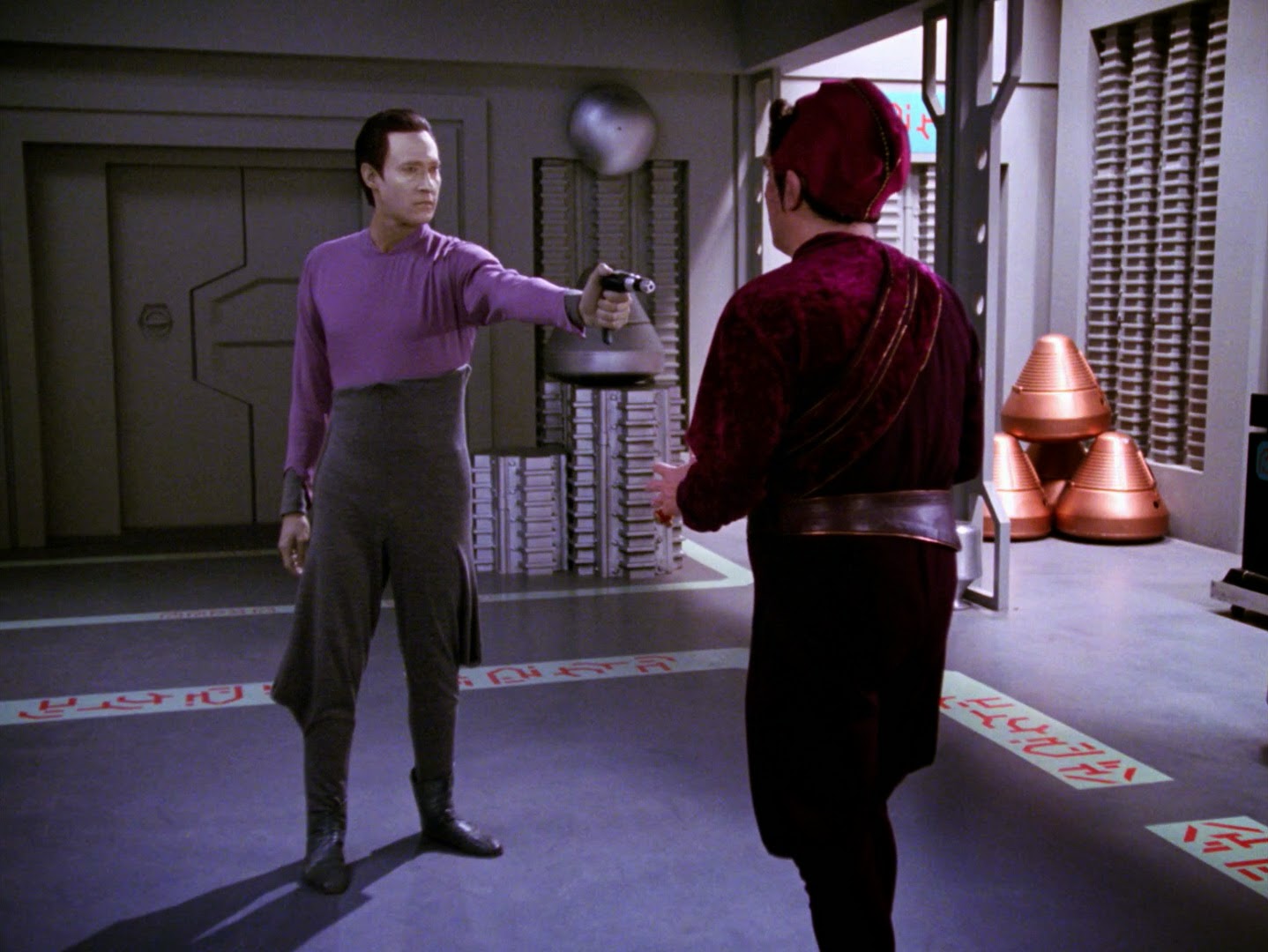
This is another gem of season three that I’ve always treasured, even if it is marred by one weird, inexplicable moment near the end. TNG rarely went wrong (past season two, anyway) with Data-centric episodes, and watching Data respond to being abducted by a quirky, amoral “collector of rare objects” is fun in all the ways that watching Data is usually fun. Meanwhile, seeing his shipmates react to his apparent death proves nicely affecting.
Episodes featuring the apparent death of a character can often be less than stellar, especially when it’s a character we pretty much know the writers aren’t really going to kill off. But by playing the Enterprise side of the story completely transparently (i.e., not trying to tease the audience into thinking that Data is really dead), this episode frees itself to use the others’ grief as a vehicle for revealing character and exploring Data’s connections to his shipmates, rather than either deploying it to manipulate us or just throwing it in sort of perfunctorily. For Geordi and Wesley to assume the task of going through Data’s things feels exactly right, and for that scene to be packed with delightful callbacks to previous episodes is even better. Then, too, the writers don’t forget the fact that the Enterprise‘s bridge officers have lost one of their own before; Tasha Yar comes up not once but twice, and the small beat of putting Worf in the position of “replacing” a deceased colleague for the second time is a nice touch that I would not have expected of the show. I enjoy, too, how Michael Dorn plays Worf’s expected impatience with Troi’s “let’s talk about your feeligs” overture, yet still lets it slip in the end that he is affected and even appreciates her concern. (On a tangent, there’s also something weirdly touching about the fact that, right after Data’s shuttle explodes, it is Worf who immediately vocalizes the shock and loss that everyone on the bridge is feeling.) Even the simple but adequate detective work via which they eventually realize what happened (with the first clue arising, as it ought, not from anything technobabblish, but from Geordi recognizing an omission in the communications record that would be out of character for Data) is effective. In short, I love pretty much every moment the episode gives us of the other regulars reacting to Data’s apparent demise (I’m having to exercise restraint here to avoid listing all of them). This part of the story is perfectly summed up by the epitaph that the captain finds for Data in his tome of Shakespeare: “He was a man, take him for all in all. I shall not look upon his like again.”
The other half of the story, as usual, draws on Data’s uniqueness to offer up an unusual take on an abduction story. Kivas Fajo is a fun and memorable guest character—quirky, dangerous, amoral, clever, and just a little bit delusional, yet somehow charismatic in spite of his awfulness—but even more fun is how Data, being Data, is not intimidated, irritated, enraged, creeped out, perversely flattered, or any of the other things that a normal person might be by him, given the situation. He calls Fajo on the latter’s bullshit, pursues his goal of trying to extricate himself from the situation calmly and methodically, and even credits his abductor as “a fine debater.” When he is unable to reason with Fajo, he tries force; when that fails, he looks for an in with Fajo’s underling (his “It appears…he has us both” is satisfyingly sharp). He even employs passive resistance tactics in an effort to make Fajo’s possession of him unrewarding! Woven in among all of this, though, is a thread about Data’s “fundamental respect for all living beings,” and the question of under what circumstances he might act against this value by taking a life. For the most part, this works. Fajo, of course, uses it as a weapon against Data, getting the android to comply with his wishes via threats to kill his underling and then, later, trying to convince Data that shooting him would be unethical. When Data ignores this and makes the decision to kill Fajo, I find it both believable and justified. What I can’t quite fathom, though, is what the writers were thinking in having him then lie to Commander Riker about it after being beamed back to the Enterprise. What the hell is that supposed to be about? Data has no reason to lie here, and it would be wildly out of character for him to do so for self-interested reasons even if there had been any! This moment just seems bizarre to me, and represents a lamentable stumble near the end of an otherwise pretty great episode.
I guess, also, I have to say that even though I have always loved the final scene of this episode, there’s an argument to be made that it doesn’t entirely fit. I’m referring to the scene in which Data visits Fajo in the Enterprise‘s brig. Fajo observes ruefully that their abductor and abductee roles have been reversed, and Data informs him that his collection of unique stolen artifacts has been confiscated. Fajo vents bitterly about how satisfying these turns of events must be for Data, but of course, the latter responds by reminding him that he does not feel pleasure, being “only an android.” The scene pairs with an earlier one in which Fajo needles Data about how he’s not going to pull the trigger, both because he’s programmed to respect life and because, being “only an android,” he can’t draw upon his rage to fuel such an action, the way a normal person might. So it works on that level, and I always enjoy moments like this one where others, despite knowing better, expect an emotional response from Data, but what they are really doing is projecting their own emotions onto him (which, as an emotional being, I find utterly relatable). Here, Fajo is looking for the validation of knowing that Data relishes having the upper hand just as much as he did, and enjoys seeing his persecutor suffer just as he himself would—but of course, he cannot get this satisfaction from Data. So, as I said, I’ve always enjoyed the scene. Still, I can’t help but to feel, on rewatching, that it seems a bit “tacked on” at the end of an episode that has mostly been about other things. Fajo is not Bruce Maddox, and his verbal sparring with Data throughout the episode has not really been about the former belittling the latter as “only an android” (apart from that one scene when Data is pointing a disruptor at him). I suppose that, in a broader sense, Fajo’s treatment of Data implies defining him as a “thing” rather than as a person, but I’m still not sure that the episode really earns its final scene, as much as I do like it.
One final thought: If you squint, you can almost make out a mostly subtextual theme about the emptiness of materialism in this episode (whose title, after all, does reference an expression that pokes fun at mindless acquisition of stuff). Fajo, obviously, is a textbook case of someone whose life revolves around trying to amass the coolest possible collection of unique “toys,” but who has no meaningful connections to other people (he casually murders his most trusted underling, after all). Was the scene in which Geordi and Wes go through Data’s few worldly possessions—every one of which is imbued with personal meaning, and most of which symbolize his relationships with his shipmates—intended, in part, to underline the contrast between Data and Fajo? Data’s treasures are few and he doesn’t even have human-like emotions, but his life is still immeasurably richer than Fajo’s? It’s a bit underdeveloped (and in fact, if there were a bit more “there” there, this might even have helped to fit that final scene into the overall themes of the episode), but I do think this is at least present (and intentionally so) in the episode—which is to its credit.
I like and agree with your thoughts. I definitely think there’s an anti-materialism theme here that isn’t adequately developed… might’ve cracked five stars if it had!