
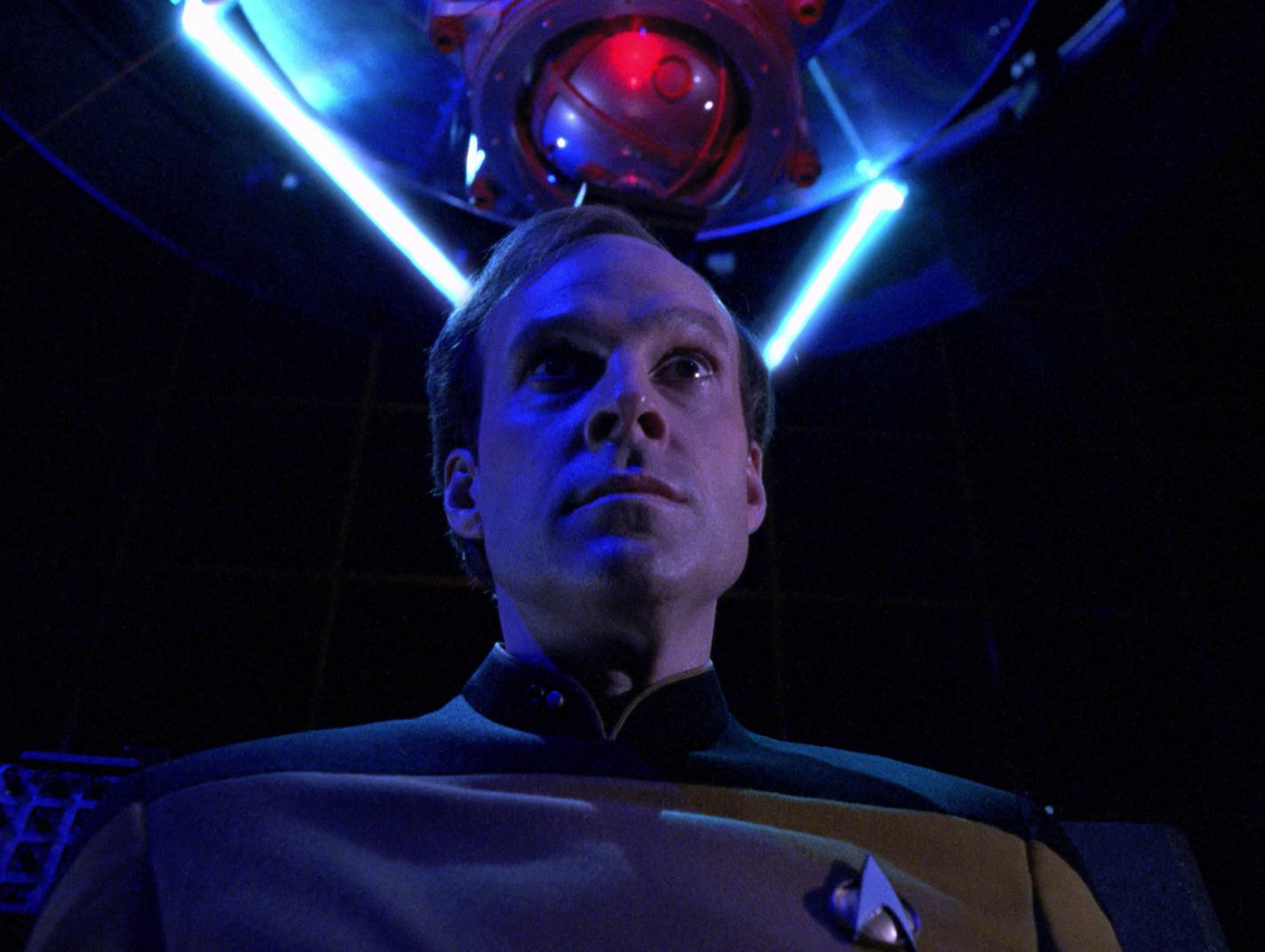
As much as I like Lieutenant Barclay, I’ve always found “The Nth Degree” to be a mostly disappointing follow-up to “Hollow Pursuits.” (Oddly, I seem to be somewhat at odds with much of the fandom on this; apparently, this is actually a pretty popular episode.) I appreciate the opening and closing scenes of this episode, but most of what happens in between does relatively little for me. What I wanted from a second Barclay episode was more Barclay—a glimpse of who this guy became, and how he was doing, down the road from his difficult adjustment to life aboard the Enterprise in his first appearance. Instead, we got a story about him being “reprogrammed” by advanced alien technology, so that for most of the episode, he isn’t really Reginald Barclay in any meaningful sense. To me, this was a distinct letdown.
The episode does open promisingly, however. I like the symbolism of Barclay playing Cyrano de Bergerac, and talking about how he feels more comfortable acting out the role of someone else than trying to be himself. I like the fact that he and Counselor Troi explicitly compare and contrast this with his previous crutch of disappearing into holodeck fantasies. I really like the fact that even though Barclay seems to have become, more or less, “one of the gang,” we see that he is still struggling…and that he’s a lousy actor! I love how he reluctantly accepts Troi’s praise and admits that he has, indeed, made a lot of progress, and yet he still feels stuck, and is kind of despondent about it. He’s coping, he’s socializing, he’s accepted, but he has no doubt imagined that this sort of progress would confer a confidence and ease that still elude him. In short, he’s facing the reality that a journey of personal growth can be a long, uncomfortable slog, even when it’s going well. How awesome is it to see TNG depicting that? This—this is what I wanted from a Barclay follow-up episode.
Unfortunately, it doesn’t last. Pretty soon, an alien probe rewires Reg’s brain and makes him hyper-intelligent, and…you know, even though I’m not really that enamored of this concept, it still could have been okay. I would just have needed to feel like despite the changes, he was in some sense still Barclay. If the episode had been about the Reginald Barclay that we know, trying to adjust to suddenly being hyper-intelligent, that might have been interesting (albeit still not exactly the story that I would have preferred). Instead, though, the following three things happen: First, as nearly always seems to happen in stories that involve someone being transformed or getting a superpower, Reg displays zero self-awareness and almost immediately stops acting recognizably like himself. (From a plot point of view, this may be justifiable given that we eventually learn that the probe actually “programmed” his brain to do what he does; from a storytelling point of view, though, it’s deeply disappointing.) Second, the story (accordingly) shifts from being about Barclay to being about the other characters trying to figure out what to do about Barclay having merged himself with the ship’s computer and taken over. And third, they fail in their efforts to deal with this situation, but it ultimately doesn’t matter, because it turns out that the aliens behind the probe are benevolent and simply want to engage in a cultural exchange. In other words, this ends up being another entry on the list of episodes in which there are no stakes, and sort of no real story, because the crisis resolves itself without requiring any cleverness or hard choices from any of the characters. Again: disappointing.
On the other hand, as soon as Barclay is once again Barclay, we get a closing scene that not only is enjoyable, but even takes a stab at imparting some relevance to the story as a whole. Barclay laments that, whatever happens to him, in the end he always remains (in Geordi’s words) “just plain old Barclay” (connecting back to his feelings in the opening scene). But Counselor Troi and Geordi offer him some wisdom that really resonates for me. “Almost everyone has a moment in their lives when they exceed their own limits—achieve what seems to be impossible,” Troi suggests. But what do you do afterwards, when the reality of your being a mere mortal reasserts itself? Can you find a way to “carry something of that experience through the rest of your life”? Personal growth always happens in fits and starts, and it’s important not to mistake the slow, frustrating struggle that separates those big moments for stagnation or regression. It’s a wonderful sentiment, and one that, even as I write this, I’m feeling like I can learn something from…so, bravo! And yet, it doesn’t really elevate the episode as a whole very much. The bulk of it has still been squandered on a story that has been neither particularly interesting, nor even about Barclay, per se…and also, despite Troi’s words, one is left with the distinct (and accurate) impression that, in fact, Barclay’s experiences here will have no lasting impact on him whatsoever.
Some smaller points: In the plus column, this episode introduces the running theme of Dr. Crusher running a sort of theater group aboard the ship, which was a nice idea and a rare gesture in the direction of giving the character something interesting to do. In the minus column, the episode resorts to some fairly contrived maneuvering in order to make its plot happen, with Geordi and Barclay going out in a shuttle to scan the alien probe, because…why, exactly? And finally, on a more ambiguous note, I’m not quite sure what to make of the fact that “regular” Barclay seems to have gotten over the worst of his infatuation with Troi, and is now able to interact with her in a normal way (which I like)…but super-confident, hyper-intelligent Barclay regresses to making inappropriate passes at her. That’s…weird, right?
I enjoy this episode more than three stars for wacky sci fi reasons, though even the wacky sci fi plot has a rather dull ending. I suppose I have a weakness for episodes where the crew take over the ship. Still, with the character mistakes it makes, I agree it doesn’t rise past three stars. In the vein of inappropriate passes… I presume you mean it’s inappropriate because she’s his counselor, right? Otherwise it would be fine? I seem to remember that this is this episode that Troi describes his “pass” as being “a good one,” as in, a competently executed.
Because she’s his counselor, yes…and because, however competently executed, it was still basically unwelcome, and he knew this (or ought to have) before he did it.