
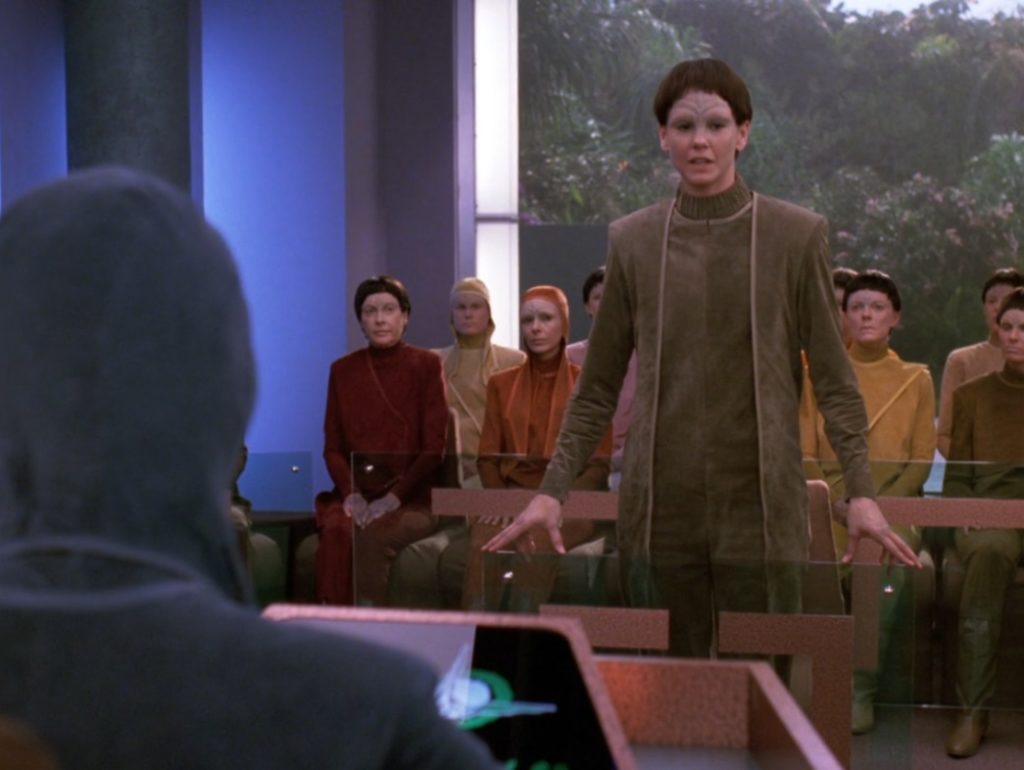
This episode, I think, is widely regarded as having been well-intentioned but fundamentally flawed. I remember thinking of it in that way myself, once upon a time. Looking back on it several decades later, though, its flaws appear more egregious than ever, and its good intentions correspondingly more difficult to credit. I would describe it as ill-conceived to the point of being fairly offensive on multiple levels, and rather dull to boot. The phrase that is coming to mind here, alas, is: Jeri Taylor strikes again.
The most frequent criticism leveled at “The Outcast,” of course, is that it profoundly lacks the courage of its putative convictions. This was TNG trying to do a gay rights allegory, despite being a show that had never once, in five and a half years (to date), given the slightest indication that gay people even exist in the 24th century. Producer Michael Piller would later say that the writers “didn’t want to just blow off the issue by showing a same-sex couple holding hands in the corner,” not seeming to understand the normalizing potential of showing gay characters in the background without making a fuss about it—or, even more importantly, the fact that the show could have both done that and made an episode that dealt explicitly with the issue. Granted, homosexuality was still much more “controversial” in the early ’90s than it is now, but representations of it in popular culture did exist, and by shying away from acknowledging it in a straightforward way, Trek fell lamentably short of pointing the way to any kind of more inclusive future here. You can’t effectively advocate for the rights of a contemporary real-world persecuted group via allegory while at the same time acting as though your quasi-utopian future society includes zero members of that group. Also, the episode misses a pretty obvious opportunity, even working within its allegorical approach, by having the androgynous character with whom Riker becomes romantically involved played by a female actor. Frakes himself apparently voiced the opinion that it would have been much more powerful to have cast a male actor in the role, and kudos to him for saying so.
Just as problematic, though, is this episode’s deeply regressive and oblivious portrayal of gender. First, are we really to believe that the Federation has never before encountered an alien race with any kind of gender structure other than a male/female binary arrangement? It’s one thing for the show to usually (always) depict aliens in this way (both as a practical matter since they have to be portrayed by human actors, and as a storytelling convenience to keep its characters relatable to a human audience), but to explicitly establish that this really is virtually universal takes things too far, for me. I mean, even if (weirdly) almost every sapient race has two sexes…we’re supposed to accept that they almost all have gender roles that are similar to “ours” as well!? This episode seems to suggest both of these things. To begin with, the J’naii lacking gender strikes our characters as so unusual that Picard feels compelled to mention it in his episode-opening log entry, despite its total irrelevance to the entry’s actual topic. Second, Riker struggles to wrap his brain around the very idea of not having sexes or gender roles as he understands them. He also has no idea what pronoun to use in referring to J’naii individuals. Really? This all also, of course, implies a crazy level of gender essentialism amongst 24th-century humans, and seemingly means that being transgender or non-binary is not a thing in Trek’s future any more than being gay is. (Again, obviously these are issues that American culture had not come to terms with in 1992 to nearly the extent that it has done more recently, but still—transgender people did exist in the ’80s and early ’90s, and the writers could have actually done their homework here if they were going to portray a non-gendered people, and done so in a way that at least implied that the concept isn’t mind-blowingly unheard of to the average 24th-century human.) Even as a teenager watching this episode when it originally aired in 1992, I found Riker’s statement to Soren that “most people” believe men and women to differ from each other in emotional ways frustrating and disappointing (I didn’t believe this!), and Crusher’s comments about men pretending not to care about their appearance deeply un-funny. And then…what in god’s name is up with Worf’s sudden burst of blatant misogyny during the poker scene!? Women are weak!? Worf has never shown this kind of thinking before (and indeed, has explicitly expressed a contrary point of view more than once)! And while Crusher does object to this sexist bullshit, she does so in a way that strikes me as ridiculously calm and understated even for the late twentieth century, much less the twenty-fourth. What the hell, Jeri Taylor!?
Also… So, the episode’s analogy to homophobia and anti-gay discrimination is presented in the form of a non-gendered people among whom a minority do adopt a gender identity, and are persecuted for it. But…what does “being female” mean to someone like Soren? Gender is a social construct that this society lacks! There are no gendered conventions among the J’naii about how one dresses, or presents oneself, or emotes, or interacts with others, etc. The episode does establish that the J’naii had sexes and genders once upon a time, so I suppose one could hypothesize that their gendered “deviants” are drawing from ancient and otherwise obsolete patterns of gendered behavior…except that Soren spends the first half of the episode asking all kinds of questions about gender and generally acting like it’s as novel a concept to her as its absence is to Riker. She can only tentatively even discern the sex/gender of the humans with whom she interacts. So, again: of what does her socially censured femaleness consist? What exactly are these “feelings” and “urges” that she claims to have? In our (modern, real-world) culture, being trans or non-binary means choosing for oneself from (or rejecting altogether) an existing menu of social and behavioral conventions in a way that happens to run counter to mainstream/conventional norms—but being a gendered J’naii couldn’t work that way, because “male” and “female” have no conventional or cultural meanings for them. Thus, the only way to buy into this episode’s premise is (again) to assume an extreme kind of gender essentialism, according to which maleness and femaleness have some kind of inherent, objective existence and meaning independent of both biology and culture. I utterly reject this.
Based on what we see in the episode, the apparent meaning of Soren’s being female is simply that she’s attracted to Riker, which itself raises a number of questions and issues. First, how does her femaleness manifest ordinarily, when she’s not interacting with off-worlders? I mean, yes, there are J’naii who secretly identify as male, too, but…do they look any different from non-gendered J’naii? And how can Soren determine that she’s attracted to men, given that she can barely even distinguish men from women? Also…for an episode that’s trying to convey support for gay rights, isn’t it kind of messed up to be essentially defining femaleness around sexual attraction to men? And finally: Of what, exactly, does the J’naii prohibition against being gendered normally consist? Is it just about how gendered J’naii conceive of themselves in their own minds?? Or does it really just amount to a prohibition of sexual liaisons with off-worlders who have gender?
On top of all of this, “The Outcast” is also replete with the more ordinary kinds of faults characteristic of a deeply mediocre TNG episode. Its background plot is among the dullest of any that the show has ever given us, for instance. And the choice to make Riker the focal main character makes very little sense with regard to either plot or characterization. Why is he, and not someone with scientific expertise, the officer assigned to work closely with Soren in studying the pocket of “null space”? And why did the writers choose him, of all people, as the character to fall into a romantic relationship with an androgynous alien? Wouldn’t someone a bit less…I don’t know…conventionally and relentlessly heterosexual, be more believable? (That scene where Soren asks him “what kind of woman” he’s attracted to, and he disingenuously responds with a list of traits that conspicuously omits any physical descriptors? Yeah, I might believe that of Geordi, or even Picard…but Riker?) And then, in the episode’s later scenes, we’re even expected to believe that Riker is super-serious about this implausible relationship, to the point of saying “I love you” and being willing to risk his entire career over it (things that we haven’t seen happen in any of the other half-baked romances that TNG has served us up to date)? Yeah, bullshit. Throw in a super-rushed ending wherein Soren’s personality is rewritten via forced “therapy” in the space of, seemingly, a few hours, and Riker pretty much shrugs and moves on with his life, and you get a story that just completely fails to work, from start to finish.
I thought, at the outset, that I was going to give this episode two stars. I mean, there are episodes that are painful to watch in ways that substantial portions of this one aren’t. But having put words to my thoughts and reactions, I realize that theoretical good intentions are virtually all this crappisode has going for it. Jeri Taylor, who never encountered an “issue” that she couldn’t dumb down and present in a cartoonishly stupid way, apparently wanted to endorse gay rights without bothering to think even remotely critically about sex or gender, much less craft anything resembling a compelling story, and figured that an incoherent sci-fi allegory plus a big impassioned speech near the end of the episode would be enough to make a profound statement. She succeeded, I understand, in riling up the religious right in 1992, but she certainly didn’t push anyone else (least of all herself) to question any unexamined assumptions—nor did she manage to produce a particularly entertaining hour of television.
Boom! Savage.
I read it again. God damn! Down goes Taylor!