
The second in a series of early-second-season episodes with a character focus on Data, this is not one of the better such (but neither is it the worst). Its two essentially separate plots—the one concerning the eponymous Okona and the one about Data trying to grasp humor—contrast each other in that one is fairly skillfully executed but rather pointless, whereas the other attempts something laudable and interesting, but stumbles in the execution.
The Okona story strikes me as an essentially first-season-esque story idea that nevertheless differs markedly from anything that was actually seen during the first season by virtue of being executed about fifty times more skillfully. Its biggest flaw is its lack of any particular point (although the involvement of Wesley with Okona does at least try, somewhat minimally, to lend it some relevance); it’s basically another story that revolves entirely around a guest character, and that, once again, resolves itself with little input from the regular characters. On the bright side, though, Okona—despite being a bit over the top—actually manages to be a reasonably likable character, and one who even keeps the audience guessing a bit. Introduce a “lovable rogue” (by the way, Troi “reading” him at the beginning and explicitly defining him as a “rogue” for the audience was totally unnecessary) who “plays by his own rules” and compulsively flirts with every woman he encounters, and it’s pretty clear that past deeds are going to catch up with him in some way while he’s aboard the Enterprise—but the fact that, in the end, he actually does turn out to be a good guy (one who’s sort of been using his seedy reputation as a shield to protect some people whom he’s disinterestedly trying to help) is a pleasantly refreshing twist. Also, although the rival “wronged” individuals demanding custody of him are pretty one-note in a way that’s reminiscent of (though not actually nearly as bad as) the intolerable characters in first season’s “Symbiosis,” the fact that the episode treats them as petty annoyances and plays their conflict for laughs, rather than taking them seriously and pretending that they represent dramatic tension or an interesting conflict, goes a long way toward rendering them tolerable (though even so, they do start to grate a little by the end). On the whole, then, my basic assessment of this storyline is that there’s nothing major really wrong with it except for its lack of any particular point.
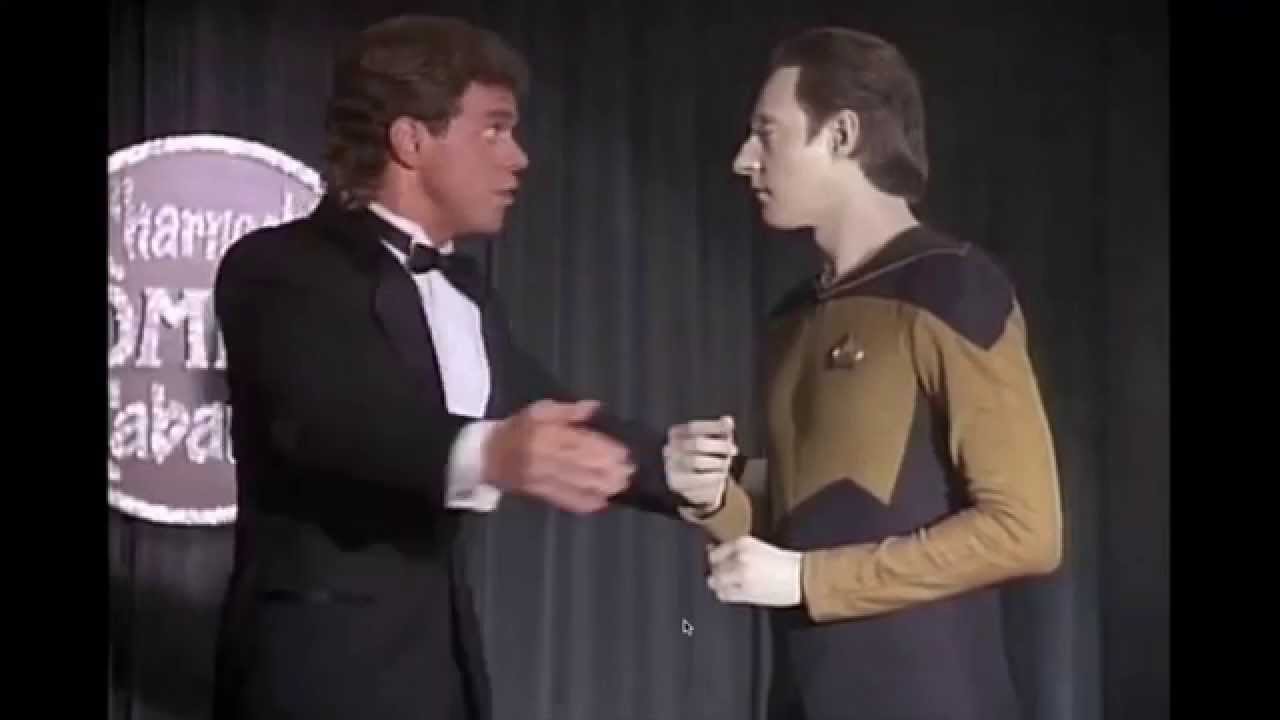
The Data storyline, on the other hand, kicks off in earnest Data’s central character arc about exploring humanity and trying to become more human—thematic material that’s dear to my heart. Data’s quest to become more human was first established in the pilot and has been referenced frequently since, but this is the first episode to really try to do anything in depth with it. Also, even though—astonishingly—there still hasn’t been any explicit statement of the premise that Data lacks emotions (I never realized that the series had gone on for so long without establishing this explicitly!), this episode at least implies it pretty strongly via Data’s inability to grasp humor, as well as through his comments about not experiencing sexual attraction and whatnot. Arguably, too, his overall demeanor since the beginning of the season has pretty effectively conveyed the concept. But in any case, this episode’s portrayal of Data trying to wrap his brain around humor is well-intentioned in the extreme, but riddled with problems in the execution (though the fundamental portrayal of Data in the episode is, in itself, near-perfect). One of the main problems is that the episode essentially “cheats” in its demonstration of how humor-impervious Data is, by relying almost entirely on atrociously un-funny jokes. Guinan’s “droid vs. ‘noid” bomb, for instance—which the episode, via Guinan, goes out of its way to assure us is really supposed to be funny—is just plain dumb. And of course, none of the material that the holodeck comic gives to Data is any funnier than “Why did the chicken cross the road?” (though I confess that I would very much like to hear the rest of the joke that Data starts to tell about “a monk, a clone, and a Ferengi”). Data hamming it up in imitation of the comic, and delivering his abominable material in the hope of sending others into hysterics, is funny (Brent Spiner is a god), but the whole concept would work much better if he were actually doing what Guinan claims that he’s doing: ruining good jokes via his clueless delivery. Then, too, when Data inadvertently amuses Guinan with his “my timing is digital” line (which is, indeed, a good line), Guinan (and the episode) cops out by refusing to try to explain to him why it’s funny. Overall, in fact, I’m distinctly unimpressed by Guinan’s contributions in this episode. Also, I think the Data story suffers a bit from never quite making up its mind whether it wants to be about Data trying to understand humor or about Data trying to be funny—two things that are not at all the same.
With all of that said, the scene at the end where Data tells jokes in front of a holodeck audience that laughs at everything he does or says has some merit. It is, again, a little cheap (why exactly was the audience programmed in this lame way?), but when Data realizes what is going on and discontinues the program, I feel for him, despite knowing that he doesn’t “feel” himself—and that’s precisely where you want a Data story of this kind to take you. Data himself rebounds in a flash, of course, wanting to reprogram the audience and keep trying. This is exactly how he should react, and I choose to believe that he later does precisely that, despite Guinan’s discouragement. And when Guinan tries to “console” him by assuring him that involvement in humor is not the only path to experiencing what it is to be human, Data’s response—that there is “nothing more uniquely human”—rings true to me as a thing for him to say, and deepens the story in a way that moves me. This particular effort of Data’s to “grow beyond his programming” (to borrow verbiage from later episodes) ends in failure, but the ongoing attempt is what makes the character so interesting and compelling.