
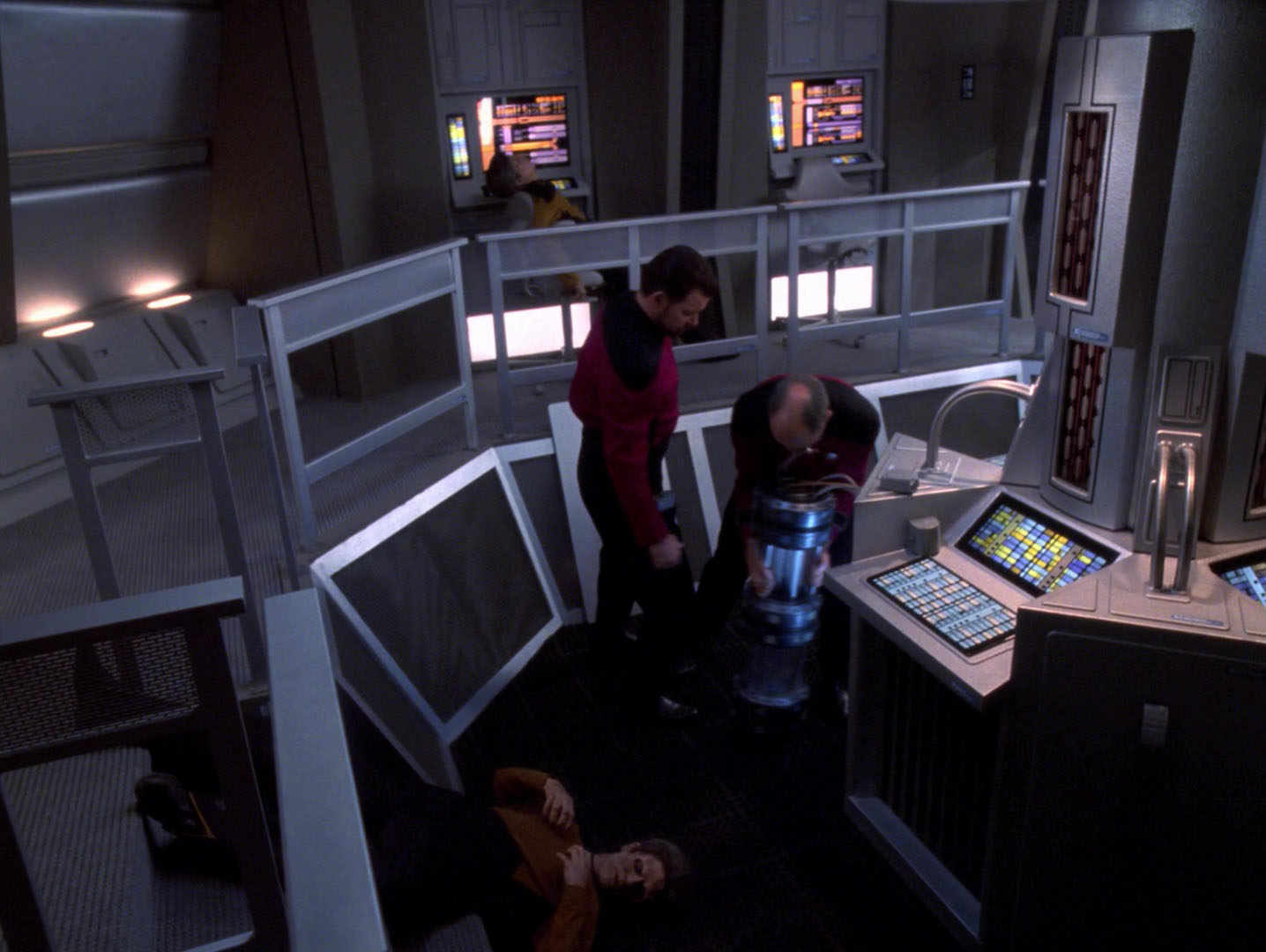
“The Pegasus” is easily the best episode of the first half of season seven. I’ve always remembered the one-two punch of “Parallels” and “The Pegasus” as a mid-seventh-season high point, but where the former is charming and fun, this one is (finally!) a serious, meaty piece of work. I’m giving both episodes the same star rating, but “The Pegasus” is the kind of Trek that I truly love. (These two episodes also serve as paradigmatic examples of the differing signature styles of their respective writers, Brannon Braga and Ron Moore.) With this episode, Moore delivers a Riker character study that calls back to a defining moment from “Encounter at Farpoint” that went on to become a recurring aspect of the Picard-Riker relationship throughout the show, and adds additional background that contextualizes it in a new way. As such, I consider “The Pegasus” to be not just another episode, but a key piece of the whole that is TNG.
When TNG’s pilot episode established the RIker-back-story incident of him having refused to let his previous captain beam down in a dangerous situation, it did so at least as much for world-building purposes as for character development; the new incarnation of Trek was announcing its intention to grow beyond the implausibility of having the captain lead every away team, as Kirk had done in the original series. But by having Picard grill RIker about this in the pilot, testing his new first officer’s mettle, the show also used it to lay groundwork for the mutual respect and working relationship that the two officers would develop. With “The Pegasus,” six and a half seasons later, Moore (who, of course, was not involved with the show when the pilot was made) goes a step further, establishing that in fact, it was this incident from Riker’s service record that prompted Picard to select him as his first officer in the first place. It makes perfect sense and fits nicely with the character that Picard became as the series matured, but prior to this episode, one could just as plausibly have interpreted that scene in the pilot differently. We didn’t even know for sure that Picard had chosen Riker, for one thing. Was he unsure about this pig-headed officer who had clashed with his previous captain? I mean, it’s clear enough in the “Farpoint” scene that when he asks if Riker intends to back down from his position, the latter’s “no” was the answer that the captain was looking for—but still, we didn’t know just how much importance our captain had attached to having a first officer with the courage to stand up to him, and one who would prioritize his own sense of the right over the kind of loyalty that produces blind obedience. So, this is a great little addition to the back story. But of course, that’s just scratching the surface, because we are learning about it in the context of a story in which RIker must confront the fallout from a still earlier incident in which he did not show the same kind of strength and integrity. It’s not hard to make the inference that the incident aboard the Pegasus, and Riker’s regrets about how he handled it, informed his later handling of the famous incident with the captain of the Hood. In other words, it played a significant role both in making him the officer that he became and in landing him his job as first officer of the Enterprise. (At the end of “The Pegasus” when Picard credits Riker with having made the right decision when push came to shove, part of me wishes that he would go a step further and point out that, in fact, long before this, Riker had taken the trouble to learn from the mistakes that he made in the original Pegasus incident, and that it had made him a better officer.)
This episode, of course, is not the first in which another superior officer has been rather less impressed than Picard is with this authority-questioning aspect of Riker’s character. One is, for example, immediately reminded of Captain Jellico’s negative appraisal of RIker in “Chain of Command.” What’s cool here, though, is how deftly the various contrasts, parallels, and conflicted loyalties are set up. Obviously, we have the basic contrast between Pressman valuing the kind of blind loyalty that the young Riker exhibited versus Picard valuing the kind of officer Riker later became, who has the courage to stand up to authority when he thinks it necessary. But for much of this episode, Picard finds himself in the ironic position of wanting Riker’s loyalty (when he questions him about the past and Riker tells him that he’s not at liberty to divulge the information he seeks), but having to settle for trusting him to do the right thing while Picard himself remains in the dark. Riker, meanwhile, is weighing various competing claims on his loyalty, duty, and conscience in a way that, for example, “Chain of Command” did not ask of him. In that episode, he gets to be subversive of authority in a way that doesn’t really challenge him; here, he has to wrestle with difficult decisions in a way that is dramatic and yields character growth. We’ve had a number of Riker episodes that have dealt with him holding back from accepting a command of his own; was he, all this time, holding on to a degree of guilt and self-doubt stemming from his actions in the Pegasus incident, and was this informing his reluctance to take the next step? And if so, do the events of this episode represent him confronting and finally putting to rest the younger version of himself that truly wasn’t ready for command? (I would like it if the episode, or at least the show in subsequent episodes, had explicitly acknowledged this in some way—say, by actually having him pursue a career “next step.” To some extent, this is the same issue that I already discussed at some length in my review of “Second Chances.” Still, this episode does imply actual growth and forward movement more clearly than previous Riker episodes have, and I appreciate that about it.) Also, as something of an aside, I really like the scene in which Riker vents to Crusher about about the injury that he sustained while sparring with Worf. First of all…of course he dealt with the stress that he’s under by sparring with Worf (!). Second, I appreciate that the episode doesn’t overly belabor this beat by actually showing us the sparring session; just hearing about it from Riker was enough to make the point that the writers sought to make. But most of all, RIker’s overblown anger at himself, and his “I knew what I was supposed to do and I didn’t do it,” are just so in character; it’s obviously about his behavior years ago on the Pegasus more than about his slip-up just now in the sparring session, but when he says the words, is he conscious of that fact? He’s Commander William “sublimated anger” Riker, so who knows?
Okay, so, all that and I haven’t even addressed the “plot” part of the episode, about a phased cloak experiment gone wrong and a salvage operation under the noses of the Romulans and a Mad Admiral and the Treaty of Algeron. There’s both good and bad in this material. Establishing that the Federation’s lack of cloaking technology stems from a treaty obligation is an interesting piece of world-building, and on the whole I like it; it’s nice to finally have an in-universe explanation for what is, in actuality, a stylistic and storytelling choice on the part of the show’s creators. I’m a bit less enthused about the “yet another Mad Admiral” aspect of the episode, but…well, whatcha gonna do? It’s an overused trope, but you can also understand why the writers were so frequently tempted to employ it. Also, when Riker reveals the existence of the phased cloak device, it’s a little weird that no one says, “Oh, you mean like the one those Romulans were testing that one time, that caused their ship to almost explode?” Like, our people have seen this technology before, and the episode doesn’t really acknowledge that. (Also, the episode offers no clear reason why it’s so important to recover the prototype from the wreck of the Pegasus. Can’t they just build a new one?) Qualms (including those relating to the plausibility of the tech itself) aside, though, the phased cloak is cool, and the back story about what happened to the Pegasus is interesting, and the search for the wreck, with the Romulans looking over our shoulders, is good fun. And then, of course, decloaking in front of the Romulan ship in order to expose the illegal tech is a gutsy move on Picard’s part. So basically, despite some issues, this all works for me.
And finally…I can hardly not comment on “Captain Picard Day”! It’s not really relevant to the rest of the episode, but it’s awesome, so I don’t care all that much. I mean, the whole idea is delightful, and the captain’s discomfort with it, while entirely expected, is also not overdone (I love, in fact, the bit where we learn that he has, in the end, selected a winner with good humor). But when the admiral calls, and sees the banner in the background, and questions the captain about it with raised eyebrows? Picard’s embarrassed response is unforgettable, and huge kudos go to Patrick Stewart for his hilariously perfect delivery of the “I’m a role model” line. Good stuff. 🙂
Phasing renders you invulnerable, so it seems way more useful than cloaking tech. Just project a hologram of your ship if it violates the treaty!
Riker never had that much of a concept behind his character to start with, so I think this episode’s ability to build on some really bare stuff from the past to create a decidedly compelling person and a great story is testament to what good writing can do.
Perhaps Riker’s character concept was a but thin “to start with” (but I mean, they pretty much all were back in season 1, right?), but I certainly think there was plenty of interesting character development for him over the years since then; this episode doesn’t remotely manufacture that out of thin…uh, space. In fact, actually…even in season one, the groundwork was already being laid. Season one established that he had been an ambitious young officer dead set on becoming captain, but had passed up an opportunity to do so in order to be first officer about the Enterprise instead; plus there was the whole “protective of the captain” / not letting him beam into dangerous situations idea, and of course the Troi romance back story…and even the small detail of playing the trombone. And then numerous episodes over the course of the show picked up on various ones of these threads and deepened them. This is ONE of those episode, but it’s hardly the first one!
Perhaps so. I find all of the TNG characters with the exception of Data as *initially* quite thin. I’d be inclined to argue that even later, Riker still seems thinner than most of the characters (with the exception of the two women). I mean, the stuff with Riker and Troi, and especially the trombone stuff, is pretty weak. I’ll grant you there’s something in the other parts you mention… though the first couple seasons were so badly written that I tend reflexively to give the writers from that time very little credit! Maybe that’s unfair of me.
I would say ALL the characters (Data included) were basically one-dimensional in season one–but at the same time, I would point out that many of them had interesting stuff at least *established* about them very early on, even if it wasn’t until season 2 that the writers started fleshing any of it out in actually engaging ways. I get the sense that at least some real thought was put into most of the character concepts at series creation time, but that the first season writers had no idea how to actually write them even as vaguely convincing, much less to delve into significant character development. So they did little more than mention/establish their various theoretical traits and/or back story elements, in ways that didn’t feel very convincing at the time. Then, from season 2 on, better writers started building on those established “facts” about the characters to do actual character development work.
There are some themes about idealism in international conflict that this episode presents that are in conflict with some of the themes of later Trek episodes. Picard is quite high minded about this stuff. But whether that’s justified is somewhat debatable, and seems to depend on whether we can actually buy the presentation the show presents of Romulans as being a legit repressive authoritarian society in contrast with a free Federation. It also raises questions about whether a truly free society that deals honestly with its less-than-reasonable enemies would be able to survive. We are clearly meant to accept the Federation as the good guys in Trek and not merely one player in galaxy power dynamics, but most of the examples of Federation behavior presented (especially in incarnations of Trek other than TNG and largely in its future) don’t bear that out. And of course, the subtext–that the Federation is basically America in space–suggests that this rosy presentation is not at all the case, and that the stuff about the Federation being good guys is just propaganda for imperialism.