
Unfortunately, the last “regular” episode of season three (prior to the grand finale) is a lackluster offering. “Transfigurations” combines a nonsensical sci-fi premise with a narrative structure reminiscent of some of TNG’s bad early episodes, in that events simply happen around the regular characters without them really contributing anything to the story. Also, the episode is (frankly) rather dull.
The writers seemingly intended this as a story that would feature Dr. Crusher, who (criminally) had never been the focus of even a single episode as of this point in the series—unless, I guess, you want to count “The High Ground.” Alas, the degree to which their effort to correct this omission falls flat speaks volumes about their lack of ideas for what to do with her. To begin with…well, she’s a woman, so I guess the obvious thing to do with her is to give her a love interest? The episode doesn’t actually even quite go there, but it overtly flirts with the idea—and it certainly doesn’t do anything else with Crusher, apart from show her working to save a patient. Even the latter serves her poorly, in that she attributes her patient’s amazing recovery to his body’s inherent recuperative powers rather than her own skill, and she never figures out what the mysterious mutations going on in his cells are about. On top of this, the episode is so short on ideas for what to do with Beverly that it actually opens on Geordi, who gets an actual romance (on which, more later) in a side plot! Poor Beverly.
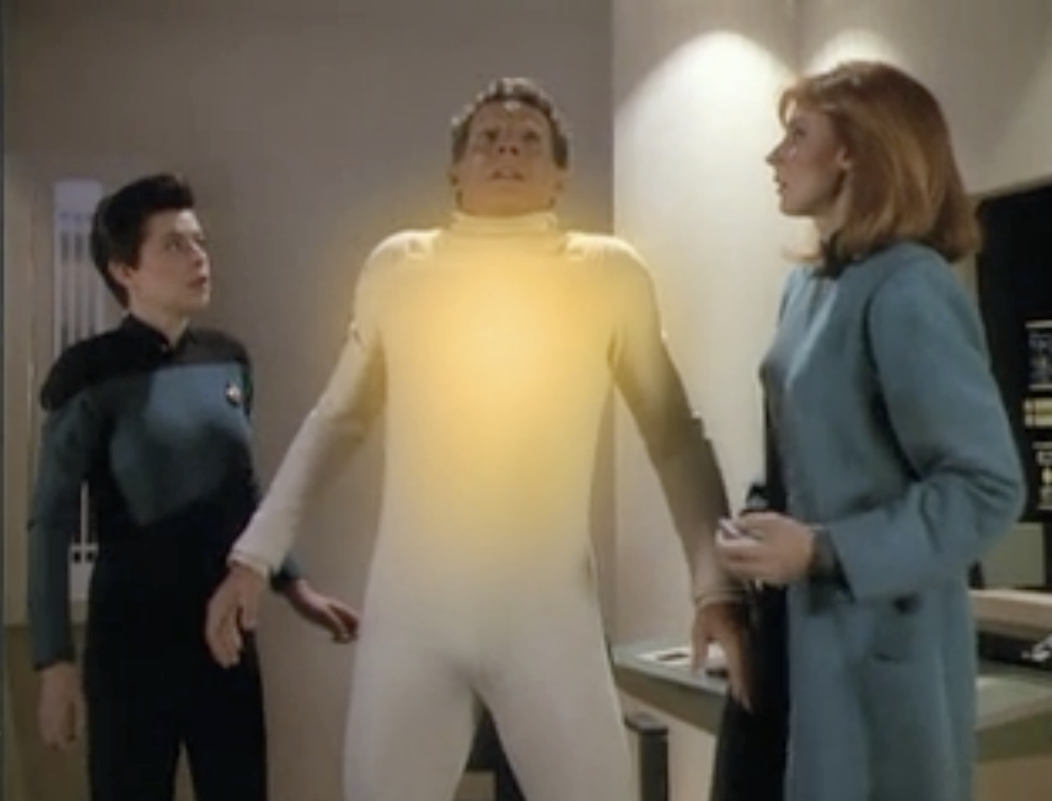
Pretty much everything about the episode’s main guest character (nameless, but dubbed “John Doe”) is also deeply unsatisfying. Dialog attempts to sell the idea that John is a really charming guy, but it’s all tell and no show. Unsurprisingly, the mystery man who doesn’t even know anything about himself utterly fails to come to life as a compelling individual. We are clearly meant to like and trust him, but the episode does nothing to put us inside his head or dramatize what it would be like to wake up in a strange place, surrounded by strange people, with no memory of who you are, while also recovering from serious injuries and undergoing mysterious internal changes that no one can explain. Meanwhile, neither Crusher nor anyone else makes any headway, as the episode progresses, on solving the mysteries surrounding him; instead, we just get a series of scenes in which parts of him glow yellow for a few seconds, and then he blurts out some new vague scrap of information. It turns out that he can magically heal people by touching them. He’s on the run. The reason why he can’t remember who he is seems to be that he has no personality to remember. Yawn. None of these revelations seems to provoke any particular emotional reactions, either from him or from Dr. Crusher. It’s all very bland and pointless. (Although, there’s at least this: The scene in which the healing powers first manifest happens in the context of O’Brien having hauled himself to sickbay after a holodeck kayaking mishap—the start of a running gag with a long future!) And then, ultimately, comes the reveal that John Doe is…evolving into a being of pure energy. Because that makes sense. (Which is dumber, do you think: the notion that his “species is on the verge of a wondrous evolutionary change” in some seemingly pre-programmed way; that this “evolutionary change” transforms him as an individual; or the nonsense concept of an “energy being”?)
Most of the episode plays out as a low-key, slice-of-life sort of story, which (somewhat bizarrely) stretches over at least a full month of in-universe time. I guess the latter is to allow time for John Doe to recover from his injuries and develop a “rapport” with Beverly (not that we actually see the latter happening), but it kind of messes with the thread of Geordi and Data trying to decode the information on the gizmo that they recovered from John’s ship. Apparently, they spin their wheels for weeks without getting anywhere with it, until one day Geordi hits upon the (seemingly not all that difficult) solution—and then they get the thing completely figured out in about two minutes. But anyway, near the end of the episode, authorities from John’s planet show up. Their leader, Sunad, immediately reveals himself as both unsympathetic and a total bonehead (why would someone in his position say anything to the Enterprise about John being a criminal who is to be executed, given that the Enterprise folks clearly feel protective of him?), but even so, for a moment it looks like an actual plot (like, with conflict and stakes) might be emerging: do we give John up to his people to be executed for vague alleged crimes, or keep him under our protection and incur the wrath of a new alien race whose ship is tactically on par with the Enterprise? Alas, however, the problem solves itself before Picard has any need to make a decision on the matter, because John suddenly remembers his identity and finishes “evolving” into a super-being who can handle the situation on his own. Thus, the climactic scene plays out via a bunch of dull exposition in which our boring central guest character flatly explains what’s going on as though reading it from a textbook, our idiot antagonist character sputters angrily and refuses to believe in what is happening right before his eyes, and musical cues inform the audience that we should feel filled with wonder.
Also, what is the point of the bits about Geordi and Christy Henshaw? Geordi gains a magical confidence boost from an early manifestation of John Doe’s developing healy-energy-powers. This event doesn’t serve as any kind of clue starting the characters on the road to figuring anything out, so that’s not what it’s there for. Because the change in Geordi is externally introduced, it doesn’t really constitute character development for him (nor is there any follow-up around what it means for him, or whether it will wear off, or whatever). It can’t even be justified as simply a gimmick to push him into connecting with his love interest, since he and Christy will not continue to be an “item” after this episode (indeed, Christy will never be seen again on the show). Even within the episode, the thread of Geordi’s luck changing with Ms. Henshaw is nothing more than a bit of background color that doesn’t ultimately go anywhere story-wise. Also, back in “Booby Trap,” Christy told Geordi flat-out that she didn’t “feel that way” about him. One really doesn’t get the impression that if he were just a little more confident, she’d be into him. People can change their minds or develop feelings over time, obviously, but “Transfigurations” seems to suggest that Geordi’s confidence boost is the thing responsible for Christy’s increased interest. Granted, I may be over-dissecting a relationship that only ever exists very much in the background, with a woman who is no more than the barest sketch of a character at best, but it does seem pretty dubious to me. And, again—what’s the point?
It’s a question that can be fairly asked about this episode as a whole, really. It ekes out two stars by not containing anything too god-awful (although “evolving into an energy being” pushes that line, for me) and by providing some modest entertainment in a few of its incidental scenes—but just barely.
By the time I finished reading this, I was wondering how you were justifying a full two stars. Everything you said is right… it’s a mess.
The whole “energy beings” concept seems like such a part of Trek from the beginning that I tend to ignore that under the assumption that that’s just how physics fundamentally works in this fictional universe. Sure, it’s the kind of woo you’d expect from someone childish enough to believe in astrology or The Secret, but look no later than season one for precedent. The Traveler is a good early example in TNG of how apparently, unlike in real life, thought is a more fundamental force in the universe than energy. There are energy beings and gods and stuff all over TOS, too… the Organians, Trelane, and Apollo, for example. And in TNG there’s the Q. We never see their evolution, of course, which makes it less dumb, but it’s a pretty hokey premise even so. None of this contradicts your points here. It’s just one of the biggest examples of how light Trek is on the science part of the science fiction. It’s really more like space fantasy. (At least Flash Gordon never demonstrated a first grader’s concept of the evolutionary process, so far as I know!)
You’re not wrong in pointing out that “energy being” (and similar) silliness already pervaded Trek before this episode. I think the reason why it bugs me more here than elsewhere comes down to presentation. To speak in terms of my “story types” categories, this episode is not presented as an “encounter with a weird alien.” In many of the other examples that you cite, the writers throw some kind of wacky shit at the characters and the episode is them reacting to it or figuring it out. However weakly justified the “wacky shit” is from a sci-fi point of view, it feels easier to wave that away and roll with it, because it’s at least justified from a narrative point of view. But in this episode, John Doe and his people’s “evolution” is presented in (misused) science-y terms (i.e as “high-concept sci-fi”), and the story tries to get us invested in what’s happening to his people on a sociological and political level. We’re actually supposed to think it’s cool and interesting that his people are evolving into energy beings, rather than just accepting the hokey premise of energy beings as the price of admission to a story about the regulars interacting with some quirky scenario. Not to say that I find stories of the latter type reliably compelling, by any means…but I at least don’t get as hung up on the silliness of the premise in that sort of context, you know?
As for how to justify two stars… Well, yeah. To a large extent, my answer boils down to: this is still way more watchable than something like “Menage A Troi.” There are story ideas present that could have been made into something. There aren’t scenes that seem designed to make me cringe. It’s not a good episode, but on the scale of bad TNG episodes…there are, unfortunately, much worse ones than this.
I totally agree. It’s a clear two star, intuitively, especially when you’re looking at it compared to Ménage a Troi or something like that. I still don’t feel too bothered by the hokiness of the premise, but I get why you do.
“The reason why he can’t remember who he is seems to be that he has no personality to remember.”
I don’t remember that. Is this just your cynical take or does the episode actually suggest this?
Otherwise—the episode is obviously an allegory for people who prejudicially oppose arbitrary differences in people or fight progress because they’re arrogant fuddy-duddies who don’t understand there are many valid ways to live. Now that I think about it, it’s a little muddled which it is. The chief aliens they encounter treats John Doe like a sexual pervert, which kind of feels like it’s an allegory about LGBT issues, but it also it clear that not just that John’s way of life is as valid as anyone’s, but also that his way of being is better. John clearly has his finger on the pulse of the new generation, which is to say, the episode is also seemingly saying something about the importance of not fighting progress for the sake of keeping with tradition. Not sure how to put these together.
As an aside, my spellcheck does not like the word “fuddy-duddies” and thinks I should change it to “giddy-daddies” or “giddy-cuddles.”
No reason why it couldn’t be both of those (pretty closely related) things. But it would work a whole lot better if those themes, say, came up earlier than the last five minutes or so of the episode.
As for that bit about John Doe lacking a personality… Uh, yeah, that was just me trying to be snarky (but maybe just ending up not being clear). 🙂
That’s fair. He is in fact that absent a personality.
There are hints earlier that John is being persecuted, but… it’s not enough to save the theme.
Also, John definitely looks like he’s having a sexual experience in the shot you used of him for this episode. Especially in light of the metaphor of his condition.
By the way, I don’t get email notifications when you respond to my comments, so I could easily miss them if you don’t tell me you made them and I don’t happen to check back later.