
This episode, for me, is a really tough call between one and two stars. It’s a damn sight more watchable than most episodes in the one-star category, but it nevertheless has precious little in the way of redeeming qualities. Its first half drags pretty badly, but is otherwise more or less okay. Then in the second half, when things finally start happening, the episode gets worse rather than better. What’s more, the eventual answer to what’s going on proves trite and dull. It’s still better than most first-season efforts, but not really by very much—and not, I’ve ultimately decided, enough to warrant even two stars.
Before we even get to the episode proper, however, there’s its deeply flawed teaser to talk about. While I greatly appreciate what the writers are trying to do here—i.e., to develop the character of Worf, and to establish a relationship of mutual respect between him and Riker—the effort is definitely botched. The unrelatedness of the teaser to the rest of the episode (aside from the fact that Worf and Riker are paired up again later on the “ghost ship”) is mildly annoying, but I could deal with it if I liked everything else about the teaser. But having Worf totally lose it in the “heat of battle” and nearly attack Riker just doesn’t work at all, nor does introducing their calisthenics outing via Picard’s overwrought worrying about it. There was a nice idea here, but it needed major work.
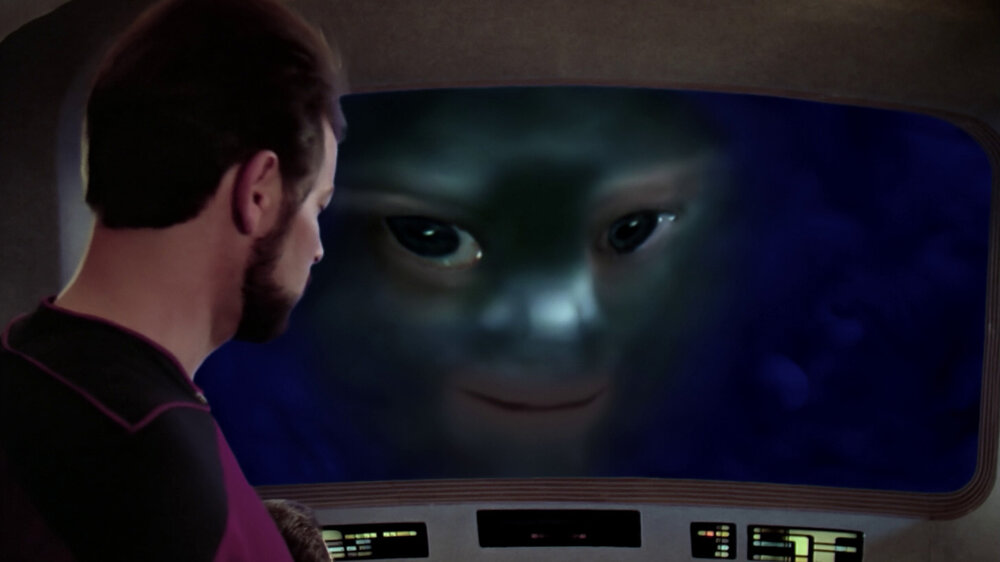
Anyway, as I already mentioned, the early part of this episode plods along much too slowly, with not nearly enough going on—though it can at least be said that the initial investigation of the “hole in space” proceeds in a satisfyingly logical way, with the bridge crew behaving like competent professionals and the the episode making no undue efforts to cheese things up. (Last season, everyone would have been all indignant and befuddled by encountering something that didn’t register properly on sensors or fit into their existing paradigms; the general scientific inquisitiveness here, and Data’s calm explanation about acknowledging unknowns, is a nice contrast.) On the other hand, I object to Picard’s “okay, I’m bored with this; let’s move on and let a ‘science vessel’ deal with it” moment. I thought exploration and discovery were supposed to be the Enterprise’s primary mission? But in any case, half the episode or so is killed ploddingly trying to figure out the anomaly—and then things suddenly start to get randomly weird. After futzing with the weirdness for way too long, the characters finally realize that they are being toyed with. About two seconds after this realization, Troi volunteers that oh, by the way, she senses an intelligence—and about two seconds after that, the (very goofy-looking) space entity who’s behind everything shows itself. In an episode where previously everything has dragged on far too long, Nagilum’s sudden manifestation somehow manages to come across as happening much too quickly. Next, as the entity examines the various characters, it notes Data’s differentness (which is sensible enough), but then zeroes in also on Pulaski’s differentness as a woman (even though she isn’t even the only woman on the bridge!), and actually makes a bigger deal of this than of Data. This has always bothered me; I mean, is a woman really more different from a man than—oh, say—a Klingon from a human?
In terms of my TNG episode typology, this one is clearly an “Encounter with a Weird Alien” episode. More particularly, it’s the second consecutive episode featuring an alien who wants to “study” humans (and it won’t be the last such episode, either!). At the same time, it’s also an instance of the recurring “virtually omnipotent being toys with the crew” motif. None of these facts, in my opinion, is to the episode’s credit. The latter type of story (usually) works when the super-powerful being involved is Q, because he’s such a fun character—and also because Q episodes usually introduce ambiguity as to Q’s motives, raise interesting questions, and so on. Nagilum is not Q, however, and in any case, I think it’s a mistake to introduce too many near-omnipotent entities. It cheapens the mystique of Q, and it strains plausibility too far—or at least, it portrays the Trek universe as too fundamentally weird and intractable for my taste. Also, a big part of what makes Q stories work is the fact that the main characters don’t let him get away with his pretentious, holier-than-thou arrogance; they defend who and what they are and assert their right to exist and not to be toyed with, and the clash of attitudes and moralities between them and Q is generally central to the point of the episode. Here, although Picard does protest when Nagilum kills a redshirt for no reason, Nagilum’s trite (and frankly ridiculous) criticisms of humanity as too aggressive and whatnot essentially go unanswered. When Picard, in the final scene, insists that Nagilum and humans do at least have one thing (curiosity) in common, it’s a decent stab at endowing the episode with an actual point—but it’s very much too little, too late. TNG was always notable for consistent promotion of an attitude of tolerant acceptance of other beings and cultures, however different from one’s own—but in the face of a being who’s far superior to you in raw power, and who has chosen to toy with your ship and crew for his own amusement (even to the point of killing someone), a pointed rebuttal of the being’s arrogant pontificating seems more called for than the extending of a self-effacing olive branch via the observation that “we’re not so different after all.” Indeed, later in the series, there will be episodes in which aliens’ treatment of Picard and company elicits just such a reaction from them—and those episodes will, correspondingly, be better than this one.
Finally, the whole self-destruct sequence in this episode is just flat-out weird; it doesn’t really make any sense, and it’s tough to sort out quite what the writer’s intent could have been with it. Are we meant to understand it as a bluff on Picard’s part, or not? How is it supposed to have been effective in manipulating Nagilum? He wants to study human mortality; wouldn’t the crew killing themselves en masse provide him with an excellent opportunity to do just that? And if it’s not a bluff, then what is it, other than a fantastically stupid and irresponsible decision? I just don’t get it. Basically, this doesn’t work at all (nor am I too fond of Picard’s rambling, evasive answer to fake Data about his beliefs vis-a-vis what does or doesn’t happen after death).
In short, this episode is weird and dull, rehashes overused story ideas, makes several major missteps, and leads somewhere that really makes very little sense. Not exactly a winning list of characteristics.