
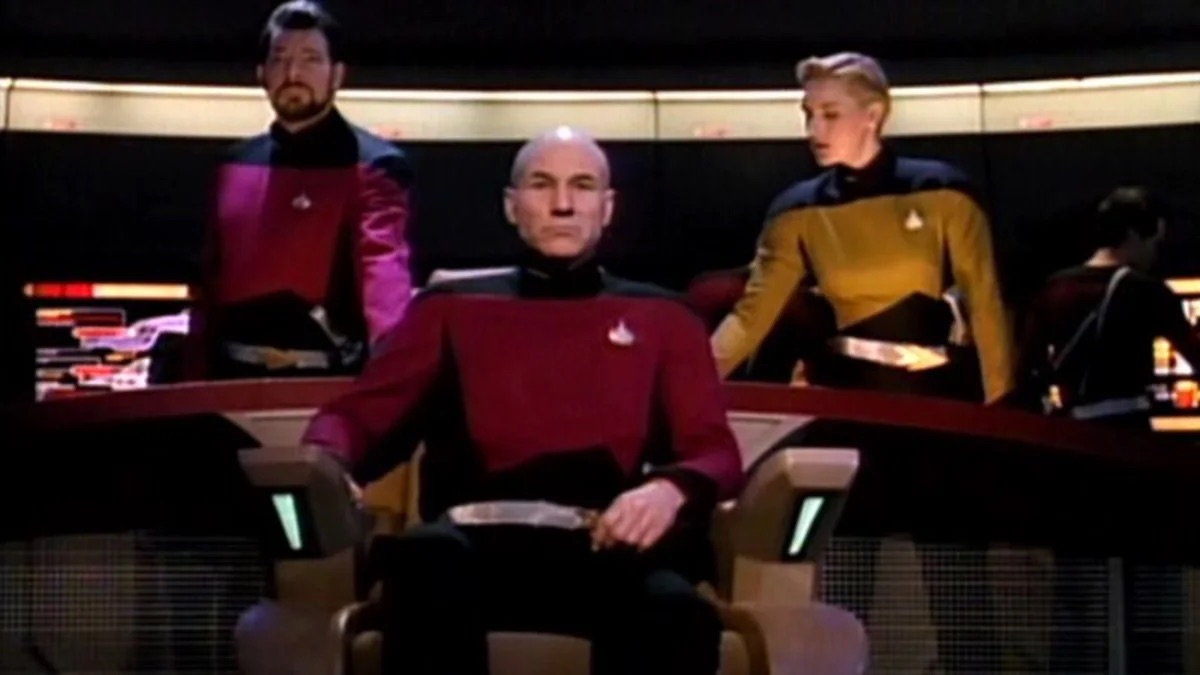
What an absolutely fantastic episode this is! A true classic, beyond any doubt. I almost don’t even know where to begin in talking about it.
Despite the many cool ideas that are in the mix at every level (plot, character, theme) in this episode, it’s the sort of story that (even more than most) really succeeds or fails in the details of its execution, I think. Fortunately, it absolutely nails those details. I might go so far as to say that over and above most of the individual story elements, what stands out the most about “Yesterday’s Enterprise” is its tone and mood, and the delightfully realized details of the alternate timeline that it presents. There’s some suspension of disbelief required, of course, in that the parallels between this timeline and the normal one are awfully close (almost all the main characters are still on the Enterprise, etc.). But the dark, brooding, and very busy-looking redress of the ship, the little changes in its routines and protocols, and the way that Picard is still the same Picard, except also…not (more brusque, more straitlaced, less collaborative and more commanding)? It’s all very immersive and engrossing. Making the alternate timeline feel real to the audience—driving home that for these versions of the main characters, this just is their reality, and what happens matters—was crucial if the episode was to have any emotional heft, and it’s not hard to imagine a version of the episode (in an alternate timeline?) that doesn’t really achieve this. But the actual episode achieves it so well that scene after scene packs an astonishing emotional punch, on a level rarely matched by more “ordinary” episodes set in the show’s regular timeline! It’s pretty amazing.
Also, what an unexpected and brilliant choice it was to bring Denise Crosby back, and make Tasha Yar a focal character in this story! We get a wonderful glimpse here of the sort of character that Yar could have been, if her tenure as a regular on the show hadn’t been limited to a period during which its writers had no idea what they were doing. She’s recognizably the same character that the first season was trying to present, I think, but here she comes to life so three-dimensionally—her hardened, soldiery persona that is genuinely who she is, yet also thinly masks an evident vulnerability and a need for meaning and human connection, making her very relatable and compelling. Yar was poorly served in the first season, both in general and when it came to her shitty death, and it feels like the writers took advantage of the opportunity afforded by this episode to rectify that somewhat; giving her the chance to choose a more meaningful death than the one by means of which the first season’s writers disposed of her works on a meta-level as much as it does on an in-story level. Also, it just adds to the episode’s emotional stakes for the heroic sacrifice being made by the crew of the Enterprise-C to be shared by someone whom we, the audience, already know and have at least some amount of investment in.
That said, another triumph of the episode is the involvement of two guest characters who are both appealing—especially Captain Garrett (embarrassingly, one of only two female captains ever depicted in Trek as of this episode’s airing, I believe). She only has a small role, but it’s one that I’ve always found memorable. Too often, captains of other ships in Trek come across unconvincingly, lacking the gravitas and the captainly qualities that you’d expect (not to mention that half the time they’re actually crazy). Rachel Garrett, though, is different. Watching the episode, I fully believe in the reality of her as the captain of the Enterprise-C, and I can conjure a sense of this whole other ship and crew, with its own internal culture and esprit de corps. Pretty cool.
The dramatic heart of the episode, of course, revolves around Picard wrestling with the impossible decision of whether to send the Enterprise-C back through the rift, to certain death for all hands, purely on the strength of Guinan’s inexplicable conviction that it must be done in order to “set things right.” That’s a huge ask, and the fact that the episode pulls off the task of making it believable that he could reach this decision is impressive. That begins with Guinan, who I quite like in this one. She freely admits that she can offer no proof, that the only reason for viewing one timeline versus the other as the “correct” one is her say-so (really glad the episode takes a moment to acknowledge this point), and that Picard’s trust in her judgement and perceptions is the only thing that can weigh in favor of him making this extreme decision. Yet she delivers this message with just enough assertiveness and chutzpah to push past the captain’s understandable resistance. The entire scene between them is just superb. My sense, though, is that the clincher—the one thing that Guinan says that sticks in Picard’s brain, and that you can almost see him grasping at and clinging to—is her earlier assertion that they aren’t “supposed” to be at war. “This is not a ship of war,” she tells the captain. “This is a ship of peace.” Picard’s reaction to this statement puts me right inside his head, as this war-weary version of our hero imagines a world in which he might have been the peaceful explorer that he had always wanted to be. Then, in the very next scene, he learns what the Enterprise-C had been doing right before coming through the rift. Guinan’s words are clearly still echoing in his head when, at the end of that scene, he muses to Captain Garrett: “It is regrettable that you did not succeed. A Federation starship rescuing a Klingon outpost might have averted twenty years of war.” Patrick Stewart’s delivery here is phenomenal, and the tragedy of this alternate timeline just feels so poignantly real. It’s a fantastic moment.
Importantly, too, this is one episode that does not chicken out by having the characters pull some convenient solution out of thin air in the final act. It puts Picard in the impossible position of having to send a ship to certain doom in order to avert two decades of war, knowing that if this succeeds, he will never even know it—because in that scenario, he won’t ever even have existed!—and then it follows through on that. He actually makes the decision, and a ship full of brave people willingly go back to fight a hopeless battle in order to maybe bring a better world into existence. It’s dark and bold and epic and tragic and just awesome, and the episode’s most classic and memorable line (which works brilliantly on three different levels simultaneously) perfectly encapsulates it: “Let’s make sure history never forgets the name…Enterprise.”
I would be remiss in ending this without at least mentioning the delightful opening scene. Granted, it has little to do with the rest of the episode, and it was clearly included mainly to give Worf a scene before diving into the alternate timeline, in which he is absent for obvious reasons. But it also becomes a classic bit of the show’s lore in its own right, which will be directly referenced in at least two episodes in the next season. Worf’s penchant for labeling anything he happens to like as a thing that befits a “warrior” is silly, but I’d like to read it (here, at least) as the writers consciously giving him an amusing foible. In other words, I roll my eyes at Worf declaring prune juice to be “a warrior’s drink,” but I do it fondly, with a smile on my face.
This one is a rare gem, for sure.
As far as I can recall, at least until Discovery, I think she remained the one of two female captains ever depicted. Pretty ridiculous.
Everything you say here. On the rewatch, it felt to me like there was so much more potential than the episode is able to access, such that some things (in particular the romantic subplot) feel underdeveloped, but I attribute this entirely to a lack of time.