
“Dramatis Personae” is going to be a tricky episode for me to review, because I have kind of a weird history with it. I don’t know whether or not I saw it right when it initially aired, but what I do recall is this: During some period of time after it aired but before I became a regular watcher of DS9, this was that one episode that I just happened to catch multiple times; any time I chanced to be near a TV when DS9 was on, it always seemed to be “Dramatis Personae” that was showing. (I feel like, in general, this is a phenomenon that I used to experience with TV shows in which I had some level of interest but that I didn’t (yet) watch regularly or deliberately; somehow, there would often be one particular episode that would happen to be airing every damn time I did tune in, and that I would thus end up seeing repeatedly, almost to the exclusion of any other episodes of that show.) As a result, “Dramatis Personae” became, for me, sort of the paradigmatic DS9 episode, during the time before I really got to know the show. And this is kind of weird, because it’s not exactly what you’d call a “typical” episode for the show. In fact, it’s actually DS9’s variant on the old “something causes all the main characters to act not like themselves” story premise. In many respects, too, it has all the shortcomings that episodes of this sort usually have, and plays out very much like they generally do. It’s a pretty middle-of-the-road episode, and I’ve accordingly assigned it a three-star rating. But there are things about it that interacted with my sketchy DS9-watching history in the early going of the show in ways that made an impression on me at the time—and looking back on it now, those same elements leave me feeling, to some extent, uniquely frustrated with the episode, even if I simultaneously feel a certain nostalgic fondness for it (that it probably doesn’t entirely deserve).
Episodes of this general ilk almost always run up against one essential problem: If the characters’ weird behavior is completely dictated by whatever outside influence they’re under, and doesn’t flow from or connect to who they are in any way, then the story becomes meaningless and uninteresting; but if it’s too connected to who they “actually” are, then the premise kind of evaporates, and it just becomes a regular story about those characters, and the writers don’t get to have their fun with making the characters act out of character in zany ways (and/or we’re left having to accept definitions of the characters that aren’t entirely at odds with their exhibiting whatever extreme behavior they’ve exhibited). So, the writers have to somehow thread the needle of conveying that although the characters are under the influence of outside forces and thus aren’t “responsible” for their antics, those antics nevertheless do connect with who they are enough to reveal something interesting about them. This is an awfully difficult balancing act to pull off, and frankly it rarely succeeds to my satisfaction. That’s definitely true in this case, and it’s the main reason why the episode doesn’t rise above three stars. But back in the era when “Dramatis Personae” represented most of what I actually knew about the show and its characters, this aspect of the episode was a lot harder to evaluate. I understood the premise and recognized that everyone’s behavior was “off,” but I think I rather imagined that some of it was a bit closer to their normal selves than it actually is, albeit more extreme. In particular, I remember taking this episode to represent DS9 living up, in a way, to its reputation as a novel version of Trek featuring more significant conflict between the main characters. Normally they didn’t mutiny and engage in all-out power struggles, I knew, but I sort of assumed that, at the very least, the conflict between Kira and Sisko here represented a more overt version of real tensions that (I imagined) had been bubbling under the surface throughout the earlier portion of the season. And here’s the thing: looking back, I wish that this had been true! The scene near the beginning of this episode (when the characters are still just their normal selves), in which Kira is all up in arms about a Valerian ship wanting to dock at DS9 but she and Sisko aren’t quite on the same page as to how to respond to the situation, is exactly the sort of scenario that I wish we’d seen more of this season—but in actual fact (I know now, but didn’t know back then), this was pretty much the first time since “Past Prologue” (the second episode of the season!) that we had seen anything like this at all. And while that’s mostly an indictment of the season as a whole rather than a failing of this episode, I end up feeling really frustrated with “Dramatis Personae” for teasing the kind of core-issue-based conflict and mistrust between the station’s Starfleet commander and its Bajoran second in command that the series promised us from the beginning (but failed to deliver for most of its first season), and then merely using this setup as an entry point into an irrelevant story about the characters becoming telepathically possessed and reenacting someone else’s conflict in an absurd and over the top way that actually has nothing to do with the real issues at hand.
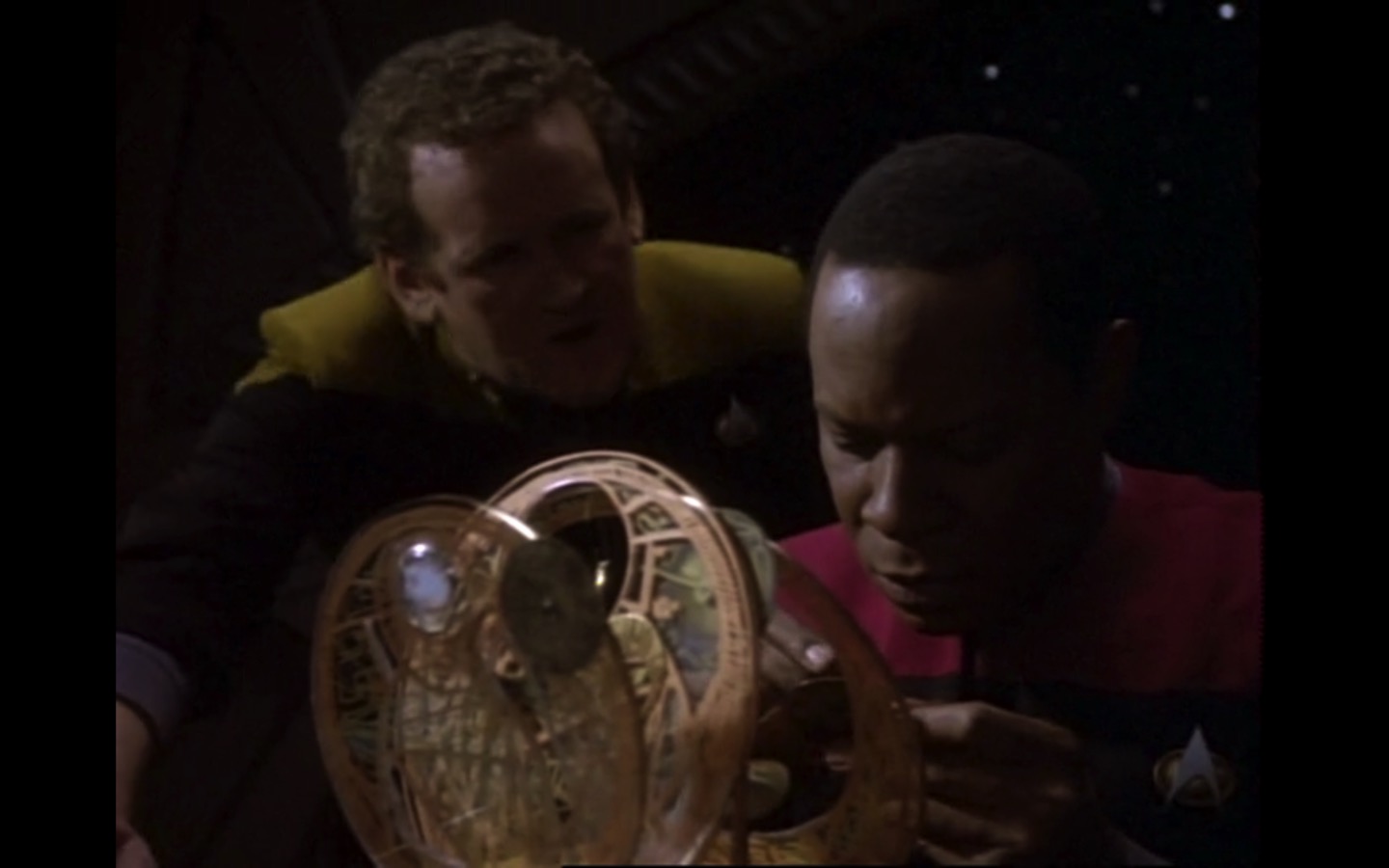
When it comes down to it, in fact, this episode is kind of all over the place in its handling of the characters. The overall plot hangs on the notion of a fundamental conflict between a Sisko faction and a Kira faction, but whereas Kira retains an agenda that resembles her “real” pre-alien-influence concerns, influenced Sisko just arbitrarily insists on thwarting her, then descends into a detached, apathetic state, and ultimately ends up obsessing over building a weird clock…all of which seems just wildly random, and certainly not based on or connecting to anything “real” about him. Dax mainly gets giggly and chatty and nostalgic, and when she eventually “picks a side” in the power struggle, it isn’t the one that I imagine she would pick if there were anything of the real her determining her choice. Bashir, on the other hand, is kind of believably an altered version of his regular self: uncommitted to either side, but into the idea of the power struggle as though it were a big game in which he wants to be a player (one is reminded a bit of how he initially reacted to Garak in “A Man Alone”). And finally, there’s O’Brien, whose over-the-top loyalty to Sisko doesn’t strike me either as an exaggerated version of his usual self or as specifically unlike him (except, of course, in its crazy intensity). Oh—and also, I’m not really crazy about the element of Kira going all slinky and seductive in her efforts to win others over to her “cause.” I mean…it’s not the real her, and it doesn’t really matter, and it’s just whatever, but it feels like an uninspired choice, and I could just have done without it. As for Odo as the lone unaffected regular character (apart from Quark, I guess) who has to figure out what’s going on and put a stop to it…I dunno; I guess it’s modestly entertaining, but it’s absolutely nothing more than that. So, all in all, we’re left with what amounts to a whole bunch of randomness with no particular logic (narrative or otherwise) to it, and certainly no deeper relevance or meaning. Ho-hum.
The little end cap scene in which Kira apologizes to Sisko for her mutiny, and Sisko quips that he’ll “let it go…this time,” I honestly do kind of like. Again, I think this is the writers trying to suggest that there’s just enough friction between Sisko and Kira “for real” that she feels like she needs to be explicit about acknowledging his authority after what happened, and I can appreciate that, even if I still wish that the show had “earned” this better by doing more to show them butting heads with each other throughout the season. Also, I think the scene would be better if there were an apology, in return, from Sisko, for stonewalling Kira and acting as though her concerns (and, by extension, Bajoran interests) were irrelevant to him. Because there are two sides to this coin, and while he’s no more responsible for his actions while under the influence of the “telepathic matrix” than she is for hers, the episode started with her pushing his limits (without actually crossing any lines) and him putting the brakes on her (not without reason), so shouldn’t the show of reconciliation at the end, if there was to be one, be two-sided as well?
I don’t think my take on this episode is going to be exactly revolutionary: it’s entertaining enough, but it doesn’t add up to much. I like watching Odo try to play both sides by relying on the affected crew’s tendency to assume that everyone else is as similarly obsessed with their narrative as they are, and it’s a pretty good time seeing Odo trick Bashir by playing on an apparent blind spot where Bashir can believe only the two of them haven’t been affected. It’s also somewhat enjoyable in general to see the characters getting conspiratorial and conniving. Brooks in particular is fun to watch; he always goes kinda psycho when he gets a chance to play a quirky character, and watching him, I genuinely believe he might say or do anything. I also like watching Kira, probably because her behavior tracks somewhat more with her usual self, though obviously blown way out of proportion. Like I said, though, all this doesn’t add up to that much. I guess it speaks to both of these factors that at the end of the episode when Odo traps everyone in the cargo bay, I was asking “oh, is it over already?”—because sure, I was enjoying watching it, but also that enjoyment was partly predicated on the assumption that there was more development to come, simply because it didn’t feel like enough had really *happened* to constitute a full episode.
Whatever you want to say about it, this is once again a failure of the series to lean into its premise. I always (deservedly) gave the Voyager writers hell for immediately abandoning most of their series’ premise (to an extent that makes me question what they could possibly even having been thinking), but even if they did a much *better* job, the DS9 writers were similarly much too willing to ignore their premise in favor of doing TNG-style episodes a great deal of the time. So if a tie-in with the show’s premise and substance are not minimum requirements for a three, call it a three.
If there was hope for a more substantial episode here, it seems to me it hinges on this being more than just a fantasy that means nothing about the characters themselves. “I know that none of us were really responsible for our actions,” says Kira at the end… but that’s unfortunate, because making this episode really work out of this would seem to hinge on making it more ambiguous where their personalities stopped and the weird phenomenon began. The writers make an effort to tie Kira’s usurpation into her actual personal motivations and character background, and that part really works for me, but the rest of the characters mostly set their usual motivations, if not their entire personalities, aside—and the whole thing just becomes an effort to take/retain control of the station just for the sake of it. It might have been more interesting to have seen Sisko and O’Brien becoming obsessive and paranoid specifically toward a goal of some kind of exaggeration of Starfleet interests, as what happened with Kira with Bajoran interests. Basically, let the characters behave normally, but start to lose all sense of proportion and become willing to apply extreme methods in pursuit of their goals. I think to make this work, they would have have to begun the episode by creating an issue of some kind that everyone was dealing with but had a slightly different take on—and then let that take get exaggerated and transformed into a sort of paranoid obsession by the “telepathic matrix” or whatever it was. Establishing that this Valarian ship traded with the Cardassians during the occupation is a great start. Suppose as well that they had some supplies that were needed for humanitarian reasons by someone in the Federation, giving Starfleet an interest in trading with them. And maybe Dax had some kind of relationship with the captain of the ship when she was Curzon, giving her a motivation to feel some way about him specifically? It seems like it may have been a missed opportunity to involve Quark by giving him a motivation here, too, if there were some cargo on board he was taking an interest in—say, possibly at the expense of Federation interests? A Kira/Quark alliance could have made for an against-expectations story.
I don’t know that I have much more to say about it than that, other than to muse that in the Trek universe, there are at least two technologies/phenomena that, paradoxically, have no defense, but that it is apparently technologically possible to deploy against your enemies at any time, and they are both quite common if the frequency with which they are a generative force in many Trek plots is any indication. The first is time travel. We’ve seen that you can essentially do this at will if you have a starship; to do so could solve many of of your problems, and while I can imagine that it could be risky, there is no way to defend against it, assuming you’re not a complete fool in how you use it. The second is telepathy (or other psychic phenomena, such as that shown in this episode). Because this psychic stuff is so undefined, no one has developed any technology that can block it, and as a writer you can pull it out at any time to introduce almost any sort of strangeness that you want. I daresay more thoughtful worldbuilding, leading to a more believable universe, would have introduced some clearer limits and parameters for these phenomena, especially psychic forces. Frankly, it would have been pretty easy to have created some psionic or telepathy-blocking tech, and the failure to do this has led to a lot of plot problems over the years, like the Borg’s use of time travel in the movie First Contact, or years of ignoring that Troi (and presumably every crew in Starfleet if they had the sense to put at least one telepath in every crew) has an ability that would have made a substantial number of plots irrelevant had she used all her senses.
More trivial issues:
• It takes Kira much too long to work out that Sisko and O’Brien took off their com badges. Isn’t that a standard thing someone would do to avoid capture? And if there are no life signs associated with the badge, wouldn’t that be a dead giveaway? (You could, of course, program the computer to tell you when people take off their com badges.)
• When the Klingon ship explodes abruptly at the beginning, why did no one see it coming? Usually they detect the warp core overloading or something.
• How does Odo know that he can suck the matrix out into space by opening the cargo bay doors? Seems like he made quite a gamble here, since it’s kind of counterintuitive that psychic whatsits are at the mercy of air currents.
• Can’t Kira override O’Brien’s orders not to contact Bajor? She is the first officer, after all, and I’m a little confused about how this O’Brien’s enlisted rank works, but there’s no ambiguity about the fact that she has the authority to countermand his orders. On the other hand, if Sisko had given the order, that would have taken care of matters for O’Brien. Speaking of which, couldn’t Sisko have used his authority with the computers earlier to have, say, locked Kira out of the controls, or shut her behind a force field and maybe seal the Bajoran crew in their quarters? I suppose his character just wasn’t motivated enough, being focused on building the clock, but you’d think O’Brien would have advised it.
• I find it rather amusing that as a way to distract from what he was really doing, Bashier pretends to casually violate doctor/patient confidentiality by gregariously and unnecessarily expounding to Odo about his previous patient’s supposed medical issue. It does kind of seem like something Bashir might do with just a little bit of tinkering with his brain.
I really like your thoughts about ways that the episode might have given more of the characters reasons to care about the Valerian ship in one way or another. It didn’t even occur to me to think along these lines. Nor to the writers, it would seem, though in their case perhaps mostly because they just didn’t (apparently) care very much about making the episode be “about” anything in particular.