
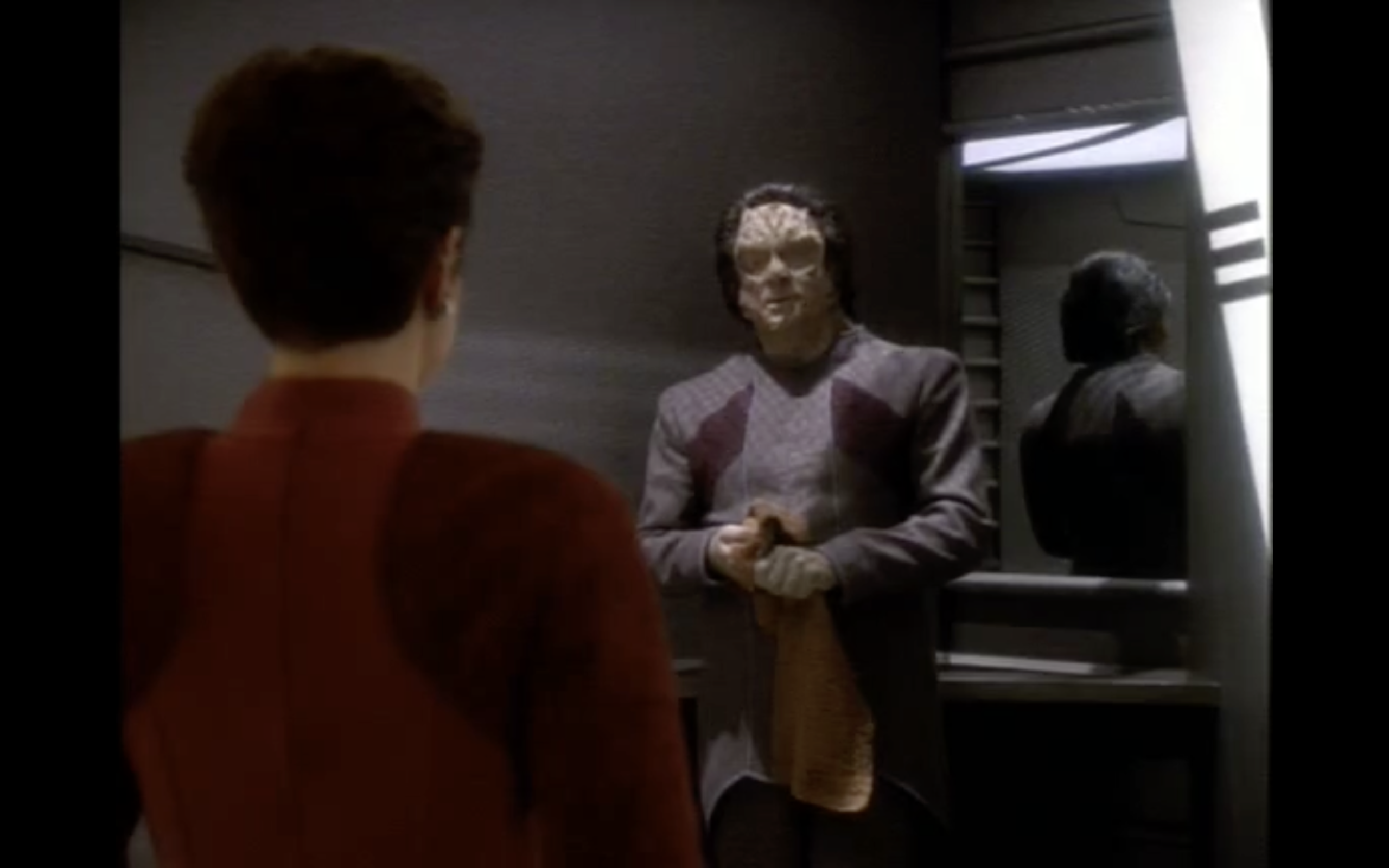
“Duet” is frequently cited as the best episode of DS9’s first season. I’m not sure that I’m willing to go quite that far, but beyond any doubt, it is one of the best. This is a season that both starts and ends spectacularly, with most of what comes in between being disappointingly mediocre. Prior to this, only three episodes had meaningfully dealt with what I see as the show’s core issues/subject matter; hell, we hadn’t so much as seen a Cardassian since “Past Prologue”! But “Duet” doesn’t merely turn the show’s attention back to the material that I prefer for it to focus on; it does so via a gripping character story that gets specific about a piece of the history that has traumatized Bajor, and forces both Kira and the audience to wrestle with some of the most difficult and troubling questions that linger in the aftermath of such trauma.
Let’s get this out of the way right off the bat: This episode’s guest character and actor absolutely knock it out of the park. The writers crafted a complex, layered, and convincingly “human” Cardassian, and the actor brings him to life in a way that (one has to imagine) no doubt exceeded the writers’ wildest expectations. In his first several scenes, everything about his demeanor can easily be read as consistent with him being an innocent and reasonable man who had nothing to do with the Bajoran occupation and finds himself in an inconvenient predicament—but at the same time, I also find it easy to read him in exactly the opposite way, as the toxic and arrogant onetime butcher whom he has come to the station to pretend to be. This serves his purposes within the story, of course, but it also serves to make him immediately intriguing to the audience. But then, in the first of the interrogation scenes between him and Kira, his innocent-man facade starts to look a lot less plausible, even as he (ostensibly) tries to sell her on the idea that that’s exactly what he is, and that if she sees him as anything else, it’s only because of her prejudices and her need for vengeance. That’s his story, but almost everything that he says is deliberately calculated to push a Bajoran former resistance fighter’s buttons—and it works pretty well, too, to the point that it almost seems like Kira misses the fact that he changes his story two or three separate times just in the course of this one scene. (One minute he’s feigning surprise at Kira’s suggestion that any atrocities took place at Gallitep; the next minute, he’s praising the brilliance of Gul Darhe’el for spreading rumors to that effect.) But even so, his talk about what an exemplary file clerk he was retains some of that initial ambiguity; is it ironic self-deprecation (emphasizing how insignificant he was at Gallitep, so as to deny Kira the satisfaction of righteously condemning him), or is it a crack in his supposed facade, betraying the underlying arrogance of an unrepentant war criminal? Next, after our people “discover” that he’s “actually” Gul Darhe’el himself, we get a couple of scenes in which he seemingly can no longer keep up the charade, and his pompous, over-the-top gloating is so horrifyingly believable that it’s easy to overlook how moronic it would be of him to carry on in this way if he were for real. (It actually hangs together well enough, because you can rationalize that he figures he’s cooked at this point, so that it no longer matters what he says; still, if he really were Darhe’el, you’d have to conclude that he was pretty fucking unhinged.) And then, finally, there’s his breakdown, when, confronted with the truth but still trying desperately to play his role, he makes the mistake of ridiculing Marritza as a good-for-nothing weakling who was tortured by the screams of Bajoran victims, and in so doing, begins to relive that very experience. Just a magnificent, riveting performance from start to finish.
As captivating as Marritza is, though, it’s Kira that the story is really about. Marritza keeps us guessing, and gets to chew the scenery a bit in the middle section of the story, but Kira’s side of their scenes together is compelling stuff, too, as she struggles to stay on track and refrain from allowing herself to be manipulated, but can’t entirely keep herself from reacting to her captive’s deliberate provocations. Also, I appreciate how this episode kind of gives us a “real” version of what the previous episode teased, by having Kira hot-headedly pushing for summary judgement of the presumed war criminal and Sisko putting the brakes on her and insisting that due process be observed. The two of them butt heads a bit, but they do so in a way that demonstrates an underlying respect and ultimately shared goals, and that really works for me. Plus, the scene in which she convinces him to let her lead the investigation, and calls back to his calling her a friend in “Progress,” is affecting, as is the trust that Sisko shows by ultimately agreeing to her request. But all of that is just nibbling around the edges of the main character arc for Kira, who naturally spends most of the episode desperately wanting Marritza to turn out to be guilty of heinous acts, and even flirts with the idea that he deserves to be executed regardless of what his role at Gallitep may have been, yet ends up coming to feel very differently in the end. In perusing other reviews of “Duet,” I’ve run across more than one that criticizes its final scene (wherein another Bajoran on the station stabs Marritza) for blatantly spelling out the “message” in a way that (they argue) wasn’t necessary, as well as at least one commentator who countered that the scene is important not for hammering home the message to the audience, but rather because it shows Kira herself fully internalizing it. I incline toward the latter view, although I’ll grant that the scene is maybe a bit on the nose. But what I mainly want to say here is that, to my mind, what changes for Kira through her experiences in this story is both more and less than just her take on whether or not being a Cardassian is enough, by itself, to make someone deserving of death. I would argue, in fact, that prior to/at the start of this episode, she already believes that it’s not. After all, she does flatly declare to Marritza at one point that “nothing justifies genocide.” Intellectually, Kira has never been in danger of dehumanizing her enemy in the same way that they dehumanized (if you’ll pardon the usage) the Bajorans; we know, for instance, that she wrestles with feelings of guilt about the violence that she has been involved in, even though she remains clear about it having been justified by the circumstances. Even more to the point, this episode gives us a nice soul-searching moment for her (staring out at the stars from the promenade), accompanied by some dialog with Dax to spell out her state of mind. She displays a welcome degree of self-awareness in this scene—referencing the prisoner’s accusation that all she cares about is vengeance, and acknowledging explicitly that she wants him to be guilty, so that she can punish him. This soul-searching indicates that indiscriminate vengeance is at least tempting for her, but also that she already recognizes it as meaningless and as the wrong path. But the most important line from this scene is when she says “As far as I’m concerned, if he was at Gallitep he is guilty; they’re all guilty.” Kira may well feel as though Cardassians in general are guilty and deserve to suffer, but what she thinks (and says) is merely that any of them who were at Gallitep are guilty; it’s still a blanket statement, but it’s a fairly measured one. Later, once she realizes the truth about the prisoner, his role at Gallitep, and his present state of mind, it’s this generalization that she is prompted to revise. Marritza, consumed with guilt, labels himself a coward; Kira counters that he was one man, in a position largely devoid of power, and that there was not much that he could have done to prevent the horrors that he witnessed. Whatever the balance of these two framings, what’s important is that Kira comes to recognize a middle ground between uninvolved and irredeemably guilty. In so doing, too, she finds herself actually empathizing with this Cardassian labor camp functionary, who previously merely represented the horrors of the occupation for her. It’s not just that she no longer sees him (nor even wants to see him) as guilty, or as deserving of death; he shifts, in her mind, out of the category “despicable piece of shit who nevertheless, per legality/ethics/basic decency, I have to allow to go free,” and into the status of a relatable fellow victim of a sort, and someone who is worthy of her compassion and respect. And that is pretty damn amazing.
That takes care of most of what I have to say about “Duet,” but there are a few minor things worth commenting on before wrapping up, and then I’ll conclude with some broader thematic thoughts. First: Besides being the first episode since “Past Prologue” to feature Cardassians at all, this was the first time we had seen Dukat since the pilot (!). He’s a delight here as usual, partly in that despite his obstructionism and general his dismissal of Bajoran concerns, it turns out that his concern for the “innocent Cardassian citizen” being held on the station is both genuine and legitimate; also, the brief exchange between him and Odo is really fun. I both fully believe in his nostalgia concerning the old days of working with Odo, and understand that he’s reframing their working relationship as friendly and collaborative when in reality it was no doubt defined by hierarchical power relations and full of tension and danger, particularly for Odo (a reality brilliantly alluded to via Odo reminding Dukat that the one time they played the game that Dukat mentions, Dukat cheated). In general, too, Odo is in good form in this episode; I also enjoy his delivery to Dukat of the line “He says his name is Gul Darhe’el.” Almost needless to say, Nana Visitor excels as well, in contrast to the overacting that she occasionally displayed in previous episodes (“Emissary,” “Move Along Home,” “Battle Lines”) as (presumably) she, the writers, and perhaps the directors were still ironing the kinks out of her as a character. Really, this is an episode in which just about everything is rock-solid.
Beyond the Kira-specific character arc at the heart of “Duet,” the story dramatizes the “big idea” that the kind of dehumanizing atrocities that took place at Gallitep (or at Nazi concentration camps, or any of all too many other real-life examples) necessarily damage the “humanity” of anyone connected with or affected by them. The victims either internalize a sense of weakness and inferiority, or they fight back, and risk cultivating an equally dehumanizing hatred of their oppressors; the perpetrators either rationalize their behavior, convincing themselves that their treatment of the victims is somehow justified, or they become traumatized by their own guilt. Bystanders, or anyone who finds themselves unintentionally complicit, face the dilemma of how to respond—how much to risk and/or sacrifice—and whether anything that they might try to “do about it” can ever be enough. Kira’s arc obviously dramatizes the “victim” side of this coin, while Marritza, in his various guises, covers the gamut of the other roles and responses. These are incredibly relatable and important ideas, and the episode does a remarkable job of packaging them all together and delivering them in an impactful way. Also: In my review of “Emissary,” I remarked that it set up Deep Space Nine to be “a show about rebuilding.” That the rebuilding of Bajor is a major focus of the show is obvious, but “Duet” introduces the idea that Cardassia, too, stands in need of rebuilding. When Marritza says that “Cardassia will only survive if it stands before Bajor and admits the truth,” he recognizes the damage that his people did to their own “souls” via their treatment of Bajor, and Kira futher underlines the idea that both peoples stand in need of “rebuidling” when she tells Marritza that “if Cardassia is going to change, it’s going to need people like you.”
This episode is pretty close to flawlessly executed and stands alongside a very small number of my very favorite Trek episodes. I almost can’t believe that they produced this in the first season of a show that with the notable exception of the pilot) has so far only hinted at the brilliance it’s capable of. Every scene introduces some new turn of events or surprise, and you see Kira’s reaction at every point in the story, from the setup where she is surprised that the person beamed aboard is a Cardassian, to the finale when he is murdered, and every new development has me engaged with Kira’s journey and relating with her experience. From the beginning, it puts Kira and Sisko at odds in exactly the way they should be. I love everything about the way Sisko is characterized as reluctantly giving Kira a chance; *this* is how you do character tension in Star Trek, and also why anyone who thinks that conflict between crew members isn’t a good thing (sorry, Gene) doesn’t really understand storytelling. I love how the actor cast as Marritza plays it as so dismissive and smug, just setting us up to hate him, and how this is undermined by finding out his true identity and motive. And I love the change that it makes to Kira as she grows from what she used to be—what she needed to be under the prior circumstances of her life—into a person grasping a greater amount of empathy and complexity. This is a perfectly executed character arc that neither changes Kira too much or too little.
If I remember right from reading about this episode many years ago, some people thought the ending where Marritza is murdered by a chronically inebriated Bajoran was too much. While I can see that take, I’m not inclined to agree. I see this as a great example of how sci fi is able to change circumstances to help us see things about our society with fresh eyes in ways we wouldn’t be able to see without an analogy. The moral here challenges us to remember the common humanity we share with people who cooperate with those who do evil and reminds us that it is not only the victim who is harmed by oppression, but also does damage to the oppressor as well, lessons that can be especially hard to internalize in a period of history like the one playing out around us right now, both in the United States and with respect to its actions facilitating genocide in Palestine.
I’m also noticing on this rewatch, based on my knowledge of what’s to come, that the way Sisko responds to what for the sake of simplicity we’ll call evil seems to change over the course of the series. In the first season, he plays these things much cooler, from a more reserved place, retaining (or at least aiming for) a greater sense of objectivity. Later on he becomes much more clearly an ally of victims. As far as I can remember right now, that does feel like an earned transition, too.
Of course, since I’ve seen this episode previously, I don’t remember how I felt watching it before I knew that Marritza was actually Marritza and not Darhe’el, and I’m a bit at a loss now to remember how these scenes landed for me when I didn’t already know how the episode ends. But honestly, I think it says a tremendous amount that even with this knowledge, the episode remains captivating from beginning to end. I like that it humanizes Quark a bit to see him empathizing with the Bajorans, even though they undercut it with a joke. This is also a great use of Dukat, and though he’s not the focus of the episode, he’s fascinating as always. If I can think of any criticism here, it would just be that bringing the drunken Bajoran murderer in during previous episodes would have have helped add a sense of surprise and tension to his murder at the end.
In short, it’s a nearly perfect episode. What else that came earlier in Trek history is better than this? Possibly nothing.
Added after: We hit on some of the same things, but your review is much more thoughtful and comprehensive than my post. In particular, your thoughts fleshing out how all parties are affected by violence of this time is extremely well considered and articulated. Also, it blows my mind that this is the first return to Cardassians since “Past Prologue”!