
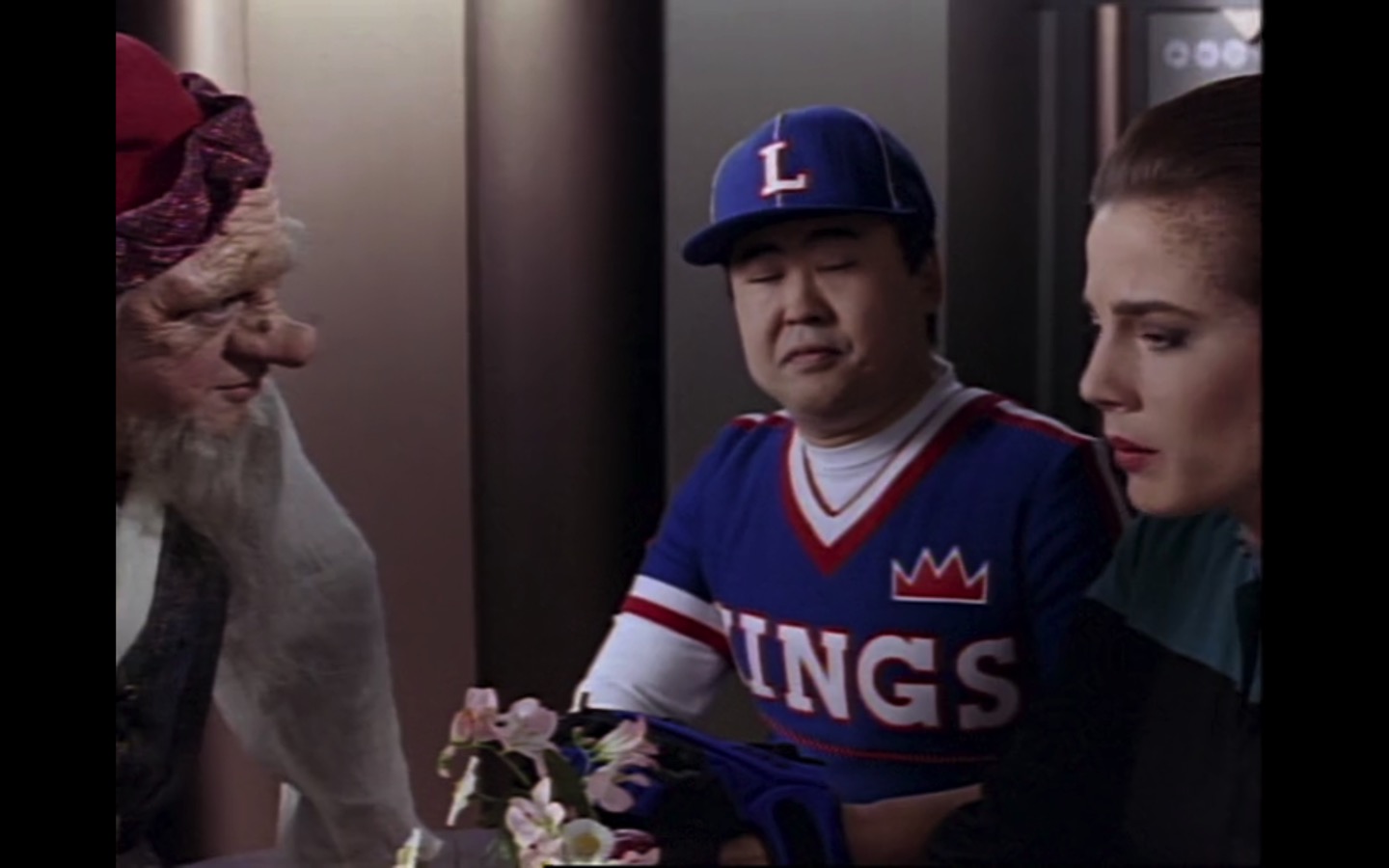
Yawn. “If Wishes Were Horses” is (ironically enough) an unimaginative, pointless, and boring episode on so many levels. It scores above the very worst episodes of this season by virtue of not being, shall we say, “actively awful,” but it’s still basically a waste of time, and the sort of episode that just doesn’t feel (to me) like it “belongs” as part of the show. This is particularly disappointing coming on the heels of the previous episode’s welcome return to the themes and promise inherent in DS9.
Honestly, I’m not sure why, over the years, the makers of Trek kept returning to episodes of this general ilk (unless, that is, it be because they were presumably relatively easy to bang out). For starters, it’s my opinion that this sort of premise (“the things we imagine are becoming real!”) just flat-out sounds more interesting in theory than it ever ends up being in practice; the level of chaos that it feels like such a scenario would actually wreak is well beyond anything that it’s particularly feasible to try to portray, nor would it be especially interesting to watch even it if could be realized in a more convincing way. Imagination is awesome, but it’s only one ingredient in the recipe for good storytelling; on it’s own, it lacks structure, logic, meaning. I mean…I have an often zany sense of humor, and appreciate wacky shenanigans more than many; still, a story that basically boils down to “random goofy shit happens!” just isn’t interesting to me. Then, too, there’s the “lack of stakes” problem. Scenes like the one in this episode where Kira imagines being engulfed in flames or whatever are always just tiresome, because duh, obviously this is not really happening and doesn’t matter, and obviously the character herself is going to realize that in a moment, so…what’s the point? Also, part of my impatience with the concept stems from the fact that it just feels like Trek has thrown this kind of thing at us time and time again, thus making it feel tireder and tireder. TNG, for instance, did a version of it in “Where No One Has Gone Before,” and aspects of “Night Terrors” were also boringly similar. Those are the only two examples that I can point to explicitly (at least at the moment), but I feel certain that there have been others. And then, as if the episode didn’t already feel tired enough, it’s topped off by the reveal that, simultaneous with the “imagination becomes reality” conceit, we’re also dealing with a version of Trek’s even more overused “advanced aliens ‘studying’ humanity” trope! Just…why?
At the very least, if the writers felt (for whatever reason) that they just had to do an episode like this one, they could have put in the effort to have the characters’ embodied imaginings reveal something interesting about those characters. Alas, though, that’s not what the episode is interested in doing. O’Brien’s “figment” arises from a bedtime story that he reads to his daughter, and reveals the “profound” truth about him that he would find it distressing if harm were to come to said daughter. Sisko’s reveals…uh, that the commander and his son enjoy baseball, I guess (there’s a revelation!). And Bashir’s, of course, lets us in on the secret that the young doctor is horny and has a thing for Dax (honestly, a motif that itself has already started to get old at this point). This is what passes for the “substance” of the story here? Somehow, I’m not impressed. Moreover, the episode’s attempts to squeeze humor out of the embodied figments almost uniformly fall flat—as, for that matter, does its attempt to generate tension (or interest of any kind, really) via the thread about the subspace anomaly. I just don’t care about any of it. (Okay, in spite of myself, I got just a bit of a kick out of Odo imagining having Quark in a holding cell. It’s obvious and predictable, but it’s still funnier and even a touch more interesting than pretty much anything else in the episode. But also: Don’t even get me started on Quark and his (human?) fantasy women. Really? That is the best the writers could come up with for the content of Quark’s imaginings?)
The other thing that I want to say here is that, details aside (as in, overlooking the blandness of what this episode actually gives us), episodes that (broadly speaking) feature goofy weird stuff happening to the characters have sometimes basically worked for me…on TNG. Even there, of course, I always preferred for there to be something more than just “goofy weird stuff happens”—like, you know, an actual semi-coherent plot, and some character relevance, or whatever. But on TNG, this sort of story (if done well enough, I mean) at least didn’t feel as wildly out of place. TNG is a show that’s about exploring the unknown, and it has characters like Data, whose reactions to the absurd sort of work in the context of his overall arc—and hell, even Picard, who, despite his seriousness and reserve, can be relied upon to engage fully with whatever weird shit the universe throws at him, and will often even manage to find meaning in it. These characters, though serious enough and amazing in more serious stories, also work in goofy-ass stories well enough (sometimes, anyway). But DS9, to me, is just a different kind of show; it has a different tone, is about different things, and its characters, by and large, just feel poorly served by being put through nonsense like what happens in this episode. This is not to say that DS9 can’t do comedic stories, or even that it would never find its own style of goofiness that works for the show that it is; it absolutely does, eventually, do so! But this style of goofiness really just doesn’t work on DS9, and it’s too bad that the writers, at this (admittedly early) point in the unfolding of the show, didn’t recognize that. (On top of which, of course, I personally prefer for DS9 to mostly stick to stories that grow out of and are distinctive to its particular setting, rather than falling back on random/generic goofy sci-fi. There are exceptions to this, but…well, suffice it to say that this isn’t one of them.)
So much for this one. Moving on…
Here’s another one that, despite not being absolutely terrible, still feels like the show is spinning its wheels as far as not living up to the promise of its premise. If wishes were horses, DS9 would have made an episode more relevant to the show’s setting instead of this one. To be fair, I don’t have the impression that the showrunners/writers ever even meant focus strictly on the premise of the series and avoid doing the same kind of “new planets and weird aliens phenomena” of previous Trek. I think they just looked at the setting of DS9 as one of a few things they could do. And I guess if they had been too adventurous in getting away from that, a large contingent of the (dumber) fans would, I assume, have taken issue. That doesn’t stop me from judging it. To my sensibilities, a “serious” sci fi version of Star Trek would avoid this almost entirely—all the episodes would be firmly rooted in the setting, and wouldn’t be possible on TNG. I would also include in this episodes that feel like they’re rooted specifically in the *characters*, which would also allow for great character episodes like “The Visitor.” I daresay that would still provide plenty of storytelling wiggle room, especially as we watch the setting change as a result of the decisions made in the first episodes.
Can you imagine if other art took as much liberty with the storytelling and just diverged into telling random stories that could happen anywhere? What if Tolkien had written another short book after LotR that focused on hobbit family dynamics, or another that was about a ghost that was tormenting a prince of Rohan or something? That’d be strange. In fairness, as far as I can think of, there aren’t a lot of other preexisting artistic mediums that offer a formula so friendly to episodic storytelling as television, and this does allow for more diverse story concepts. It would just be my strong preference for everything that happens to have some kind of ongoing effect on the universe around them and the personalities of the characters.
I’m very much digressing here, but just to say: We do have episodes that are really loose with scientific principles that are nevertheless good, but I’d be curious about what a “hard science fiction” version of Trek might look like. You would have to throw out a *lot* of episodes, including a lot of good episodes, to make that work, and one could even question whether it was Star Trek once we’d gotten rid of it all. So maybe what I’m talking about isn’t Star Trek at all, but a a different hard sci fi series that examines the project of building a better world in a more straightforward realistic way without getting distracted with shows about people getting split in two by the transporter, or what happens when a family of money-grubbing trolls goes to visit their mom in the rain. Yeah, it wouldn’t be Star Trek, but it could pretty awesome if it adhered better to reality and took on the task of showing what a better future might look like.
Anyway, getting back to the matter at hand, this episode really just feels like a series of imagination-related scenarios without much point, and it doesn’t show us anything new about the characters. We discover that Bashir and Quark are horny, and that Odo wants to put Quark in jail, and the Siskos love baseball, and maybe a few sundry other minor things, all of which we already knew. And what’s with the scene with imaginary Jadzia, Buck, and Rumplestiltskin talking together? The episode seems to want to depict them as bit nefarious there, but as it turns out, they aren’t (or at least, I think we are meant to think they aren’t), and the scene also seems to remove the element of mystery about what’s going on, but for no particular reason.
Also, apparently the imaginariums are pre-existing entities, but they also take on the personality characteristics of the beings they are imagined as? So would the Rumplestiltskin-entity really steal someone’s child? Or was that just a facade? It’s not clear. It’s potentially interesting to put O’Brien in a situation where he has to trade his daughter for the safety of the crew, but they don’t go anywhere with it. Mind you I’m not exactly sure what they would have done with it, but if we imagine that they had elected to turn the whole episode around a concept like that, it probably would have been more interesting than this. I mean, even if they were determined to make yet another episode about aliens trying to learn about us by fucking with us, forcing us to make impossible decisions like that would be one hell of a way to do that, and a way of coming at it that as far as I can recall no previous episode has done, at least not quite in that way.
I’m also really left feeling that if this episode’s concept were really worth doing at all (I’m not convinced it was, but just for the sake of argument), it really would have needed a lot more budget and a lot more imagination to get it off the ground. The station hardly feels like a place transformed by human imagination. All things considered, if a few ostriches, a gambling payoff, and a few beautiful women is the lion’s share of what humanity has to offer as far as imagination goes, then that’s pretty sad showing for us as a species. If people’s imaginations were coming to life, we really should have seen about a thousand times this much chaos.
And just how does the process work, anyway? Is it supposed to be like Mage (the RPG) where belief manifests reality? Are the manifestations are a result of what people are thinking about, as with Buck or Rumplestiltskin, or are they what people want, as with sex kitten Dax? Sometimes the imagined scenarios seem to have an effect on the world around them, and sometimes, they just melt away without affecting anyone, as when Kira was encountering an explosion. Did Quark actually lose money? Could Bashir actually have had sex with the imagined Dax? It seems like it in these latter cases, but the way it works in each case appears to vary randomly. Speaking of such, were the fantasy women aliens, too, or were they just automatons? And what’s so special, incidentally, about empty-headed women who want to have sex with you when you have access to a holosuite you can use at any time to generate those? If wishing for things (or even just imagining them in general) makes them appear, given how it manifested with Dax, wouldn’t the place be filled with many alternate versions of all the characters doing wish fulfillment for each other and (in so doing) exposing each other’s vulnerabilities? If this episode conceptually *is* worth doing, I think that’s the hook, right there—characters accidentally telling on themselves to the other characters in this way. That way the episode actually becomes about the characters. Only Julian gets this treatment, and what it reveals about him, while no doubt deeply embarrassing for him to experience, was also clearly already obvious to the rest of the senior staff, and all the more so to the audience.
As for the ending, it’s a bit clever, I guess, that Sisko resolves the situation by realizing they were just imagining the rift problem to begin with, but then this whole thing turns out to be yet another in a long line of cases of aliens trying to understand humanity by doing weird shit to them without their knowledge or consent. This has become such an absurd cliché by this point in Trek. Once again the aliens claim that they’ve never before seen some trait that would surely be quite basic to any spacefaring species. Imagination is rare? Just how do you do anything remotely novel or go anywhere even slightly new as a member of a self-aware species without first *imagining* yourself doing so? And if the aliens are testing the crew by subjecting them to scenarios where their imagination brings out new information about them, then surely they’ve seen “imagination” demonstrated every time they’ve used this trick previously—or if not, why were they expecting it to work? I suppose they were just *imagining* that it would? (Or, on the other hand, does this explain why so many species are just humdrum fuddy-duddies who scoff and behave irritably when a new alien species comes calling? Perhaps imagination truly is a trait unique to humans, Bajoran, and a few other Alpha Quadrant species that have all joined the Federation. We have our explanation!)
In any case, once this is all resolved, these curious aliens, having put a whole bunch of lives at risk to gather this information, decline to share anything about themselves or begin building a relationship with the species they have just been studying and promptly just fuck off, never to return. I mean, what the absolute fuck about that kind of behavior. I know I always say I want aliens to be different from humans, but I’d like them to do that in a way that isn’t, you know, stupid. And I know Buck claims that they were “just watching” and not responsible for the jeopardy that the station was in, but that’s obviously horseshit. These aliens are either mildly malevolent or completely incompetent, so why Sisko seems happy about the whole event in the end, I don’t know.
Minor points:
• For an Engineering-minded Irish everyman-type, O’Brien is amazingly skilled at doing voices and reading stories. I almost think he should have gone into acting.
• Why is Bashir sleeping with his uniform on? And without sheets? What time is it when this happens?
• So apparently, if he can have any woman he wants, Quark’s ideal preference is to bed (clothed) human and Bajoran.women. To a Ferengi, that should be kinky as fuck.
• Doesn’t it seem kind of weird that they make no effort to contain the aliens when they start appearing? They don’t know what their intent is or what their abilities are. Normally, the crew would at least *attempt* to isolate a potentially dangerous life form that turns up out of nowhere and is wandering around on the station without authorization.
• As I was saying above, I think we’re meant to believe that the aliens are, if not benevolent, at least not malevolent, but the Rumplestiltskin character at least *acts* like he’s dangerous. Imagine if the final scene had taken place with that character instead of Buck. We’d be left with a very different sense of things, and I’m not sure anyone would believe him at all, as I think we’re meant to believe Buck (although as I stated above, I don’t).
• Odo’s lack of technological aptitude, pioneered in “Vortex,” continues here (apparently) as he fails to realize he could use the transporter on the ostriches and instead spends hours chasing them around the station. Even if they prove immune to teleportation, is this really the best use of his time? They don’t seem to be dangerous. And just who was thinking so hard about having flightless birds around, anyway? Now *that’s* the story I really want them to have told.
• If some kind of strange phenomenon is causing the gambling tables to be rigged against you, wouldn’t you just imagine that you were winning—or if that didn’t work, close the bar? Or were too many people imagining that the bar was open?
“To be fair, I don’t have the impression that the showrunners/writers ever even meant focus strictly on the premise of the series and avoid doing the same kind of “new planets and weird aliens phenomena” of previous Trek. I think they just looked at the setting of DS9 as one of a few things they could do.”
I don’t think I’d go quite that far. To be sure, I think they always intended to give themselves the leeway to do a variety of kinds of episode (and up to a point, I don’t even begrudge them that)–but I get the sense (from reading the DS9 Companion, among other things) that they genuinely did set out to make a show with a somewhat different tone and more of a narrative focus than what TNG was. I also think, though, that for most of the first season, they were struggling to figure out quite how to do that, while also balancing at least some amount of pressure to make familiar-feeling Star Trek that would pull in TNG’s audience. I imagine that, intentions aside, writers who came over from TNG tended to have TNG-ish ideas, and in the scramble to come up with enough story concepts while still sort of refining, on the fly, what the new show WAS, they probably fell back on easy/familiar ideas more than at least some of them would have liked. I could be way off base on all of this, of course, but these are my impressions. I also have the impression that in the second season, the show does become at least MORE focused on its distinctive premise and themes and such than it is in season one. I look forward to evaluating this anew when I get there.
“…what happens when a family of money-grubbing trolls goes to visit their mom in the rain.”
I laughed pretty hard at this. 🙂
“Did Quark actually lose money? Could Bashir actually have had sex with the imagined Dax?”
Precisely. What the fuck, if anything, are the STAKES here? Does any of the nonsense that we see actually *matter* in any way?
“And what’s so special, incidentally, about empty-headed women who want to have sex with you when you have access to a holosuite you can use at any time to generate those?”
Also an excellent question. Quark’s fantasy-come-true was just criminally under-imagined by the writers.
“O’Brien is amazingly skilled at doing voices and reading stories.”
That’s because he’s folksy.
“Why is Bashir sleeping with his uniform on? And without sheets?”
Because he’s a Starfleet officer. Haven’t you noticed how often they do this? I know I called it out in at least one of my TNG reviews. And yeah, it’s pretty dumb. (I’d say that it kind of takes you out of the story, except…in this case, I was never that involved in the “story” to begin with.)
“If some kind of strange phenomenon is causing the gambling tables to be rigged against you, wouldn’t you just imagine that you were winning—or if that didn’t work, close the bar? Or were too many people imagining that the bar was open?”
Again, this gets at the crux of why stories like this one tend not to work. “Imagination becomes reality” is a concept that inherently resists logic or structure, so basic things about what’s supposed to be going on end up vague and ill-defined. If Quark were to imagine all his customers losing all their money to him, while they are imagining winning big, whose imagination wins? Or is none of it even real enough for the question to matter? There are no coherent answers, so it’s just a jumble of boring.
Well, Starfleet uniforms, especially the DS9 incarnation, do look like pajamas. I kinda like the idea of having only one outfit and not having to bother picking out different clothes every day. You once asked me if I’d join Starfleet if I lived in this universe. One the downside, there are wars every other day and it would be dangerous as hell dodging temporal anomalies. But on the other hand, I wouldn’t have to change clothes before going to bed.
The only version of this story I can think of that would be worth doing would have had the characters creating other versions of their coworkers to do wish fulfillment for them. Consequences ensue!