
Here is one of the most confounding things about the first season of Deep Space Nine: its Lwaxana Troi episode is better (and by a considerable margin) than its Q episode. That’s not something that can be said about any season of TNG!1 Now, for my money, the fact that we can even speak at all of the season’s Q episode vs. its Lwaxana episode is an indicator that the series has yet to fully find its own identity, and is still a little too stuck in the mold of its predecessor. Still, I have to hand it to the DS9 writers for actually coming up with a not-terrible story for my least favorite recurring character. Not that “The Forsaken” is brilliant, by any means; most of it is pretty trivial, much of it kind of silly, and even its best bits are easy to imagine being even better. But the episode is wholly watchable, and it makes positive contributions to the show as a whole (plus, none of its lesser aspects is bad enough to bother me too much). Honestly, for a Lwaxana Troi story, that warrants some kudos.
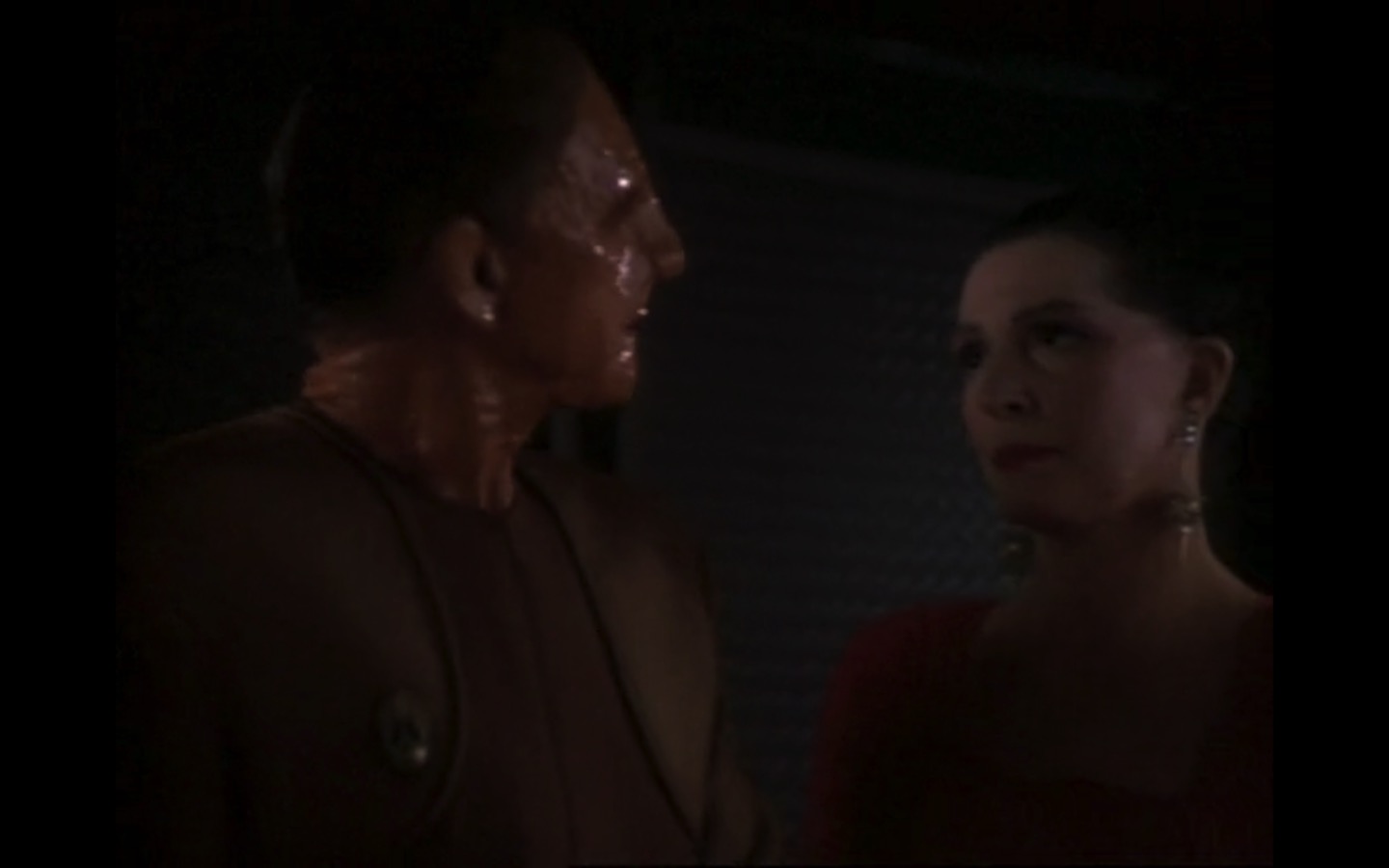
The key here is that this episode does something that, unaccountably, none of the Lwaxana TNG episodes ever did, despite the fact that TNG was actually better positioned to do it than DS9 was: It uses her as a catalyst for significant character development (or at least, character revelation) for one of the show’s regular characters. On TNG, even on those occasions when Lwaxana was used for something more than dumb humor, the story generally focused on her, despite the fact that her whole reason for being present was that she was the mother of one of the main characters. Bizarrely, the writers repeatedly chose to play her off of Picard, or another guest character, or generally to do just about anything else they could think of other than using her to do meaningful character work with Deanna Troi. In this episode, at first, it rather looks as though they mean to give us her same old schtick, just with Odo filling in for Jean-Luc, and one steels oneself (on first viewing, anyway) for an hour of unfunny hijinks centered on her self-deluded amorous pursuit of the poor, uninterested constable. But then, after isolating the two of them in the stuck turbolift, the episode actually aims for something a bit more substantive. Running with the previously established premise of the shapeshifter’s regenerative cycle, we establish Odo to be not just uncomfortable in a social way, but actually headed into serious difficulty, leaving Lwaxana unable, for once, to sustain her standard oblivious and self-cenetered mindset. What follows is an exchange that yields some fertile character back story info about Odo, and then pushes him to a breaking point beyond which he becomes physically incapable of maintaining his usual dignity and reserve, and the gruff, “private” constable is forced to let this relative stranger (and the audience) see him at his most vulnerable. “Vortex” had previously made some effort to get inside Odo’s head and explore what makes him tick, but it’s “The Forsaken” that ends up being the definitive early “Odo episode” that both sets the baseline for who he is beneath the surface and plants story seeds for later episodes to explore further.
With all of that said, though, I still have criticisms to level even at the Odo/Lwaxana portion of the episode. To begin with: frankly, I still don’t like Lwaxana Troi as a character, and I see no compelling narrative reason why it needed to be with her, in particular, that Odo got trapped in the turbolift. Why not either a) a less annoying and more appealing guest character, or b) one of the other main characters? But also, if it absolutely had to be Lwaxana, then maybe make it matter that it’s her by having the experience prompt some introspection and doing some character work for her as well. I mean, the episode has her absolutely throwing herself at Odo merely because he, in the course of his normal duties, helped her out with something, and (as usual) seemingly with no awareness that her sudden interest in him is not remotely reciprocated. This, of course, is wholly consistent with how she usually behaves—and it’s a pretty messed-up behavior pattern to have! We couldn’t get a moment, when they’re trapped together and he wants to “pass the time quietly” but she wants to “get to know each other,” wherein she pauses to ask herself why she’s like this, and faces up to some of her own insecurities? I mean, sure, it’s a nice enough moment when she takes off her wig and lets Odo see what she really looks like, but her line about how even non-shapeshifters feel compelled to change who they are sometimes scratches a surface that could have been dug into a bit more. These two characters are both driven by insecurity and loneliness, but they’re otherwise radically different from each other, even though each is also kind of full of contradictions. Odo’s a shapeshifter, and he modeled his physical form on that of another person (one toward whom, we’ll later learn, he has some complicated feelings), but he copes with his fundamental insecurities by being rigid and inflexible in who he is, regardless of what anyone else might think—rather the polar opposite of how Lwaxana deals with hers. Lwaxana does care what others think of her and is all too willing try to change herself in order to be pleasing to others…but she also, despite being a telepath, is chronically oblivious to how others actually feel about her.2 (She also feels a need for constant verbal chatter, despite coming from a world where people supposedly do a lot of their communicating via telepathy alone). So, there was plenty more to dig into here, right? Now, admittedly, I wouldn’t want any time taken away from learning things about Odo in order to make room in the episode for exploration of Lwaxana’s issues—but borrowing time from the avalanche of triviality going on elsewhere in the episode would have been just fine! And finally: This is more of a quibble/aside (I guess?) then a major critique of the episode, but Lwaxana rambling on to Odo about the time when she and her daughter were abducted by a Ferengi daimon who wanted to use her a sex slave (TNG’s “Menage a Troi”), and conveying that it was really not all that bad (!), and even that the daimon’s “passion” for her was kind of sweet (!!), etc….is weird and disturbing, right? Like, that’s not just me, is it? (In general, I have trouble wrapping my brain around how anyone associated with making Star Trek could have looked back on “Menage a Troi” and thought anything other than “hmm, let’s maybe never mention or draw anyone’s attention to that episode ever again.)
As for the two other storylines (if they can even be called that) in this episode, they don’t have much to recommend them. The one about the…uh…software lifeform (?) that causes mischief in the station’s computer for a while until O’Brien decides to adopt it as a pet is unconvincing, pointless, and silly, and I honestly don’t have much more to say about it than that. Bashir babysitting the whiny ambassadors is, I think, even dumber, but at least not quite as pointless. I don’t mind the ending of it, where it turns out that he has kept them safe through a crisis and they warm to him, and it pays off his earlier scene with Sisko wherein the commander tries to sell him on the idea that making favorable impressions on ambassadors could be good for his career. But the implicit underlying gag that has ambassadors being, somehow, the least diplomatic people in the galaxy, makes no sense at all, nor is there really anything entertaining about it. I do think it’s time for the show to start doing something more with Julian than just having him be cluelessly arrogant and self-involved, but this didn’t do very much for me.
Finally: Why, exactly, is the episode called “The Forsaken”?
- Okay, sure, there are some close cases. Season one’s “Hide and Q” is just as bad as “Haven,” but “Encounter at Farpoint” still beats them both out (despite only warranting two stars). And in season four, “Qpid” and “Half a Life” are about on par with each other. ↩︎
- Curiously absent from the episode is any mention of whether or not Lwaxana can read Odo. I assume not, both because of his uniqueness and because there’s no indication here that she can, and its seems like it ought to affect the story if she could. But for this not to be addressed explicitly is odd, especially given that the question of whom she can or can’t read in general does come up at the start of the episode. ↩︎
The annoying ambassadors plot is standard below-average fare Trek. Why are these three diplomats hanging out, and all together, at the station at all? The episode may have established this when I wasn’t paying attention (I don’t recall), but whatever the reason, it’s not relevant to anything else that happens, so it feels pretty random. And why do *none* of them, despite being in a field where interacting with other people is a critical component of their primary task, have even a shred of emotional intelligence? I’d be exaggerating to say I was longing for their deaths in a plasma explosion, but I do think it’s fair to say this plot would have been at least marginally more interesting if they *had* died in it. Maybe that at least would have inspired some new perspective for Bashir? If the ending where they suddenly love Bashir constitutes a twist, it’s a totally undramatized one. We don’t see any of why these clueless ambassadors actually coming around to liking him, and even if we had, it still would have seemed somewhat hollow unless it showed us something about Bashir—say, something about how his people skills are improving, maybe, since that has been an issue for him. Failing that, this whole subplot would have been better left on the cutting room floor.
I’m not sure I have very strong feelings about the plot of O’Brien chasing an AI lifeform around. It’s an interesting idea, perhaps different enough from “Galaxy’s Child” that we can consider it not a redo, and while it fits with the Lwaxana/Odo plot to the extent to which it provides a justification for the malfunctioning turbolift, the whole story just amounts to the crew problem investigating a weird phenomenon with no real emotional stakes. It also seems as though the crew somewhat jumped to the conclusion that the lifeform was essentially a “puppy” and then just happened to have been right. There’s nothing offensive about this story, but there’s no obvious way to give O’Brien a character arc through it, and I wonder if it would have been more interesting if there’d been some way to have shown the audience in a more visual way how the creature was behaving playfully. I’d also say that it would have been better if we’d ever heard from O’Brien’s pet again in subsequent episodes… like, if O’Brien took it out to the holosuite sometimes or something and gave it a body, maybe? Or if we got some clue as to its origins? The more I write these reviews, the more I realize how often bad writing is partially a result of failure to sufficiently contextualize and connect people and situations, and how simply starting to sketch this stuff out, asking and answering questions about the details, almost always makes things deeper and more engaging. They didn’t really do that here.
As to the main part of the episode… I really don’t love watching Lwaxana embarrass herself displaying absolutely no self-awareness whatsoever. She says it wouldn’t be polite for Odo to shapeshift out of the turbolift… but you know what else is impolite? Relentlessly sexually harassing someone who very, very obviously isn’t interested in you and has made that abundantly clear—and I find it frustrating that this isn’t taken at all seriously, either by Sisko or by the episode. Now, it’s not exactly the same (due to patriarchial power dynamics), but I think if you imagine a man speaking to a woman as vehemently and persistently about how she ought to go out with him and how great he is, you get a sense of just how wildly inappropriate Lwaxana’s behavior is, and between this and her absurd narcissistic assertions about how everyone wants to be with her, she is just really hard to like.
And then we get to the end of the arc, during which Lwaxana suddenly displays both significant emotional intelligence in her relationship to Odo and a good deal more self-awareness in general. She artfully gives him the space to be himself under stressful circumstances, then demonstrates her own vulnerability, and the scene is genuinely quite emotionally affecting. I don’t like how the episode got there, but I *really* like what it reveals about Odo as a person and his background, how he became the cynic he is, and the hurt that lies underneath all his suspicions.
The thing of it is, as of that scene, by actually taking her character more seriously, this story essentially stops treating Lwaxana like (mostly) a one-note joke stretched out gratingly over a bunch of TNG episodes and starts to suggest that underneath that all, she actually has a psychology, and that she’s more than just an annoyance to those around her (and to the audience). Now, while Lwaxana does display self-awareness and vulnerability in discussing her desire not to be ordinary, she does stop short of revealing anything that might actually contextualize her narcissism. A person doesn’t really tend to behave like she does in the absence of some kind of significant trauma, probably in childhood; if human psychology is analogous to Betazed, as it certainly appears to be, I would say it’s almost a given that Lwaxana had a significant experience of being emotionally invalidated by her most important caretaker(s) at that time in her life. I would also submit that there is a significant element of marginalization that applies to women who are 50+ and a loss of personal power that informs Lwaxana as a character, but that is inconsistent with the setting and is unacknowledged by the episode (or any on TNG) as well. If I were writing this episode but wanted to remain consistent in depicting Lwaxana as she has previously been depicted, I would have started by toning down her initial harassment somewhat so she isn’t quite as unlikable to start with, and then, by the end, perhaps at least hinted at some of her background… and tried to leave more of a suggestion not just that opening up to Odo and being seen by him in response had been important for her, but also that maybe it was helping her start to let go of her need to pretend that she’s the center of everyone else’s world. I think they do suggest that it made an impact on her, but I’d have liked to see something a bit more concrete.
All this makes the episode pretty hard to rate. If everything were as good as the final scene in the lift, it would be five stars, but it’s dragged down considerably from that by the previous part. The ambassador plot, I daresay, is too underdeveloped to get more than two stars. The O’Brien plot can maybe get three. I suppose I’d settle on three stars in the balance. [Adding after reading your review: That’s a really good point that they could have had someone else in Lwaxana’s role here; that probably would have made the episode much better.]
Other points:
• Am I misremembering the TNG episode Lwaxana references, or does she have a bizarrely and disturbingly distorted explanation of the events of that episode?
• “The Forsaken” seems like an odd name for this episode. Is it drawing a parallel between the lost AI and Odo and/or Lwaxana? That doesn’t seem to be quite the word to describe what unifies them thematically. Is is that Odo and Lwaxana were “forsaken” by their early caretakers? Maybe, but I don’t feel like the episode is entirely aware of that, so I’m a little confused. Is it that they were anticipating that the episode itself would be been forsaken by the audience?
• Apparently there are puppies on Bajor, if Kira’s offhanded quip is any gauge. They don’t even do the usual sci fi thing of just adding a planet adjective to a regular animal here. There are just straight-up regular dogs on Bajor. I suppose we could assume instead that Kira knows about Earth dogs, so I’ll spare you my usual rant about why don’t they bother to make different species actually seem a bit different from each other.
“Why are these three diplomats hanging out, and all together, at the station at all? The episode may have established this when I wasn’t paying attention (I don’t recall)…”
Sisko’s opening log entry said that they are “on a fact-finding mission to the wormhole”–whatever that means. But yeah, we never see them actually DOING anything other than being whiny dipshits.
“• Am I misremembering the TNG episode Lwaxana references, or does she have a bizarrely and disturbingly distorted explanation of the events of that episode?”
I would say that, apart from minimizing the “business interest” aspect of why the daimon abducted her, she relates the *facts* of what happened fairly accurately. But if what she says here genuinely represents her TAKE on the whole experience, then she’s even more messed up than I already thought she was.