
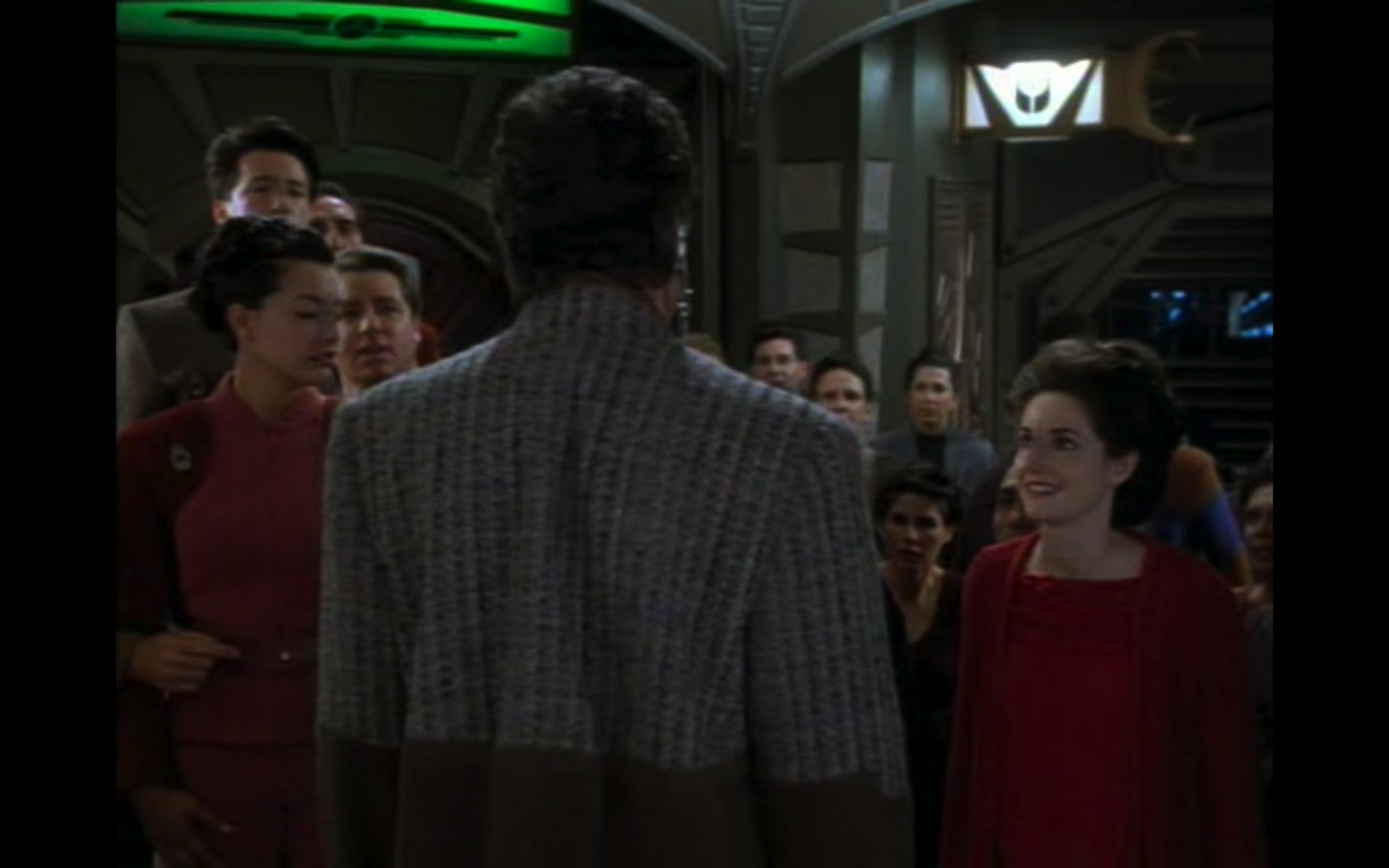
“The Homecoming” is both a classic episode and, in my opinion, pretty much exactly what DS9 needed to kick off its second season. It’s the sort of episode that, without actually retconning or undoing anything, effectively wipes the slate clean, permitting us to mostly forget about all the pointless, wheel-spinning nothing stories on which the show squandered too much of its first season and get excited about where it might take us now that its writers seem to have remembered what it was supposed to be about all along. It also innovates by following up the first season’s non-cliffhanger finale with the first installment of what ends up being Trek’s first-ever more-than-two-part episode (and the first series of connected, to-be-continued type episode runs wherein each individual segment nevertheless has its own unique title). This review, of course, is only about the actual season premier, but it bears mentioning here that DS9’s season one finale, followed by the three-part saga that opens its second season, see the show focusing in a more sustained and in-depth way on its core narrative and signature themes than at perhaps any other point in its entire run. This, then, is DS9 as I always wanted it to be!
The episode’s opening hook—Kira telling Sisko that she wants to borrow a runabout, but not wanting to tell him why—is just an utterly classic and unforgettable piece of the show’s early history. The scene is perfect, nailing the working relationship between the two characters as it exists at this point in the series in a way that glides right past the inconsistencies and missed opportunities from earlier episodes that got in the way of similar developments toward the end of season one. Sisko’s reaction to the request is not specifically suspicious or distrustful, but he does, naturally, insist on knowing what Kira intends to use the runabout for before he will consider her request. As for Kira, she obviously would like for Sisko to just agree to her request with no questions asked, but is realistic enough to know that this is not likely to happen, so has clearly come prepared to reveal what she’s up to when push comes to shove. Also, I appreciate the fact that Sisko already knows who Li Nalas is without needing to be told; given how famous and revered the episode establishes him to be, there’s no way that Sisko hasn’t heard all about him after being stationed here for a full year, and I like that the episode gets this right. Plus, the tone of the scene is just so much fun: Kira all nervous energy and restrained exuberance, Sisko initially cheery and relaxed, but pivoting to wary and contemplative as he takes in what Kira has to say…and then, when he starts to leave in response to a call from O’Brien, the slightly comical note of Kira’s teenager-asking-to-borrow-the-car urgency as she blurts out “Do I get the runabout?”, and Sisko’s classic parental punt of “I’ll have to think it over.”
Beyond the “opening hook” itself, too, something that really struck me on this watch is how skillfully the episode sets up, and gets us into, its story. Especially given that this is the season premier, you don’t want to just jump straight into the action—but neither, of course, do you want to piss away half the episode on setup. “The Homecoming” manages a perfect balance. The opening scene between Odo and Quark welcomes us back to the station following the season hiatus,1 and then Quark’s meeting with the freighter captain sets off the sequence of events that leads to Kira’s request for a runabout—but along the way, the episode is also quietly reintroducing us to the show’s characters and their various relationships (including the Sisko/Jake relationship, via their conversation about Jake’s big date that Kira interrupts). The Kira/Sisko runabout request scene, in addition to what I’ve already said about it, also deftly works in some exposition about Bajor’s deteriorating political situation, which both provides Sisko with a reason to go along with Kira’s plan and does setup work for the next two episodes in this three-part arc—and the interruption that pulls Sisko away from his chat with Kira before he has come to any decision on the matter pushes that even further, introducing “The Circle” and its escalating agitation. Then there’s a nice Sisko/Dax scene in which the commander ruminates about “our mission here” and we get to hear where his mindset is at with respect to Kira’s request. We didn’t, by any means, need scene after scene of Sisko trying to decide whether to agree to it or not—but we did need to see him wrestle with it just a little, and the scene with Dax gives us exactly that.2 When I got to the point at which Kira and O’Brien actually set off in the runabout on this watch, it felt to me like the episode had taken exactly the right amount of time to get us there, and done exactly the right amount of background exposition, tone-setting, character motivation, and establishing of stakes, to make me feel fully engaged with the story. (Similarly but later in the episode, bringing the political turmoil down on Bajor close to home for Sisko and the audience by having it impact Jake is a really nice touch; without actually ever going to Bajor, it makes the stakes of the story feel real in an effective way.)
The episode’s central twist, wherein the story of Li’s heroism turns out to be less than entirely accurate, serves the story well enough. One’s fear would be that the episode would end up revealing him to be nefarious in some way, or explicitly a fraud, but thankfully it steers clear of anything like that; he’s just a regular guy (though still genuinely a resistance fighter!) who, through happenstance and misunderstanding, got turned into the hero that Bajor needed to believe it had. It’s perhaps a bit disappointing that we don’t learn a little more of his story; did his reputation truly rest entirely on this one incident? Did he not, subsequent to it, actually serve as any kind of leader in the resistance? Still, what it speaks to is the idea that Bajor didn’t rid itself of its Cardassian occupiers due to the larger-than-life heroics of some great leader; it was a broader and more decentralized struggle in which lots of ordinary people each played a part, and their collective strength, not some savior, was what made victory possible. What Sisko says of Bajor’s current situation, in other words, also applied during the occupation: it didn’t need a single amazing leader to follow, but rather a symbol to believe in and rally around—someone in whom they can see “the best in themselves.” This rings true, and is an empowering idea. Now, Sisko’s line did also remind me of TNG’s “Rightful Heir,” wherein some Klingon clerics clone Kahless (there’s a nice alliterative phrase!) and try to pass the clone off as a mystical/foretold second coming, in a bid to restore glory to the empire (or whatever) by similarly giving the people a symbol to believe in. In my review of that episode, I expressed my approval of how Worf, after learning the truth, insists on making it public, so that Klingons generally can choose to rally around him if they want—but in full knowledge of what he is, in contrast to the clerics’ scheme of deception. So, should I now be condemning Sisko for not acting similarly here? And do I think that this episode falls into the trap that I said “Rightful Heir” avoided, of “conveying [the] deeply problematic message . . . that it’s okay to mislead the public with inspiring lies in order to achieve a unity of purpose…and shore up a governing regime”? Well…true to its reputation, DS9 presents us with moral ambiguity and shades of grey. On one hand, the legend of Li Nalas is not a lie that someone manufactured deliberately, unlike the faked second coming of Kahless; it’s a misunderstanding that spread far and wide before the man at its center could manage to correct it, try though he seemingly did. On the other hand, once Sisko learns the truth, he could make any number of different choices about what to do with it, but the one that he immediately seizes on it to use the popular image of Li Nalas to promote unity among the Bajoran people, not to correct the historical record about Li’s encounter with Gul Zarale. As far as I can tell, in fact, he doesn’t even let Kira in on the truth! Sisko still differs from the Klingon clerics in that his actions don’t reek of hypocrisy like theirs do, and also in that his role in the whole affair is that of an interested outsider who wants what’s best for Bajor (as he sees it, of course), rather than that of someone with a direct stake who hopes to gain personally by associating himself with a revered figure. (Relatedly, the goal of helping a struggling, divided people recover their strength and stability in the aftermath of a brutal foreign occupation feels very different from the Klingons’ obsession with returning their warlike empire to its traditional values, or whatever the hell it was that they were on about.) Still, Sisko’s idea that Bajor still “needs” what Nalas symbolizes to its people, even if it’s essentially based on a fiction, doesn’t exactly jibe with what someone once famously called “the first duty of every Starfleet officer,” and I’m not arguing for letting him entirely off the hook on this point. It’s a choice that tells us things about who Sisko is, for good or ill—and future episodes, I think, will continue to run with this characterization. At the same time, I think the show is implicitly suggesting that this aspect of Sisko is part of what makes him the right man for the job, in a way that gets at its overarching themes about how a troubled society (like our own) could progress toward becoming something more like Trek’s 24th-century ideal, and about the compromises that might need to be made along the way. These are tricky issues, and the episode succeeds at engaging with them meaningfully and providing food for thought—and that is what, in my view, DS9 was dreamed up to do.
Of course, in the episode’s final moments, everything that Kira and Sisko have managed to set in motion suddenly seems to veer off course. The reluctant hero, after a brief trip planetside during which he was welcomed home by cheering crowds, is given a meaningless title by the provisional government and then promptly shipped back to the station, where Kira finds herself abruptly replaced and put out of a job as “thanks” for her daring rescue. What’s going on, here!? Springing this turn of events on both the characters and the audience right before going to “To be continued…” provides a delicious “wrong note” to whet our appetite for the following episode!
- Quark’s “every once in a while, declare peace” bit is something that I’ve always remembered fondly, but I absolutely did not remember that it occurs in this, of all episodes! I would have thought that it came much later in the series. ↩︎
- Several of these scenes also just sparkle with a sense of energy, life, and fun, in a way that feels somewhat different from a lot of what we got in the show’s first season. Sisko’s conversation with Jake is one example; another is him tossing around his baseball at the beginning of the scene with Dax. I don’t know; I guess it just strikes me as the writers remembering, more fully than they often did last season, that the pilot set up characters with passion and quirks, and letting those characters take on life in ways that transcend immediate plot. “The Homecoming,” in short, feels in some respects like a moment of arrival (or, sure, homecoming) for the show that DS9 was becoming as it grew past its first-season birth pangs. ↩︎
****
I’d written a lot about this episode, and unfortunately lost a great deal of it to a data issue. This is my best attempt to reconstruct it, but I definitely feel like my first draft was better! Anyway, the plan this season is to offer my own star reviews for comparison purposes, even though it can be pretty hard to do that at times.
Anyway, I figured I’d start putting my stars at the top of the episode.
This is a solid episode, and we’re back to dealing with the stuff that makes DS9 a great show. In some ways the episode doesn’t really try to do that much, which I take no issue with. It feels in a lot of ways like a setup for the next two episodes, and mainly just introduces Li Nalas and his concept, drawing me in enough so that I’m really interested in where they’re going with it. The climax, where it’s revealed that he’s not who people think he is, is a simple one, and isn’t exactly surprising given how we’ve seen him behaving before that. Sisko’s pitch that Bajor needs a symbol is also quite straightforward and it’s pretty obvious this is what he’d say, but it still works. It’s all good enough in my mind to get the episode to a four. I don’t know that it’s ambitious enough for more than that, as the setup for a three-season arc, but it’s overall a very enjoyable effort that sees DS9 really coming into its own. The writers also understood their characters… Quark and Odo, Ben and Jake. Dukat. The whole deal with everyone knowing that Kira was leaving with the runabout.
I’d say my criticism of the episode falls into two parts. First, it’s just that I’d like to see them doing a lot *more* of what they’re doing here. This is summed up in Kira’s line to Sisko early on that “you and I both know the provisional government is made up of political opportunists too busy fighting amongst themselves to care what happens to Bajor,” This should be the essence of the show, and something we really needed to see *dramatized*. Sure, I appreciate a certain subtext being made text, but it’s still not enough. Factional fighting in half a dozen districts and religious riots? Surely there are plenty of stories there that we should have explored before we got here. You could say that’s more a criticism of season one, but ideally, but even starting from here, they could have started with episodes exploring this and then got to this trilogy by the middle of season two, because the lack of context does undermine the full reality that this episode is trying to build on. And more than that, we really need more characters to represent parts of Bajor that are underrepresented. One could consider this an unfair expectation given that DS9 has a good many more such great side characters than any other Trek series, and in particular Bariel and Winn stand out as representations of Bajor’s religious community. But if it’s the case that “Bajor lacks strong leadership,” it would really help us tell stories in this universe if we could see some of those leaders squabbling and trying to do things. Obviously they introduce Jaro here, but he’s dispensed with quickly in the trilogy and never much developed as far as I remember. Seeing how media works in the Trek universe also might help flesh this out.
For the second part, while I really enjoy the politicking around whether Kira gets her runabout, the whole excursion was much too easy, which undermines both the believability of the whole affair and the stakes. if you’re going to do this, you need to send more people along. How about a whole team of covert ops, rather than just a couple of officers making up a cute strategy about bringing a prostitute to the Gul? If they really wanted to sell this, they also needed to have some serious casualties. Numerous Bajorans in the camp should have been willing to sacrifice themselves to save Li, for one thing, and some should have died getting Li Nalas off the planet. Maybe the detainees could have smuggled a subspace radio connected to them off Cardassia IV in Li’s earring so they can coordinate their attack and so Kira would know where to find them in the first place? That could have helped make the whole rescue feels more believable. I can buy that the camp would be relying on secrecy rather than a lot of guards for defense, but you’d really think Cardassia IV itself, as (apparently) a fully habitable planet, would be better guarded. This whole situation requires stakes in order to set up the idea that the Bajorans believe deeply in Li and to sell his importance before they pull the rug out and we discover he doesn’t really have any objective importance, but they pull the caper off without much sacrifice. If you want tus to believe that the Bajorans think Li Nalas is an incredible person, show us that not only do Bajorans believe in him enough to die for him, Starfleet has to take some losses to back them. This creates pressure on Kira to keep the faith and more pressure on Li to live up to it. Also related to this is Li’s relative lack of injuries. The man just spent a decade in a labor camp, presumably under brutal conditions. At best, he would have some significantly neglected medical issues and a bunch of traumatic stress from the experience, but our Li seems mostly just kind of emotionally exhausted, and even that seems to be mostly from the pressures of his unearned fame rather than ten prior years of abuse. Show us a Li who is struggling hard to keep it together, and maybe have Sisko recognize this enough to make sure he gets counseling and medical care. This also illustrates further the ineffectiveness of the provisional government, since they’re pushing a traumatized man into service that he’s not really up for, and not really using him and his reputation effectively.
Anyway, it’s solid episode suffering from the limits of network TV—budget, time, and the canon established to this point in the Trek series. Can they live up to this setup? Tune in next review to find out.
Shorter takes:
* “Either we bring back Li Nalas or we don’t come back at all,” says Kira. I guess I buy this level of fanaticism from her, except what if Li’s not there and it’s, like, a trap or something? Okay, let’s assume she means this is her take assuming he’s actually there. While I can mostly see O’Brien as the sort who’d go along with it, him having certain feelings about Cardassians and all, he does have a *family* he’d be abandoning. I wonder what Keiko would say if she heard that he’s fine with this? Or was O’Brien just going along to get along with Kira here? I’m not exactly complaining about this, because it is interesting and suggests some story potential, but it does feel like the ideas here needed are development and follow through. Like, if he was for real, O’Brien’s concept of his duty should become an issue with Keiko at some point. Even a much more mature version of the couple might still have had some difficulty with *that* conversation! Or if he was just blowing smoke, maybe it would have worked better for him to have confronted Kira about her fanaticism and to remind her that some people have things to live for other than rescuing Bajoran heroes? In fairness, this wouldn’t really fit so well with the rest of the episode, but if that’s the case, should the scene really be here at all? Basically, the episode needs to commit to a concept of O’Brien. Either he’s inclined to a level of loyalty to Bajor/being anti-Cardassian/commitment to Starfleet that would likely be an issue for him as a family man sometimes, or he’s going to have an issue with Kira’s expectation, surely.
Random stuff:
* It’s a little weird for Kira initially not to care much about rescuing the other prisoners and only Li. I can see her coming to that conclusion out of necessity, or based on the idea that they’d use Li to negotiate for them later, but it seemed like it was her first impulse, which doesn’t seem right.
* Li’s attempt to escape as a stowaway illustrates his reluctance, but I don’t quite buy the idea that he would want to take off from the his own planet to a completely foreign section of the galaxy instead of going home to whatever family and friends he once had on Bajor, presumably the only home he’s ever had. I don’t think the powers that be can force him to do anything, so why wouldn’t he just insist on going home rather than running off completely? Either option would be a big step toward deflating his mythology, and admittedly it might not be very fun to be around and watch the attention that provided either, but if the alternative is never going home again? And if he was going to disappear, why not aim to do so on Bajor, or at least more locally than the Gamma Quadrant. As with Cardassia IV here and Bajor in the past, planets are assumed to be strangely small. The only address it seems Kira has available to find the camp is the name of the planet, but somehow, that’s enough. Likewise, Bajor may have small land masses and large oceans, but surely you could find a place to hide there. I seem to recall the planet also has a habitable moon… but maybe the entire thing has been wrecked to generate energy, ha.
* Geez, Sisko… “they’re unwilling to risk going to war with Cardassia over an earring” is more than a bit reductive. You could make this point much better by saying they’re unwilling to risk war over the rescue of one war hero… that still seems kind of foolish, doesn’t it?
* Asking someone “how are your lobes” is like asking about their tits or something. Even for people in their situation, and even if we assume they kind of know each other, it’s a bit tacky. Moreover, there’s something just a tiny bit off about this whole scene. Quark and the woman seem to be acting like they’re being super illicit and underworldy, but it seems more like the woman is doing a favor for the Bajoran government by bringing the earring, and she doesn’t have anything to gain personally by it. Why not just offer it directly to station staff? That’s what Quark does straightaway anyhow. And neither of them really attempt to use the situation to their personal advantage, even though they could, presumably, withhold information for money.
* The scene at the beginning with Quark and Odo is really fun, but I’d have liked it a good deal better as Quark’s idea than a standard Rule of Acquisition. They’re essentially doing Ferengi species worldbuilding instead of character development for Quark. I guess that’s fine, but I don’t find characters that are just direct stereotypes of their species very interesting. DS9 will shortly be in the process of differentiating Nog and Rom massively from Ferengi norms. Shouldn’t Quark be less of a generic representation of a Ferengi than the side characters? I’m not objecting to him being, and remaining, a capitalist; I just like the idea that he might be clever in ways that other Ferengi *aren’t* necessarily, and for him not to just be a mouthpiece for Ferengi culture.
* “I/Curzon never enjoyed talking about one of the things you’re most passionate about all that much, and I/he lied about it to you for years” is kind of a shitty bomb to drop casually on your friend before immediately changing the subject.
You put effort into critiquing aspects of the episode that I largely passed over without comment, but I do agree with most of your criticisms. I didn’t talk about the rescue being way too easy mostly because it wasn’t an aspect of the episode that I cared about all that much (I sort of felt like “it had to succeed, so it did, and while the writers could have put more effort into making it believable, that’s wasn’t what they wanted the episode to be about”); however, your point about casualties has made me think about it somewhat differently. I really agree with your thoughts about how this should have required sacrifice. It would have helped to sell what a big deal LI is, it would have (as you said) amped up the pressure on him and thus helped make his later instinct to run away a bit more plausible (I also agree that trying to actually leave Bajor was an odd response to his situation), and it night even have done something interesting with what Kira laid down to O’Brien about “either we leave with Li or we don’t come back at all.” As for wanting more Bajoran poltiics…I mean, yes, I agree, but I guess my take is that since this is about as much as we EVER get, I’m taking it for what it is…
On smaller points:
I see your point about Quark and his rule of acquisition, but arguably we’re still seeing Quark’s own take on what to *do* with what is honestly a pretty odd “rule.” I mean, can you imagine any of the bumbling sub-sapient dipshit Ferengi we saw on TNG trying to pull off an “every once in a while, declare peace” move? I think Quark IS cleverer than a lot of other Ferengi, even though he is also frankly just not very good at exploiting opportunities/making actual money (he never sticks to his guns in the face of everyone else’s negative reactions to his greed). He may have been acting in accordance with a ROA here, but I still think there’s more Quark individuality in it than boilerplate “follow the rules of acquisition” genericness, y’know?
Also, I think you’re being a little hard on Dax with your final point. She said that Curzon DID enjoy talking about baseball–just not as MUCH as he led Sisko to believe. It’s not hard to imagine the dynamic; Sisko’s always going on about this ancient human sport, and it’s a quirk of his that Curzon genuinely found charming, but *sometimes* it could get to be a bit much; still, he mostly rolled with it in good humor. That’s what I took from Dax’s remark.
I appreciate your point about Jake being a great way to demonstrate Bajoran politics. This is one of the few ways the trilogy really sells me on the idea that something major is really going on… the need to evacuate, and Jake more than any of it. And the skill with which the writers consistently handle Jake’s relationship with his dad is so far above the next most comparable mentor relationship of Picard and Wesley that it really does feel remarkable.
Yeah, there’s definitely more to Quark than just that rule here, and I agree that saves the scene for the most part. Still, I think it would have been better without the rule of acquisition thrown in there; I still think it works better as just his idea. I love the idea that the Ferengi have such a book that serves as a sort of bible for them, but I would personally mostly get rid of these references, complete with explaining which number the rule is, pretty close to without fail. What would have been more interesting, I think, was if they just had a book that was analogous to the bible (and maybe that they even called “the bible”) with ancient stories about people exploiting each other that they’ve adapted for modern life and that they may quote from and argue about interpretations from. Perhaps a bit subversive for the show at the time, granted.
It is interesting to contemplate whether Picard would have promoted Li’s legend in spite of knowing the truth. I don’t really see Picard as being so rule-bound and lacking in pragmatism that it’s hard to imagine him making a similar decision to Sisko in this episode. Even at the end of the last episode, what would really be gained by spreading the truth? It would really come across as almost mean-spirited, trying to drag down a famous war hero, and from the Emissary, no less? Seems that would cause a lot of unnecessary conflict, and I don’t think Picard would be thrilled about jumping into that.
I guess I’m not sure how I would envision Picard handling it. I do kind of have a hard time with the idea of him acquiescing to a big historical lie like this, even though there is some (limited, and pretty different) precedent. But the bigger leap for me is to the idea of him actively (and immediately) *seizing* on the false narrative and wanting to *use* it (even for noble purposes). I mean, there’s middle ground between taking the initiative to disabuse the Bajoran people of their cherished image of Li, and purposely holding him up a symbol around which they should unite. Also, an approach that involved acknowledging the truth about Li’s famous exploits wouldn’t necessarily have to be mean-spirited (though some might inevitable see it that way); it could be about emphasizing the ideas that I referenced in the review about how Bajor is actually stronger than its people mostly realize, and that it was the collective efforts of ordinary Bajorans that brought down the occupation, not the heroics of one extraordinary dude. Now–whether that approach or Sisko’s was actually “right” for the situation…is an open question, and I think (as I said) that the show at least somewhat implies that Sisko’s approach, for good or ill, is more suited to the circumstances on Bajor.