
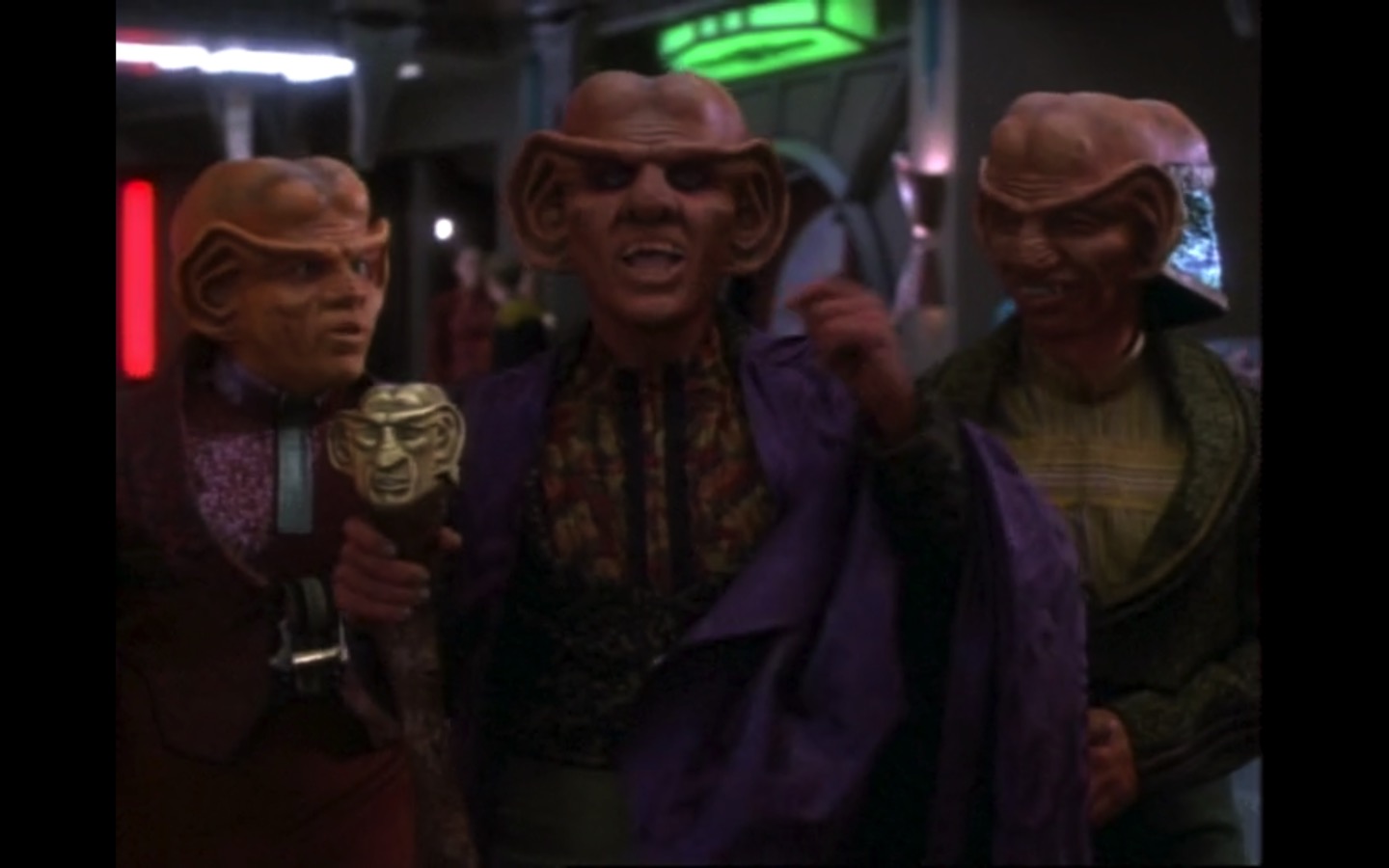
Well, here we are: The first of DS9’s infamous “Ferengi episodes.” While there will be some exceptions, the show’s periodic forays into Ferengi-centric (attempted) comedy will, on the whole, be dismally bad. I had actually remembered this first one as not being too terrible—but while I was right in a relative way (it’s nowhere near as bad as a lot of the later Ferengi episodes will be), it’s still not very good at all. I struggled a bit with rating it, because for some reason, I don’t quite want to be super-hard on it. Maybe it’s because watching it doesn’t make me feel ill, as will be true of too many of its successors; it’s silly and dumb, but not barf-inducingly unwatchable. Or, I dunno, maybe it’s partly because I wasn’t quite as frustrated and bored with it as I was with “Move Along Home.” (Also, I gather from perusing other reviews that “The Nagus” is actually fairly well-liked by a lot of fans, which strikes me as…odd.) The truth is, two stars might be on the generous side…but that is nevertheless where I have landed on this one.
Broadly speaking, I guess, the fundamental problem that I have both with “The Nagus” and with many future Ferengi episodes is this: DS9, after performing the almost unimaginable feat of presenting us with a Ferengi character who doesn’t make me cringe every time he appears on the screen, but instead actually comes across (most of the time) as a reasonably believable person…then turned around and developed the habit of reducing him, and his culture in general, to a collection of ill-conceived, unfunny, one-note jokes in almost every episode that foregrounds him. I mean, exactly what about this episode are we supposed to be able to take at all seriously? That the leader of the entire Ferengi people shows up on Deep Space Nine (unannounced, and not even noticed by station leadership), randomly appoints Quark as his successor, and then (seemingly) promptly croaks, and no one (least of all Quark himself) thinks to question any of this? That Rom tries to murder his brother (twice!), and not only does Quark totally shrug it off (or rather, is actually impressed by it!), but Odo and Sisko and the rest don’t bother imposing any consequences? (You could argue that he never actually goes through with the second attempt, but he and Krax still set off a bomb on the promenade, for fuck’s sake!) That Quark (or anyone) would have the first clue what to do upon suddenly becoming the Grand Nagus, but also, that no concerns for his safety would even enter his head until someone actually threatened him? That, after being threatened, he would brush off Odo, and look to Rom to protect him? Every bit of this is absolutely ludicrous.
With the introduction of the Grand Nagus, the show had an opportunity to do some world-building in a way that might have furthered the project of salvaging the Ferengi as a viable concept/people, and to actually explore the idea of this ultra-capitalist society on a thematic level. The writers chose, however, to stick with using them as a kind of running joke instead. (To briefly throw them a bit of a bone, though: Even though I find his performance a bit grating, I have to concede that casting Wallace Shawn in the role was sort of brilliant.) What, one might ask oneself, would the leader of a people such as the Ferengi be like? By what means, and toward what kinds of ends, would he exercise power over other Ferengi? For example: Why does a Ferengi businessman need Zek’s blessing in order to be the one who gets to introduce synthahol to the gamma quadrant? Wouldn’t the various Ferengi who were interested in such a venture just pursue it on their own initiative? And if not (because one can certainly imagine reasons why it might not work that way)…well, then shouldn’t it be the show’s job to develop the idea of the Ferengi, and of the Nagus, by showing us why not, and how it does work? And shouldn’t the answers, like, function as a meaningful sci-fi allegory for how capitalism works (maybe contrasting ideology with reality) back here in the real world? Or, another angle: When Zek congratulates his little assembly of business leaders about profits being up, whose profits is he talking about, exactly? Does he, and do the others, give a shit about how profitable Ferengi business ventures in general are, rather than caring only about how successful they each are individually? And, again—if so, then why? And what does it mean/tell us (about the relationships between money and power, say)? For that matter, does the Nagus actually have business ventures of his own? One would presume so, but the episode doesn’t bother to define anything about him other than his sort of cartoonish role as a feared and respected leader lording it over the rest of the one-note caricature Ferengi, who, for their part, toady up to him because…uh…well, they just do. Another question: Why is it that, in seeming contravention of everything we’re told about Ferengi values, Zek could, if he chose, force Quark to sell his bar to him for a pittance? Again, the show could develop this premise in way that would actually say something—but instead, it gives us sitcom in place of social commentary. Or: Do Ferengi typically find ways to rationalize their own greed and dishonesty to themselves, and see themselves as “good,” in the way that real people (however awful) generally tend to do, and feel maligned by outsiders’ negative views of them? Or do they actually share everyone else’s view of them as unscrupulous bastards, and take pride in it? Because during Zek’s conference, we have him bemoaning their poor reputation (which he blames on “lies” spread by their competitors) one minute, and then, just a few seconds later, they are all celebrating their opportunity to exploit virgin territory, where they might actually be taken at their word—”until we decide to break it!” Ha ha, aren’t these clowns just a hoot? There’s nothing real about any of this, no willingness to take the idea of the Ferengi at all seriously, and certainly no effort to use them as a vehicle for any kind of meaningful commentary about capitalism. What’s really weird, in fact, is that even though, on one hand, the writers do seem to disapprove of the Ferengi’s uber-capitalist ethos, they choose, for some reason, to portray it as fundamentally clownish and harmless (something to laugh at), rather than exploring what could be powerful, alluring, and/or dangerous about it. What’s up with that?
There’s secondary storyline about Jake and Nog that’s all right, even though not everything about it make sense. For instance—uh, Nog can’t read? Seriously? The episode wants us to understand that the Ferengi don’t value abstract education the way we do, but…like, Quark and Rom and the Grand Nagus and presumably all the other adult Ferengi we know of can read, right? And it’s probably a useful skill in business, right? Also, if Nog can’t read, then how in god’s name was he supposed to have written an essay about ethics for school? (Also, I don’t remotely buy that Miles would be the logical choice for a substitute teacher for the school while Keiko is away. Okay, so he’s her husband, so I guess he’d be invested in supporting her and helping the school to succeed—but is there no more qualified person anywhere on the station? And isn’t he…kind of a busy guy?) But anyway: Putting all of that aside, the little story about the bond that Jake and Nog have formed despite their respective fathers’ misgivings, and Nog trying to balance that bond against his loyalty to his dad and to traditional Ferengi values, and Sisko confronting the fact that his son is at an age where he’d rather hang out with a friend than be taken somewhere fun by his dad, is worth something. And even though Nog’s supposed illiteracy is ridiculous, it does work for the story to wind up in a place where Sisko essentially finds out that rather than Nog exerting a negative influence on Jake, maybe Jake is a good influence on Nog, and that maybe he (Sisko) can relax and let go a little bit and trust his son to be the kid that he’s tried to raise him to be.
A few other tidbits: Although we’ve certainly seen Rom in previous episodes, he doesn’t really emerge as the Ferengi we will know throughout the series (with his characteristic demeanor/mannerisms, way of talking, and mixture of subservience and resentment toward Quark) until this one (murder attempts aside!). Also, the whole concept of the Rules of Acquisition makes its debut here—and since, despite their being somewhat silly in the same kinds of ways as the other Ferengi stuff that I complained about above, I do actually find the Rules entertaining most of the time, I’ll give the episode a point or two for that (and Rom’s very rhythmic recitation of the first Rule in this episode has long stuck in my head as a classic bit). (Wow, that was a very alliterative phrase! Now I want there to be a book entitled “Rom’s Rhythmic Recitation of the Rules of Acquisition.”) Anyway, these are few more reasons (however modest) not to totally hate this episode. (On the other hand, though, I call a total bullshit on the writers establishing that Molly O’Brien is somehow 3 years old already! Also, I had totally forgotten that the premise of the Ferengi selling off the desiccated remains of their illustrious dead loved ones as collectibles had been established here, long before the episode “Body Parts.” One thing that this means is that I was actually not hard enough on the TNG episode “Suspicions” when I questioned the claim made there that the Ferengi “have death rituals that require the deceased’s body to not have been violated.” When writing that review, I thought that (beyond just seeming ridiculous on its face) this was at odds with a later-established premise about them commodifying and selling their remains…but actually, “The Nagus” preceded “Suspcions,” so there was even less excuse for that nonsense!
This is probably one of the better Ferengi episodes, and there are worse ways to spend forty-five minutes. Still, for some reason, I don’t really have very strong feelings about it. I suppose it’s competently scripted enough to essentially tell a coherent story, which is maybe emough to clear the three star bar, but it just lacks something—ambition, I guess, either to something more meaningful, or to something funnier. It’s not really about anything that matters, and I wouldn’t say it shows us anything new about any of the characters.
I think my feeling about it relates to my sense that if you’re going to start spending entire episodes exploring the characters of a particular culture, I’d like to feel like that society is a *real* one. Wallace Shawn as the Nagus is *really* absurd, and I do find him *amusing*, but I also don’t feel like the worldbuilding they do with Ferengi society totally works for me. It’s not just that the Ferengi characters (and particularly Zek) are extremely goofy—it’s also that the way the leader of the Ferengi government (if that is what he is) just kind of pops up and starts palling around with Quark and various other random Ferengi in exactly the way heads of state don’t, to paraphrase Douglas Adams. There’s no evidence here of a whole society represented by a diverse array of factions with the complexities that the leader of a society would inevitably find himself surrounded by and constantly engaged with. We never see the Nagus or his staff take a call from off-station. We never see any affairs of state beyond the intended exploitation of the Gamma Quadrant. Is there a Ferengi media that is interested in the doings of its heads of state? Apparently not, because we don’t see anyone recording them or asking them questions, either as some kind of propaganda network or to represent the kind of challenging role news media are theoretically supposed to in a democracy. I’m not really clear if the Nagus is supposed to be a monarch of some type, if there are other facets to Ferengi government like a senate or something, or if there’s something more complex/different from our own society than that at work here, but if you’re going to parody capitalism, wouldn’t it have made more sense to create a Ferengi society that was either overtly anarcho-capitalist (having dispensed with all systems that theoretically could interfere with profitmaking) and had no single leader at all), or, more realistically, a puppet government behaving at the whim of various corporate interests? One could make the case for the former if one wants to present and debunk a concept of capitalism that is idealogical/Randian, or the latter if you want to debunk one that’s more practical/realistic, since in practice, having a government is something the status quo factions of capitalism would want, since they can use it to manipulate their competition. And I can’t say I don’t chuckle a bit when the Ferengi leaders at one moment are all acting indignant that anyone would suggest they weren’t totally reputable businessmen and the next laughing about how they’re going to screw over the people of the Gamma Quadrant, but I also feel like I would *more* appreciate showing us a Ferengi society that’s a bit more subtle in the way it skewers capitalism, showing characters who still lack self-awareness but also just have a bit more complexity to their psychologies, you know? Like, especially these days, capitalists and their apologists are often unsubtle in the ways they expose themselves, but there’s a certain amount of complexity to the systems they generate to enable them to grift.
Actually, it’s kind of funny how the Ferengi are depicted as capitalists, because even as a civilization, they really are bad at it. On the face of it, the writers may seem like they’re making fun of capitalism, but if you think about it at all, they end up depicting it as relatively harmless most of the time by characterizing Ferengi society as something other than a few obscenely powerful monopolistic empires that either control the government or eliminate it entirely in favor of warlordism. The capitalism of the Ferengi we see on DS9 is more a parody of “mom and pop shop” capitalism, where the average Ferengi might actually have a shot at being a boss. Quark himself, while privileged, has a business without coming from an aristocratic family, and we mostly don’t see Ferengi throwing their weight around with the latinum-equivalent of modern-day billionaires. In fact, when we do see powerful Ferengi, oddly enough they seem to be associated with the government or with regulatory bodies, such as The Nagus or (later) Brunt from the Ferengi Commerce Association. Overall, they’re depicting Ferengi society as something like a form of American liberal democracy capitalism from an era in which the robber barons were at least mostly held in check. That sort of capitalism has some decidedly rough edges (and DS9 clearly, and fairly, links it to sexism and worker exploitation), but in comparison to the real thing, it’s actually pretty benign—not to mention impossible in practice, at least in the long run. Putting capitalism and socialism next to each other as the Ferengi (not as a caricature) and the Federation could have been an opportunity to examine an “ideal” future more closely. I think our current situation in America, where perverse financial incentives have culminated in a feast for the most shameless of opportunistic grifters (those most willing to sell themselves out completely or look like absolute fools for the chance at power) demonstrates that opportunities for some pretty broad humor are still possible by depicting the logical consequences of capitalism. Some of our politicians are not really much less absurd than Zek.
Most of what I’ve said here is less than a critique of the actual episode and is more of the framework in which it was conducted. And of course, the writers didn’t know what would happen thirty years later, and one could certainly argue that I’m asking too much from what is essentially a sitcom. If someone really finds this episode to be a fun romp, I won’t argue. It’s really just a question of preference and enthusiasm.
As to Rom plotting to murder Quark… boy, I dunno. Should we have seen more hesitation from him here? They’re still figuring out who this guy is, clearly. And I guess he didn’t push the button, but it’s a little weird that there are no consequences for luring someone to an airlock under false pretenses and implying that you’re going to flush them into space.
Minor points:
I didn’t remember that they established the Ferengi tradition of selling portions of their dead so early. Well, there’s a little worldbuilding for you.
I don’t really love what happened with the Rules of Acquisition becoming a marketing thing with episodes looking to list off another rule at every opportunity, but the first rule is a nice little gag/spoof on capitalism, and as you know, I’ve always loved the dactylic/iambic rhythm of “once you have their money, you never give it back.”
Why does Quark have dark eyes and other Ferengi don’t? Also, I know the real world reason for Quark being the only Ferengi who doesn’t wear a little thingy on the back of his head had to do with what they had a budget for, but if they were going to make an exception here, why wouldn’t they create an in-world reason for it that could set your main character apart?
The chief engineer on the station has to sub for the teacher? As if Miles O’Brien isn’t busy enough! Isn’t there anyone else on the station who can do this?
Seems like there ought to be better soundproofing on those holosuites. I could hear the Nagus’s laugh when I think he was supposed to be in one, and that’s an awfully disturbing thought if you think about what he (and others) are routinely doing in there. I’m going to assume he had left the holosuite at the moment we heard him laugh, because the alternative is just too awful to contemplate.
It annoys me that Trek’s presentation of the Ferengi carries on the ridiculous tradition of making human women so objectively sexy such that all other species find them to be attractive. I can buy that Ferengi might sometimes be attracted to humans, but this should be a bit anomalous, and occur with the same regularity that the reverse happens. This is a gross failure to understand what sexual attraction is and how evolution works.
Wait a second. Nog can’t even read… but he’s expected to write an essay? On ethics, of all things? This is a major failing of his teachers, who have grossly misunderstood their task. Poor Nog!
Jake teaching Nog maybe stretches plausibility a bit, but it’s cute and saves the episode a bit.
Again, we hit on a lot of the same points, even if I was a bit harder on this one than you were.